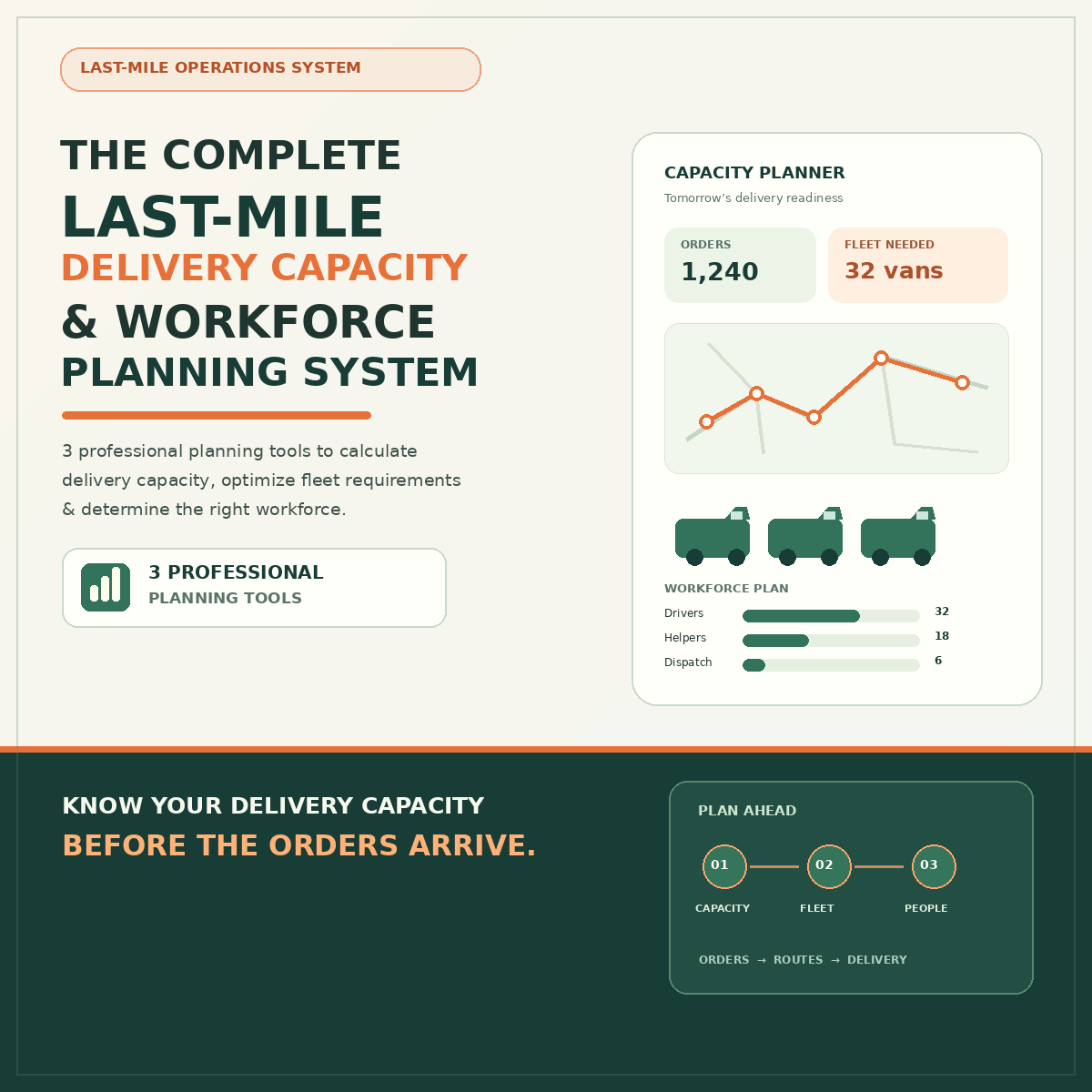
THE COMPLETE LAST-MILE DELIVERY CAPACITY & WORKFORCE PLANNING SYSTEM
THE COMPLETE LAST-MILE DELIVERY CAPACITY & WORKFORCE PLANNING SYSTEM
3 Professional Planning Tools to Calculate Delivery Capacity, Optimize Fleet Requirements & Determine the Right Workforce
Know Your Delivery Capacity Before the Orders Arrive.
How many deliveries can your business handle tomorrow?
How many routes will you need? How many vans and riders should be deployed? How many delivery agents must be available per shift? Should you use your own fleet or outsource additional deliveries to a third-party logistics provider?
These are not minor operational questions.
Getting your capacity planning wrong can create expensive consequences.
Too few vehicles and agents can result in delayed deliveries, missed delivery windows, customer complaints, and overtime expenses.
Too many vehicles and agents can leave expensive resources underutilized while your business continues paying for unused capacity.
Introducing the DELIVERY CAPACITY PLANNING PACK — a practical collection of three interactive planning tools designed to help delivery businesses calculate daily capacity, determine fleet requirements, and plan workforce requirements using actual operational inputs.
From daily shipment forecasts to route capacity, fleet costing, shift allocation, and recruitment planning, this toolkit helps turn delivery operations planning into a structured, measurable process.
No complicated software. No subscription. No internet connection required after downloading.
FORECAST. CALCULATE. ALLOCATE. OPTIMIZE.
GET YOUR DELIVERY CAPACITY PLANNING PACK — ONLY $8.99
3 Interactive Planners | Fleet & Manpower Planning | Scenario Analysis | Works Offline
ARE YOU PLANNING YOUR DELIVERY CAPACITY OR JUST GUESSING?
Every delivery operation faces the same fundamental challenge.
You have a certain number of orders to deliver, a limited fleet, available delivery agents, specific delivery windows, and operational constraints.
Your job is to make all these resources work together.
But many delivery businesses still plan using yesterday's numbers, rough averages, and manual spreadsheets.
This creates several problems:
- Delivery volume increases, but fleet capacity remains unchanged.
- Morning peak demand exceeds the number of available routes.
- Vehicles are available, but not enough delivery agents are rostered.
- Riders are overloaded while other zones have unused capacity.
- Route lengths exceed operational limits.
- Third-party logistics costs increase unexpectedly.
- Absence and attrition create staffing shortages.
- Recruitment decisions are made too late.
- Overtime becomes the permanent solution to capacity problems.
The real issue is that delivery capacity is not determined by one number.
It depends on the relationship between shipment volume, delivery windows, route productivity, vehicle capacity, workforce availability, and operational efficiency.
The Delivery Capacity Planning Pack brings these variables together through three specialized planners.
Stop planning based on assumptions. Start planning using measurable capacity requirements.
3 PLANNERS. ONE COMPLETE DELIVERY CAPACITY SYSTEM.
TOOL 01 — DAILY CAPACITY PLANNER
KNOW HOW MUCH DELIVERY CAPACITY YOU NEED EVERY DAY
Your daily shipment forecast should determine how many routes and delivery resources you need.
But daily averages can hide important problems.
A delivery network may have sufficient capacity across the entire day and still fail during the morning or afternoon peak.
The Daily Capacity Planner helps you calculate operational requirements using shipment volume broken down by zone and delivery window.
Key capabilities:
- Enter shipment forecasts by zone.
- Organize demand by delivery window.
- Calculate route-hours for each zone and window.
- Determine required routes.
- Identify peak-window capacity requirements.
- Calculate vehicle requirements.
- Check parcel capacity.
- Calculate agent requirements.
- Include absence allowances.
- Apply surge buffers and planning utilization.
- Estimate daily delivery costs.
- Generate a printable zone-by-window planning matrix.
Business benefit: Understand how much delivery capacity you need for each zone and time window instead of relying only on total daily shipment volume.
Ideal for:
- Same-day delivery operators.
- Next-day delivery businesses.
- Courier companies.
- Last-mile delivery teams.
- Dispatch managers.
TOOL 02 — ROUTE CAPACITY PLANNER
DETERMINE THE RIGHT NUMBER OF ROUTES, VEHICLES & THIRD-PARTY DELIVERY RUNS
Having enough vehicles does not automatically mean your delivery operation has sufficient capacity.
Each route has operational limitations.
Drop time, stop design, route length, and maximum drops can all influence how many routes are required.
The Route Capacity Planner evaluates these constraints separately and identifies the constraint that determines your route requirement.
Key capabilities:
- Calculate route requirements from shipment volume.
- Evaluate delivery drop time.
- Review stop-design assumptions.
- Apply route-length limits.
- Apply maximum drop limits.
- Identify the binding operational constraint.
- Split fleet requirements between owned vans, riders, and 3PL routes.
- Check van parcel capacity.
- Check rider bag capacity.
- Compare 100% owned fleet costs.
- Compare mixed fleet costs.
- Compare 100% 3PL costs.
- Run peak-day scenarios.
- Evaluate surge scenarios.
- Examine absence-day scenarios.
Business benefit: Understand whether you need more vehicles, better route design, additional riders, or outsourced capacity.
Ideal for:
- Fleet managers.
- Route planners.
- Courier operations managers.
- Logistics business owners.
- Third-party delivery operators.
TOOL 03 — MANPOWER CAPACITY PLANNER
CALCULATE HOW MANY DELIVERY AGENTS YOU ACTUALLY NEED
Your delivery network is only as effective as the people available to operate it.
You may have enough vehicles but still fail to meet delivery commitments because you do not have enough agents available per shift.
The Manpower Capacity Planner calculates staffing requirements across shifts and zones.
It also considers the impact of absence, rostering efficiency, employee attrition, and recruitment ramp-up.
Key capabilities:
- Calculate required agents by shift.
- Organize workforce requirements by zone.
- Compare required and available headcount.
- Identify overstaffing and understaffing.
- Calculate staffing requirements using drops per hour.
- Include shift duration.
- Apply rostering efficiency.
- Account for employee absence.
- Estimate recruitment requirements.
- Include attrition cover.
- Consider recruitment ramp-up.
- Estimate recruitment costs.
- Calculate overtime stopgap costs.
Business benefit: Build a workforce plan that supports actual delivery demand rather than repeatedly relying on overtime and last-minute recruitment.
Ideal for:
- Workforce planners.
- HR and recruitment teams.
- Delivery operations managers.
- Courier business owners.
- Logistics workforce supervisors.
HOW THE THREE PLANNERS WORK TOGETHER
The real advantage is not simply having three separate calculators.
It is connecting demand, fleet, and manpower into one operational planning process.
STEP 1 — FORECAST YOUR DELIVERY DEMAND
Use the Daily Capacity Planner to enter expected shipment volumes by zone and delivery window.
Understand where demand is concentrated and identify peak periods.
STEP 2 — CALCULATE ROUTE REQUIREMENTS
Use the Route Capacity Planner to determine how many routes are required based on shipment volume and operational constraints.
Evaluate your fleet mix and identify where additional capacity is needed.
STEP 3 — DETERMINE VEHICLE REQUIREMENTS
Review parcel capacity, van capacity, rider capacity, and the number of outsourced delivery runs required.
STEP 4 — CALCULATE MANPOWER REQUIREMENTS
Use the Manpower Capacity Planner to determine how many agents should be available per shift and zone.
Consider absence, efficiency, attrition, and recruitment requirements.
STEP 5 — COMPARE OPERATIONAL SCENARIOS
Evaluate different demand levels and resource combinations.
Compare owned fleet costs, mixed fleet costs, and third-party logistics costs.
STEP 6 — SAVE AND REVIEW YOUR PLAN
Save planning records, export data to CSV, and use printable calculation notes to support operational discussions.
One planning method. Three connected operational decisions.
PLAN FOR PEAK DEMAND, NOT JUST AVERAGE DEMAND
One of the biggest mistakes in delivery capacity planning is using average daily volume to determine fleet requirements.
Consider a simple example.
A delivery business processes 1,000 shipments per day.
At first glance, it may appear that dividing 1,000 shipments by average daily vehicle capacity is sufficient.
But what happens when 450 shipments must be delivered during the morning window?
The operation may have enough total daily capacity but insufficient capacity during the actual delivery peak.
The Daily Capacity Planner addresses this by breaking demand down by zone and delivery window.
You can evaluate:
- Peak-window route requirements.
- Vehicle requirements.
- Agent availability.
- Surge allowances.
- Planning utilization.
- Absence allowances.
- Daily delivery cost.
This makes it easier to understand where capacity constraints occur before they become delivery failures.
Plan for the busiest operational window, not just the daily average.
OWNED FLEET VS MIXED FLEET VS 3PL
Should you operate everything using your own vehicles?
Should you use a combination of vans, riders, and outsourced delivery partners?
Or should you outsource the entire delivery operation?
There is no universal answer.
The right decision depends on your delivery volume, operating costs, fleet utilization, staffing availability, and service requirements.
The Route Capacity Planner allows you to compare three operating models:
OPTION 1 — 100% OWNED FLEET
Evaluate the daily cost of operating your own delivery resources.
OPTION 2 — MIXED FLEET MODEL
Combine your own vans and riders with third-party delivery capacity.
OPTION 3 — 100% THIRD-PARTY LOGISTICS
Evaluate the cost of outsourcing delivery requirements to external providers.
You can compare these models using your own cost and capacity assumptions.
The result is a more structured basis for fleet planning and outsourcing decisions.
YOUR WORKFORCE PLAN SHOULD BE BASED ON DELIVERY DEMAND
Recruiting too many agents increases payroll expenses.
Recruiting too few creates service pressure and overtime costs.
A realistic manpower plan needs to consider more than the number of deliveries.
It should account for:
- Deliveries per hour.
- Shift duration.
- Rostering efficiency.
- Employee absence.
- Attrition.
- Recruitment lead time.
- New employee ramp-up.
- Overtime requirements.
The Manpower Capacity Planner brings these variables into the staffing calculation.
You can compare required and available agents by shift and zone, identify workforce gaps, and estimate recruitment costs.
It also helps evaluate overtime as a temporary bridge until additional employees are available.
Make recruitment decisions using calculated workforce requirements rather than guesswork.
BUILT FOR REAL DELIVERY OPERATIONS
Realistic Planning Utilization
The planners include an 85% default planning utilization assumption, along with configurable buffers and absence allowances.
This recognizes that a delivery network planned at 100% theoretical capacity has little room for operational disruption.
Visible Calculation Assumptions
Important planning inputs remain visible.
You can review the assumptions behind the calculated requirements rather than relying on unexplained numbers.
Binding Constraint Identification
The Route Capacity Planner identifies which operational constraint determines the route requirement.
This helps you understand whether the problem is drop time, route length, or maximum drops.
Peak-Day and Surge Scenarios
Evaluate additional delivery volume and absence scenarios before committing resources.
Workforce Attrition Planning
Include attrition cover, recruitment ramp-up, and recruitment costs in manpower planning.
Daily Fleet Cost Comparison
Compare owned fleet, mixed fleet, and outsourced delivery models using your operating cost assumptions.
Printable Planning Notes
Each planner produces a calculation notes section explaining how the requirements were calculated.
Use these notes to support vehicle requests, recruitment proposals, and operational reviews.
Plan History and CSV Export
Save planning records and export them to CSV for further analysis and comparison.
WHO SHOULD USE THE DELIVERY CAPACITY PLANNING PACK?
Same-Day Delivery Businesses
Plan delivery capacity around multiple zones and delivery windows.
Next-Day Delivery Operators
Estimate fleet and manpower requirements using expected daily shipment volumes.
Courier Companies
Evaluate route productivity, rider requirements, and vehicle utilization.
Last-Mile Delivery Managers
Coordinate delivery demand, fleet availability, and workforce deployment.
Fleet Managers
Compare vehicle requirements and evaluate owned versus outsourced capacity.
Logistics Business Owners
Make more informed decisions before investing in additional vehicles or expanding delivery operations.
E-commerce Fulfilment Businesses
Understand how changing order volumes affect delivery capacity and staffing requirements.
Third-Party Logistics Providers
Evaluate delivery demand, route requirements, and operational costs across different client volumes.
WHY CHOOSE THIS DELIVERY CAPACITY PLANNING SYSTEM?
Three Specialized Planners
Access daily capacity, route capacity, and manpower planning in one package.
Demand-Driven Fleet Planning
Determine vehicle and route requirements based on shipment volumes and delivery windows.
Peak-Window Analysis
Understand why your busiest delivery period may determine the size of your fleet.
Fleet Mix Cost Comparison
Compare owned vehicles, mixed fleet arrangements, and outsourced delivery models.
Constraint-Based Route Planning
Identify the operational factor limiting your route capacity.
Workforce Planning
Calculate agent requirements by shift and zone while accounting for absence and rostering efficiency.
Recruitment and Attrition Planning
Estimate workforce gaps, recruitment requirements, and associated costs.
Scenario Analysis
Examine surge days and absence scenarios before they affect actual operations.
CSV Export and Saved Plans
Maintain planning history and export information for operational reviews.
Offline and Private
Your forecasts, staffing details, and cost assumptions remain locally stored on your computer.
WHAT YOU RECEIVE
Your purchase includes four downloadable files:
- Daily Capacity Planner.
- Route Capacity Planner.
- Manpower Capacity Planner.
- Delivery Capacity Planning Pack Index Page.
Additional features include:
- Example data in every planner.
- Automatic local progress and plan saving.
- Saved plan history.
- CSV export.
- Printable calculation notes.
- Fleet cost comparison.
- Peak-day and surge scenarios.
- Workforce and recruitment planning.
Product Format: Downloadable HTML files.
Number of Planners: 3.
Additional File: Pack index page.
Usage: Browser-based.
Internet Requirement: Not required after downloading.
Data Storage: Local browser storage.
Price: ONLY $8.99
FREQUENTLY ASKED QUESTIONS
1. What is the Delivery Capacity Planning Pack?
It is a digital collection of three interactive planning tools designed to calculate daily delivery capacity, route requirements, fleet requirements, and manpower requirements.
2. Do I need Excel or specialist software?
No. Each planner is a standalone HTML file that opens in a compatible web browser.
3. Does it work offline?
Yes. The planners work offline after downloading.
4. Do I need to create an account?
No. There is no registration or subscription requirement.
5. Can I use it for my own delivery business?
Yes. You can enter your own shipment volumes, delivery zones, delivery windows, route assumptions, vehicle capacities, staffing information, and operating costs.
6. Does it work for different countries and currencies?
Yes. The tools are parameter-driven. You can configure your own operating costs, zones, shifts, delivery windows, and currency.
7. Can it calculate how many vehicles I need?
Yes. The planners calculate vehicle requirements based on your entered delivery demand and capacity assumptions.
8. Can it help me determine how many delivery agents to recruit?
Yes. The Manpower Capacity Planner compares required and available agents and supports recruitment planning with attrition and ramp-up considerations.
9. Can I compare my own fleet against 3PL?
Yes. The Route Capacity Planner compares 100% owned fleet, mixed fleet, and 100% outsourced delivery models.
10. Does it account for employee absence?
Yes. Absence allowances are included in the planning methodology.
11. Can I save my plans?
Yes. Each tool maintains a local plan history.
12. Can I export the results?
Yes. The planners support CSV exports for spreadsheet analysis and operational reviews.
13. Does the toolkit automatically optimize real-world delivery routes?
No. It calculates capacity requirements based on the route constraints and assumptions you enter. It is a capacity planning system, not a GPS-based route optimization or live dispatch platform.
14. Can it guarantee delivery performance?
No. Actual performance depends on traffic, delivery conditions, parcel characteristics, workforce availability, customer availability, and other operational factors. The planners support better resource planning but do not guarantee delivery outcomes.
YOUR NEXT PEAK DELIVERY DAY IS ALREADY APPROACHING
You know that shipment volumes will change.
You know that some delivery windows will be busier than others.
You know that vehicle availability, rider capacity, and employee absence will influence your ability to deliver.
The question is whether you will plan for those requirements in advance or react when the operation starts falling behind.
The Delivery Capacity Planning Pack gives you three practical tools to calculate the capacity you need, evaluate your fleet options, and plan your workforce.
Forecast the demand.
Calculate the routes.
Determine the fleet.
Plan the people.
LESS GUESSWORK. BETTER RESOURCE ALLOCATION. MORE CONTROL OVER DELIVERY OPERATIONS.
GET YOUR DELIVERY CAPACITY PLANNING PACK TODAY
ONLY $8.99
3 Interactive Planners. One Complete Delivery Capacity Planning System.
Download instantly through Payhip and calculate your first delivery capacity plan.
IMPORTANT DISCLAIMER
The Delivery Capacity Planning Pack provides operational planning estimates based on user-entered data and configurable assumptions. Actual vehicle, route, workforce, and delivery requirements depend on traffic conditions, delivery locations, parcel characteristics, operational policies, employee availability, and other business-specific factors. The planners do not provide GPS navigation, live route optimization, dispatch automation, or guaranteed delivery performance. Users should validate calculated requirements against actual operational conditions before making staffing, fleet investment, or outsourcing decisions.