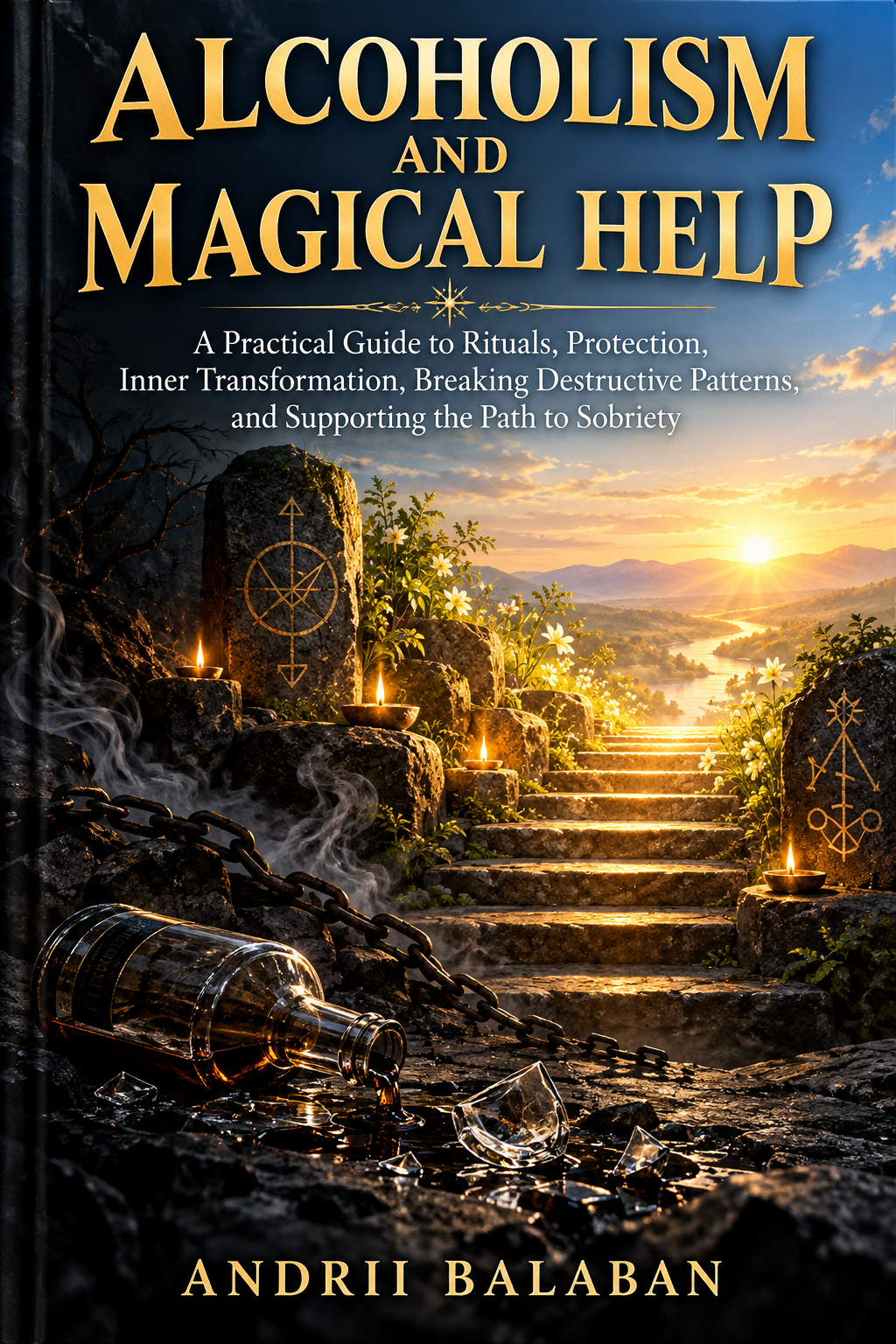
Alcoholism and magical help
Contents
Chapter 1. Alcohol dependence and the limits of magical help
The opening chapter establishes the foundation for the entire book by explaining what alcohol dependence is and why it cannot responsibly be reduced to weakness of will, moral failure, negative energy, possession, a curse, or any other single explanation. It examines the physical, psychological, behavioral, interpersonal, and social dimensions of addiction and defines the appropriate place of magical practice alongside medicine, addiction treatment, psychotherapy, psychological support, rehabilitation, peer support, and personal responsibility. Special attention is given to alcohol withdrawal and the circumstances in which suddenly stopping alcohol can be medically dangerous. The chapter establishes the central rule of the book: ritual may accompany treatment and recovery, but must never be used as a reason to delay or reject necessary professional care.
Chapter 2. The magical anatomy of dependence: habit, desire, repetition, and bondage
This chapter develops a magical and symbolic model of addiction without confusing metaphor with medical fact. Dependence is explored through the images of the chain, the circle, the knot, the repeated path, the false refuge, the consuming fire, and the vessel that can no longer remain full. These images become practical ritual tools for identifying what alcohol represents in a person’s life: relief, escape, reward, social belonging, emotional anesthesia, habit, rebellion, avoidance, or self-destruction. The chapter teaches the practitioner to distinguish the substance itself from the situations, emotions, relationships, thoughts, and routines that have become connected with drinking.
Chapter 3. Diagnosis before ritual: understanding the person and the problem
Before attempting magical work, the practitioner must understand what is actually happening. This chapter develops a structured method of preliminary assessment covering drinking patterns, previous attempts at sobriety, treatment history, triggers, relationships, living conditions, dangerous situations, available support, motivation for change, and realistic immediate goals. Magical divination may be used as a supplementary reflective practice, but it is never allowed to override observable facts or professional assessment. The chapter also explains when the appropriate magical action is not another ritual but encouraging the person to obtain urgent medical, psychological, or social assistance.
Chapter 4. The first threshold: rituals of decision, separation, and beginning
This chapter begins the practical magical work. It presents rituals designed to mark the conscious transition from an alcohol-centered pattern of life toward recovery. Water, fire, thread, knots, written statements, stones, candles, symbolic vessels, and acts of separation are used to give visible form to a decision that might otherwise remain abstract. The purpose is not to pretend that one ceremony instantly removes dependence, but to create a meaningful threshold: before this act stood one pattern of life; after it begins the work of constructing another. Particular attention is given to combining ritual declarations with immediate practical actions.
Chapter 5. Purification and breaking destructive patterns
This chapter develops rituals of cleansing and symbolic release from the accumulated associations surrounding alcohol. Rather than treating the person as contaminated or morally impure, purification is understood as the deliberate removal of objects, routines, environments, memories, and behavioral cues that repeatedly lead back toward drinking. Ritual bathing, cleansing of living space, symbolic destruction of written patterns, removal of alcohol-related objects, smoke, water, salt, fire, and protective boundary practices are integrated with practical changes to the person’s environment. The central principle is that magical cleansing becomes stronger when the physical world is changed with it.
Chapter 6. Craving, triggers, and magical protection during vulnerable moments
A person may sincerely desire sobriety and still encounter powerful cravings. This chapter focuses on the moments when intention is tested by stress, loneliness, anger, celebration, social pressure, familiar places, particular people, memories, or sudden emotional distress. The reader learns to construct short protective rituals, grounding actions, symbolic barriers, emergency objects, written formulas, and predetermined responses that can be used alongside evidence-based coping strategies and professional guidance. The objective is to reduce the distance between the moment of temptation and the moment in which the person remembers that another response is possible.
Chapter 7. Magic alongside medicine, psychotherapy, and psychological help
This chapter is devoted entirely to integration. It explains how ritual practice can coexist with medical treatment, prescribed medication, psychotherapy, psychological counseling, rehabilitation programs, support groups, and other forms of professional assistance without competing with them. Rituals may be constructed around attending an appointment, beginning treatment, completing a difficult therapeutic stage, maintaining medication adherence as prescribed, speaking honestly with a therapist, or returning to treatment after disengagement. The central message is simple: accepting professional help does not weaken magical work. In a responsible system, every effective source of assistance is allowed to contribute to recovery.
Chapter 8. Family magic: helping a loved one without controlling them
Alcohol dependence frequently becomes a family problem, even when only one person drinks. This chapter is written for partners, parents, adult children, relatives, and others who desperately want to help someone they love. It distinguishes support from control and protection from obsession. Rituals focus on strengthening healthy boundaries, protecting the household, reducing destructive participation in another person’s drinking, preserving emotional stability, supporting opportunities for treatment, and maintaining hope without pretending to command another person’s will. The chapter also addresses the difficult truth that sometimes helping another person requires refusing to protect them from every consequence of their behavior.
Chapter 9. Relapse, failure, guilt, and the ritual of beginning again
Recovery does not always follow a straight line. This chapter addresses relapse without either condemning the person or minimizing what has happened. A relapse becomes something to examine: what preceded it, which warning signs were missed, which supports disappeared, what circumstances changed, and what must now be strengthened. Rituals of acknowledgment, cleansing, recommitment, repair, and renewed boundaries are combined with the practical principle that relapse may require renewed medical or therapeutic assessment. The chapter teaches that beginning again is not the same as pretending nothing happened; genuine renewal incorporates what the failure has revealed.
Chapter 10. Rebuilding the life that alcohol occupied
Removing alcohol can leave an enormous empty space. This chapter therefore shifts attention from stopping a behavior to constructing a life in which sobriety has somewhere to live. Ritual work is directed toward sleep, daily structure, relationships, work, money, physical surroundings, creativity, learning, dignity, pleasure, social connection, and future goals. The practitioner learns to create ceremonies not merely for rejecting alcohol but for welcoming specific alternatives into the space it previously occupied. Recovery becomes a process of restoration rather than permanent deprivation.
Chapter 11. Long-term protection and the magical maintenance of sobriety
This chapter deals with the period after the initial crisis has passed. It develops daily, weekly, monthly, and anniversary practices intended to keep recovery visible without turning sobriety into an obsessive ritual system. Protective objects, journals, candles, seasonal ceremonies, gratitude practices, personal vows, symbolic milestones, and periodic reviews are used to reinforce continuity. The chapter also emphasizes that long-term stability requires flexibility: practices that once helped may need to change, professional support may need to be resumed, and new life circumstances may create new vulnerabilities that must be recognized rather than denied.
Chapter 12. The complete practice of magical support for recovery
The final chapter brings the entire system together. It presents a coherent model beginning with assessment and safety, continuing through decision, purification, separation, protection, treatment support, work with cravings, family boundaries, response to relapse, reconstruction of everyday life, and long-term maintenance. A complete ritual cycle is provided for supporting the transition toward sobriety, with clear stages of preparation, intention, symbolic action, commitment, closure, and immediate practical follow-through. The book ends with the principle on which the entire approach rests: the ritual may illuminate the road, strengthen the decision, and give meaning to the struggle, but recovery is built through the continuing actions of the person and through every legitimate form of help that can support them.