

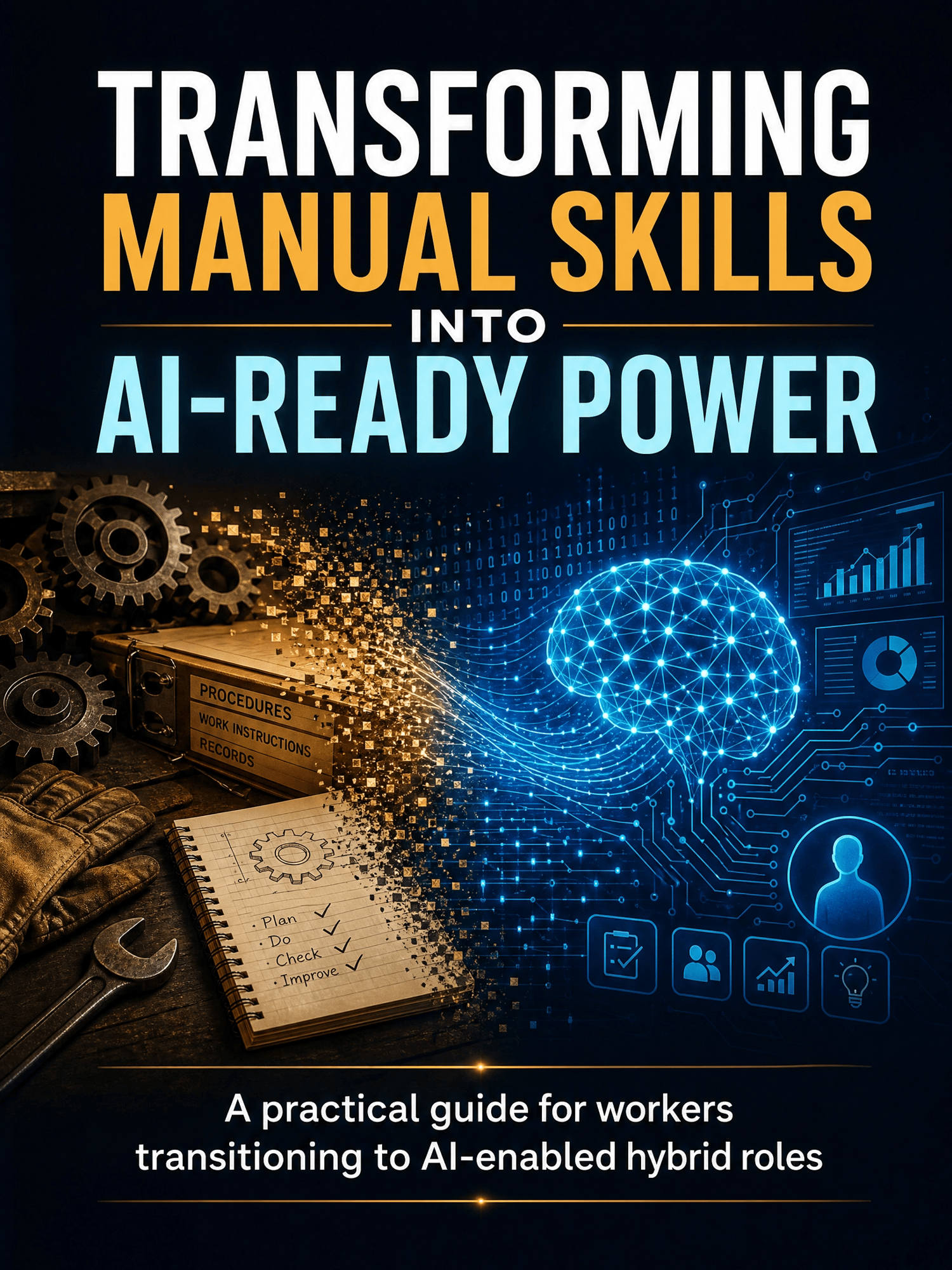
Transforming Manual Skills Into Ai-Ready Power
This guide speaks directly to professionals whose careers took shape within business processing, accounting, customer service, graphic design, marketing, and other roles built around steady manual effort and specialized skill. Many of these professionals now find themselves competing for positions that mention automation, AI agents, or hybrid workflows in the very first line of a job description, often without any clear explanation of what those terms mean for someone with their background. This guide was written to fill that gap, offering a clear, structured path for anyone who feels capable but uncertain about how their experience fits into this changing landscape.
It is equally suited to someone actively searching for a new role and someone still employed but sensing that their current position is quietly shifting beneath them. Both situations call for the same underlying work, translating hard-earned experience into language and positioning that reflects where employment is heading rather than where it has been. Whether the goal is an immediate transition or a proactive repositioning within a current field, this guide offers the same structured approach to help a reader move forward with clarity rather than hesitation.
What an AI-Ready Service Operator Is
An AI-ready service operator is a professional who understands how to work alongside automated systems and AI agents rather than in competition with them, applying human judgment precisely where it matters most. This person does not need to write code or build algorithms, but they do need to understand how AI-assisted workflows function well enough to manage them, question their output, and step in when nuance or accountability is required. This blend of oversight and hands-on service delivery defines the role increasingly sought across nearly every industry touched by automation.
Becoming this kind of operator means shifting from being the sole executor of a task to becoming the trusted judgment layer that ensures quality, accuracy, and appropriate human context around automated output. A customer service professional in this role, for example, might rely on AI to draft initial responses while applying their own understanding of tone, urgency, and relationship history to refine and finalize communication. This shift does not diminish the value of experience. It repositions that experience as the very safeguard that makes automated systems trustworthy in real-world use.
How Manual-Intensive Experience Translates Into Hybrid Value, Especially With Critical Thinking
Years spent in manual-intensive roles build a form of pattern recognition and situational judgment that AI systems still struggle to replicate consistently. A professional who has handled thousands of customer inquiries, reconciled countless financial discrepancies, or produced design work under shifting client expectations has developed an intuitive sense for exceptions, red flags, and context that no automated system currently manages reliably on its own. This accumulated judgment becomes the central asset that hybrid workplaces need most.
Critical thinking, in particular, stands out as the skill that manual-intensive work quietly builds over time without ever naming it directly. Recognizing when a routine process has produced an unusual or risky outcome, understanding when a client's request requires more nuance than a standard workflow allows, and knowing when to escalate rather than proceed are all forms of critical thinking sharpened through repetition and real consequence. Translating this ability clearly, rather than assuming employers will recognize it automatically, becomes one of the most important tasks addressed throughout this manual.
Why AI Fluency Now Matters in Service-Based Roles
AI fluency, meaning a working understanding of how AI tools function, where they excel, and where they still require human correction, has become an expected baseline rather than a specialized add-on skill in service-based roles. Employers increasingly assume that candidates can collaborate with AI-assisted systems, even in fields that once relied entirely on manual execution. This expectation does not demand technical mastery, but it does require enough comfort and familiarity to avoid appearing disconnected from how modern workflows actually operate.
Service-based roles in particular benefit from this fluency because so much of the work involves communication, accuracy, and responsiveness, all areas where AI tools now assist heavily. A professional who understands how to review AI-generated content for tone and accuracy, or how to use automated systems to speed up routine tasks while maintaining quality control, positions themselves as an asset rather than someone requiring extensive retraining. This fluency, built gradually and demonstrated clearly, forms a central theme running through every remaining chapter of this manual.
How to Use This Manual
This manual is structured to be worked through sequentially, since each chapter builds directly upon the reframing, positioning, and confidence established in the one before it. Reading ahead without completing the reflective work in earlier chapters, particularly the identification of transferable skills covered in Chapter One, often leaves later chapters feeling abstract rather than actionable. Working through each section deliberately, even taking time to write out personal examples as they arise, produces far stronger results than passively reading straight through.
Some readers will move through this material quickly, already sensing many of the connections between their experience and future opportunities. Others will need more time, particularly if their previous role felt highly specialized or disconnected from anything resembling automation or AI collaboration. Both paces are entirely appropriate, since the goal is not speed but clarity. A reader who finishes this manual with a genuinely clear sense of their own value will move through resumes, applications, and interviews with far more confidence than one who rushed through without that foundation.
What Success Looks Like in the Next Role
Success in a new AI-enabled hybrid role rarely looks like mastering every available tool or becoming a technical expert overnight. It looks like confidently applying existing judgment within a new workflow, communicating clearly about how and why decisions are made, and steadily building trust with colleagues and supervisors who see reliable human oversight as essential to their operations. This kind of success accumulates gradually through consistent, dependable performance rather than a single impressive display of technical skill.
Longer-term success extends beyond the first role itself, into a broader sense of career stability and adaptability as hybrid work continues to evolve. A professional who successfully navigates this first transition typically finds subsequent transitions far less daunting, since they have already proven to themselves that their experience holds real value in a changing landscape. This growing confidence, built through direct experience rather than reassurance alone, becomes the true measure of success this manual aims to help every reader achieve.