
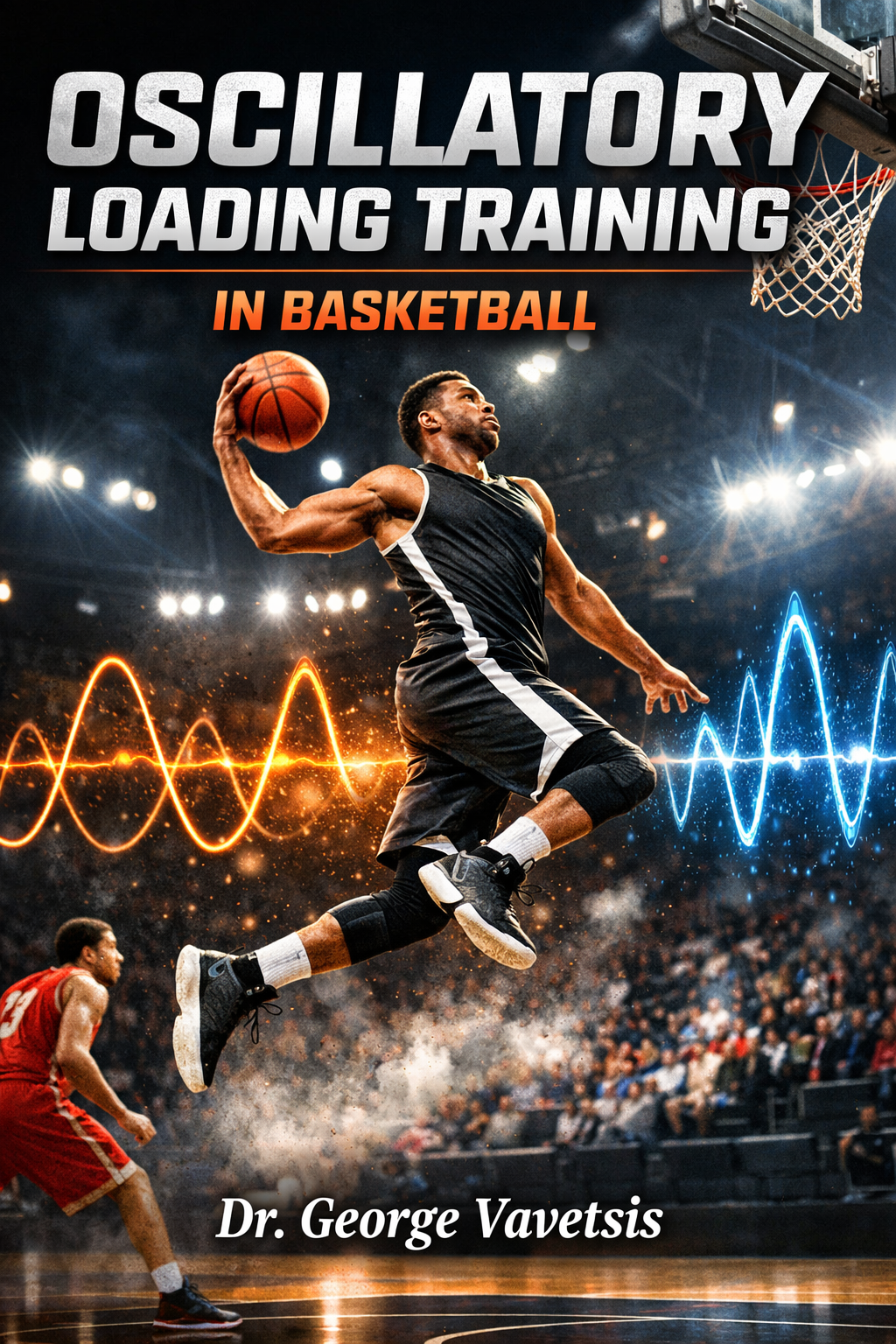
Oscillatory Loading Training in Basketball
Pages: 806
Modern basketball is a game of oscillations. Beneath the visible flow of offense and defense, beyond tactics and skill execution, lies a hidden biomechanical rhythm that governs how force is produced, transferred, absorbed, and recycled. Every jump, stop, cut, drive, and landing represents a sequence of loading and unloading cycles—a dynamic oscillatory process that shapes performance, efficiency, and injury resilience. This book explores that invisible architecture: Oscillatory Loading Training in Basketball.
In contemporary high-performance basketball, the athlete is not merely producing force; the athlete is managing force waves. Movement is not linear—it is rhythmic. The human body behaves as a complex spring-mass-neuromuscular system, continuously shifting between stiffness and elasticity, tension and release, impulse and absorption. These oscillatory patterns occur within milliseconds, yet they determine explosive take-off, rapid deceleration, lateral containment, and reactive acceleration. Understanding and training this oscillatory nature of movement provides a new framework for strength and conditioning in basketball.
The concept of oscillatory loading originates from the observation that basketball actions are composed of rapid reception–impact–transfer phases characterized by repeated force fluctuations and elastic interactions between muscle, tendon, and ground reaction forces
. These oscillations are not random. They follow specific frequencies, amplitudes, and directional patterns that can be trained, optimized, and monitored. The difference between an average athlete and an elite performer often lies in how efficiently oscillatory energy is stored, transferred, and reused.
Traditional strength training has focused on maximal force production, hypertrophy, and linear power development. While these qualities remain essential, they are insufficient to fully prepare the basketball athlete for the chaotic, high-frequency loading environment of the game. Basketball is not simply about producing force—it is about producing force in oscillation: during stretch-shortening cycles, during reactive deceleration, during lateral micro-stabilization, and during rapid transitions between concentric and eccentric phases.
Oscillatory loading represents the bridge between classical strength training and true sport-specific neuromechanics. It integrates biomechanics, neurophysiology, elastic energy dynamics, and movement coordination into a unified performance model. Within this framework, stiffness is not rigidity but controlled elasticity; stability is not immobility but oscillatory balance; and explosiveness is not only force magnitude but impulse timing and frequency synchronization.
Throughout this book, oscillatory loading is explored across key basketball movement domains:
- Triple-extension and vertical propulsion
- Eccentric braking and controlled deceleration
- Lateral shuffle stability and defensive containment
- First-step acceleration and drive initiation
- Penultimate step mechanics and jump preparation
- Reactive second-jump rebound ability
Each of these domains contains distinct oscillatory signatures—specific patterns of force fluctuation, stiffness modulation, and neuromuscular timing. Training must therefore move beyond general strength prescriptions toward oscillatory-specific load design, where frequency, rhythm, perturbation, and elastic rebound become primary programming variables.
This book is written for strength and conditioning coaches, sport scientists, performance specialists, and advanced practitioners seeking a deeper, more precise understanding of basketball performance. It presents oscillatory loading not as a theoretical concept but as an applied training system. Every principle is translated into:
- Mechanical objectives
- Neuromechanical mechanisms
- Force-vector characteristics
- Exercise design and progression
- Coaching cues
- Monitoring metrics
- Common deficits and corrective strategies
- Game performance transfer
In elite sport, performance gains are no longer achieved through volume alone but through precision. Oscillatory training provides that precision by targeting how the body interacts with force over time, not merely how much force it produces. By improving oscillatory efficiency, athletes jump higher, stop faster, change direction more safely, and react more explosively—while simultaneously reducing energy loss and mechanical stress.
Another central theme of this book is energy economy through elastic intelligence. Efficient athletes do not waste force; they recycle it. They convert eccentric braking into elastic propulsion, transform lateral instability into controlled stiffness, and convert rapid deceleration into explosive re-acceleration. Oscillatory loading is the mechanism through which this transformation occurs.
The book also introduces practical monitoring tools to quantify oscillatory performance, including reactive strength metrics, stiffness indices, oscillation variability, deceleration timing, and force-time pattern analysis. These tools allow coaches to identify hidden inefficiencies—energy leaks, instability zones, delayed rebounds, and stiffness asymmetries—that often remain undetected in traditional strength assessments.
Importantly, oscillatory training is not limited to elite athletes. It provides a developmental pathway from foundational neuromuscular coordination to advanced reactive performance. Whether applied to youth development, injury prevention, return-to-play protocols, or high-performance competition, oscillatory principles remain consistent: control the rhythm of force, and you control performance.
This book does not aim to replace traditional strength and conditioning—it aims to evolve it. It invites the reader to move beyond static concepts of strength and toward a dynamic understanding of movement as a living oscillatory system. Basketball, in its essence, is a game of rhythm, timing, and reactive force. Training must reflect that reality.
Oscillatory Loading Training represents the next progression in basketball performance science—a shift from force production to force orchestration, from strength to elastic intelligence, from movement execution to movement architecture.
The future of performance lies not only in how strong the athlete is, but in how precisely the athlete moves within the oscillations of the game.