PARTNERSHIPS
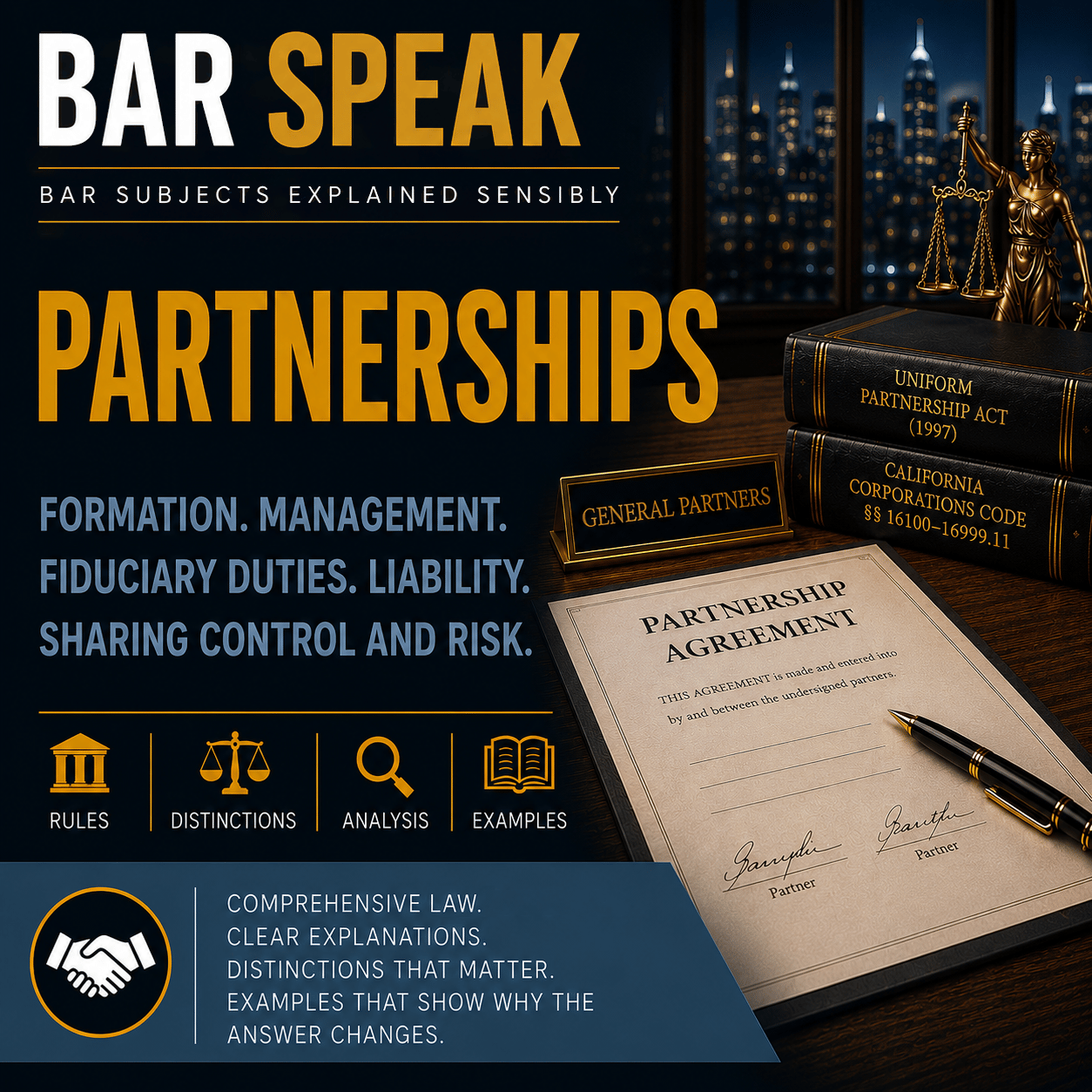
BAR SPEAK: Partnerships is a focused California bar-prep guide designed to make partnership law easier to understand, organize, and apply. Rather than treating formation, partner authority, liability, fiduciary duties, dissociation, and dissolution as disconnected rules, BAR SPEAK presents them as parts of a single framework so students can determine when a partnership exists, when a partner can bind the firm, who is personally liable, and what happens when a partner leaves or the business winds up.
The guide covers the Partnership topics tested on the California Bar Exam, including formation of general partnerships, profit-sharing presumptions, default governance rules, actual and apparent authority, purported partners and partnership by estoppel, limited liability partnerships, limited partnerships, partner liability for contracts and torts, incoming and outgoing partners, internal management, indemnification and contribution, fiduciary duties, transferability of partnership interests, admission of new partners, dissociation, wrongful dissociation, post-dissociation liability, buyout rights, dissolution, winding up, and distribution of partnership assets.
Throughout the guide, closely related rules are separated and compared so students can see exactly when one rule ends and another begins. Particular attention is given to distinctions such as actual authority versus apparent authority, ordinary-course versus outside-the-ordinary-course acts, general partnerships versus LLPs and LPs, partnership liability versus individual partner liability, economic rights versus management rights, dissociation versus dissolution, and the different consequences of a partner’s departure depending on whether the business continues or winds up.
What makes BAR SPEAK different:
- Clear rules followed by plain-English explanations
- Partnership formation organized around co-ownership, profit motive, and the profit-sharing presumption
- Partner authority broken down into actual authority, apparent authority, and purported-partner liability
- General partnerships, LLPs, and LPs distinguished by management authority and personal liability
- Contract and tort liability separated so partnership obligations are not confused with individual partner liability
- Fiduciary duties organized around loyalty, care, and the obligation of good faith and fair dealing
- Internal governance rules covering voting, management, compensation, indemnification, and contribution
- Dissociation and dissolution treated as separate concepts with different legal consequences
- Buyout, winding-up, and distribution rules organized around what happens when the partnership relationship changes or ends
- Built for understanding first, memorization second
This is not a stripped-down attack outline that simply lists partnership rules and liability doctrines. It is a stand-alone Partnerships guide for students who want to understand how the partnership relationship works from formation through winding up, how partner authority affects third parties, how different partnership forms change liability, and how to recognize the factual distinctions that determine the result before they are expected to memorize and apply the rules.
BAR SPEAK
Bar Subjects Explained Sensibly