

Solving Linear Equations - Pair Up Activity
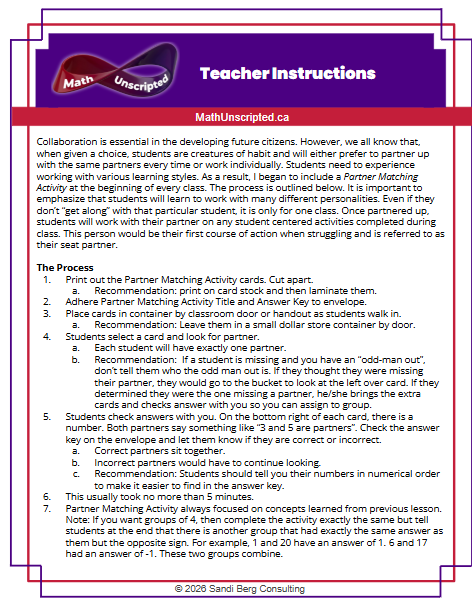
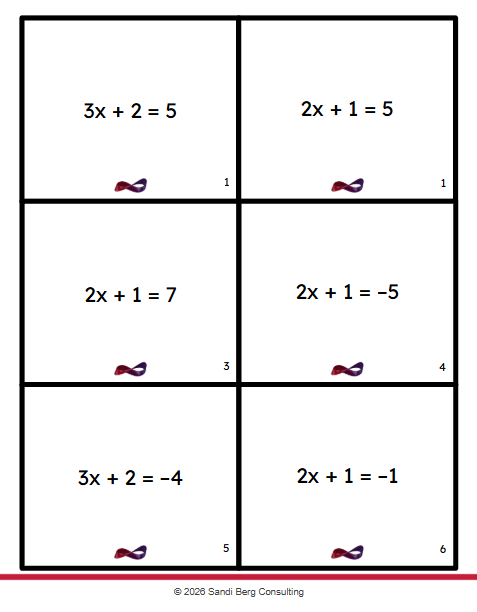
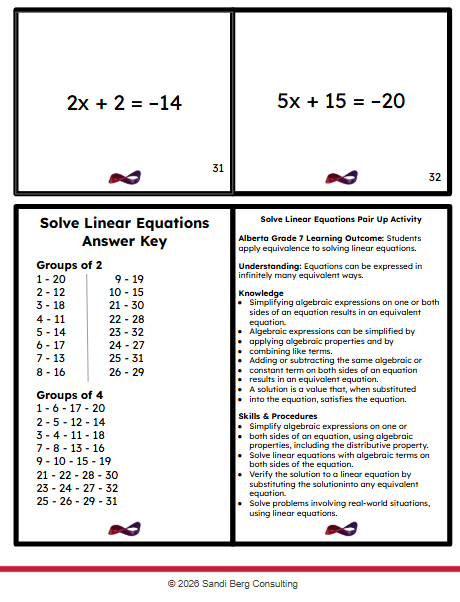
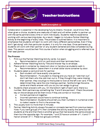
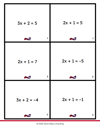
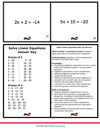
Collaboration is essential in the developing future citizens. However, we all know that, when given a choice, students are creatures of habit and will either prefer to partner up with the same partners every time or work individually. Students need to experience working with various learning styles. As a result, I began to include a Partner Matching Activity at the beginning of every class. It is important to emphasize that students will learn to work with many different personalities. Even if they don’t “get along” with that particular student, it is only for one class. Once partnered up, students will work with their partner on any student centered activities completed during class. This person would be their first course of action when struggling and is referred to as their seat partner. This document contains cards that can be used to sort students into groups of 2 or groups of 4.
Grade 7 Math, Alberta
Learning Outcome: Students apply equivalence to solving linear equations.
Understanding:
*Equations can be expressed in infinitely many equivalent ways.
Knowledge
- Simplifying algebraic expressions on one or both sides of an equation results in an equivalent equation.
- Algebraic expressions can be simplified by
- applying algebraic properties and by
- combining like terms.
- Adding or subtracting the same algebraic or
- constant term on both sides of an equation
- results in an equivalent equation.
- A solution is a value that, when substituted
- into the equation, satisfies the equation.
Skills & Procedures
- Simplify algebraic expressions on one or
- both sides of an equation, using algebraic properties, including the distributive property.
- Solve linear equations with algebraic terms on both sides of the equation.
- Verify the solution to a linear equation by substituting the solutioninto any equivalent equation.
- Solve problems involving real-world situations, using linear equations.