











The Book Thief Novel Study | 6-Week Literature Unit, Worksheets & Answer Key | Grades 9–12
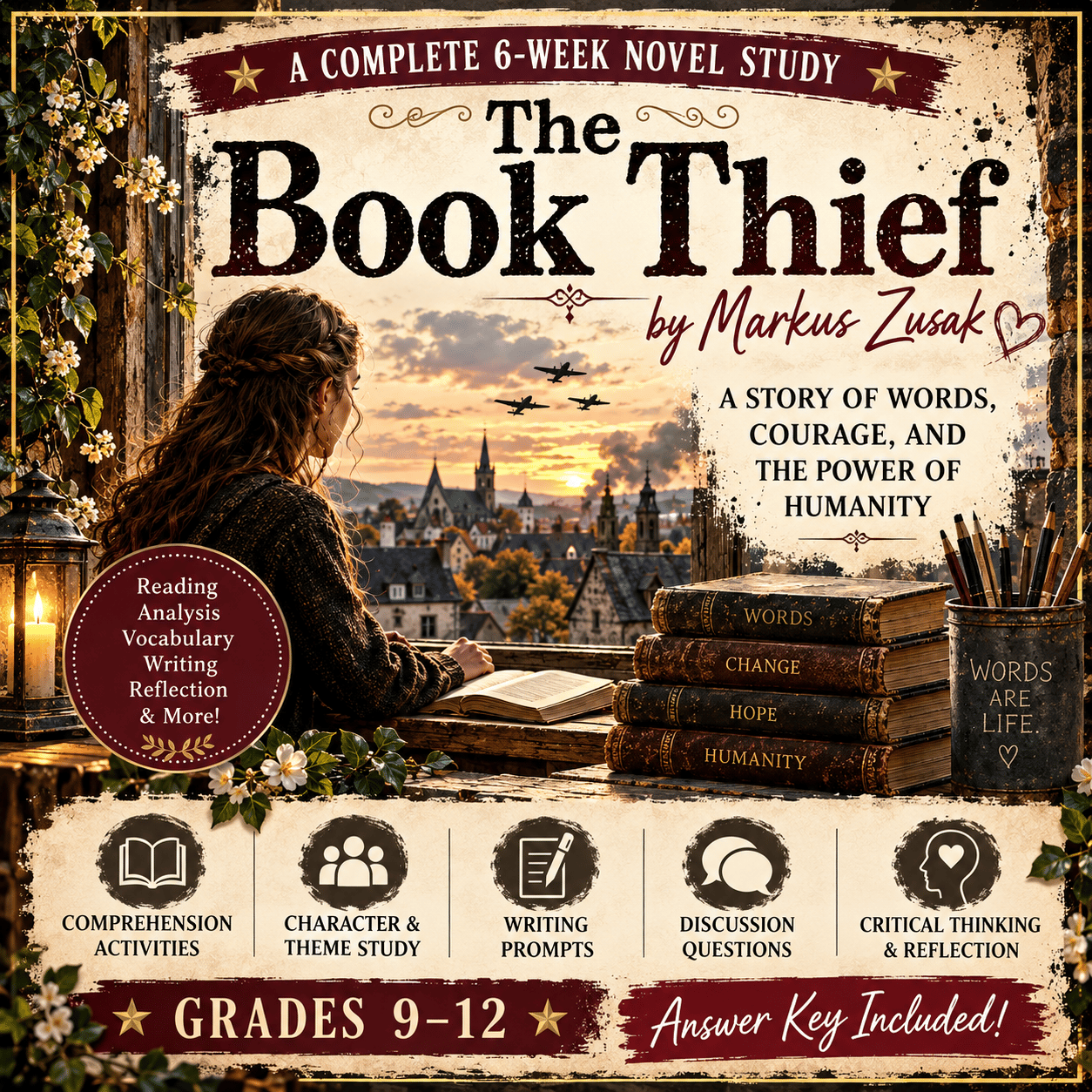
The Book Thief Novel Study by Markus Zusak | Complete 6-Week Literature Unit | Grades 9–12
Bring The Book Thief to life with a comprehensive, 83-page, six-week novel study designed to strengthen reading comprehension, vocabulary, literary analysis, critical thinking, and evidence-based writing.
Teaching The Book Thief by Markus Zusak? Looking for engaging, ready-to-use literature worksheets that go beyond basic comprehension questions?
This complete six-week novel study provides high school English teachers, homeschool educators, and parents with structured reading activities that encourage students to analyze characters, explore themes, examine literary techniques, and develop a deeper understanding of this powerful historical fiction novel.
Set in Nazi Germany during World War II, The Book Thief follows Liesel Meminger, a young girl who discovers the transformative power of words, books, friendship, and compassion during one of history’s darkest periods.
Through thoughtfully designed reading comprehension questions, vocabulary activities, character studies, theme analysis, and reflective writing prompts, students explore the novel’s complex messages about humanity, courage, resilience, loss, and the power of storytelling.
This 83-page printable PDF includes six weeks of organized literature activities, teacher notes, and an answer key to support classroom and homeschool instruction.
WHAT’S INCLUDED IN THIS NOVEL STUDY?
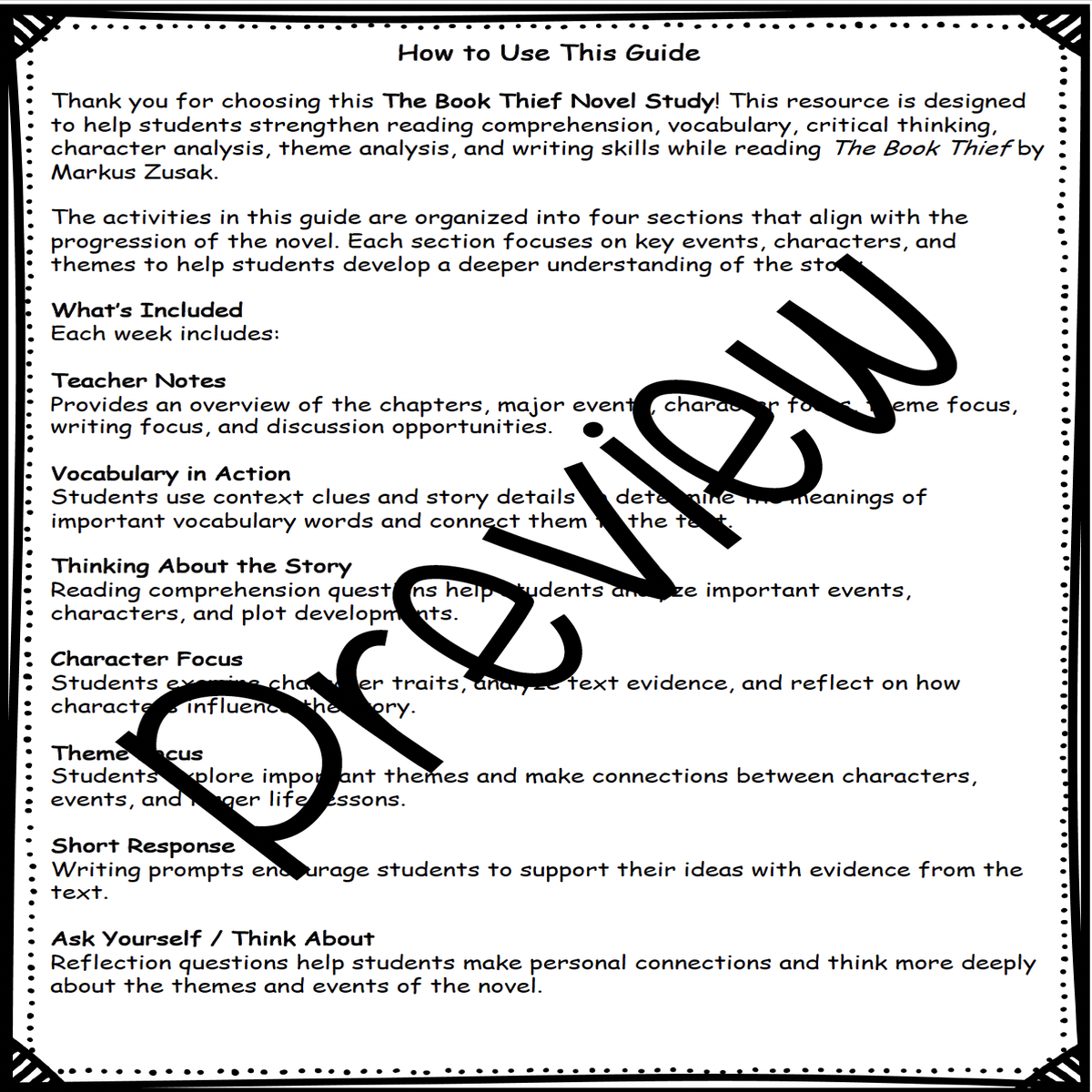
This comprehensive The Book Thief literature unit includes seven recurring instructional components designed to support meaningful reading, discussion, and literary analysis.
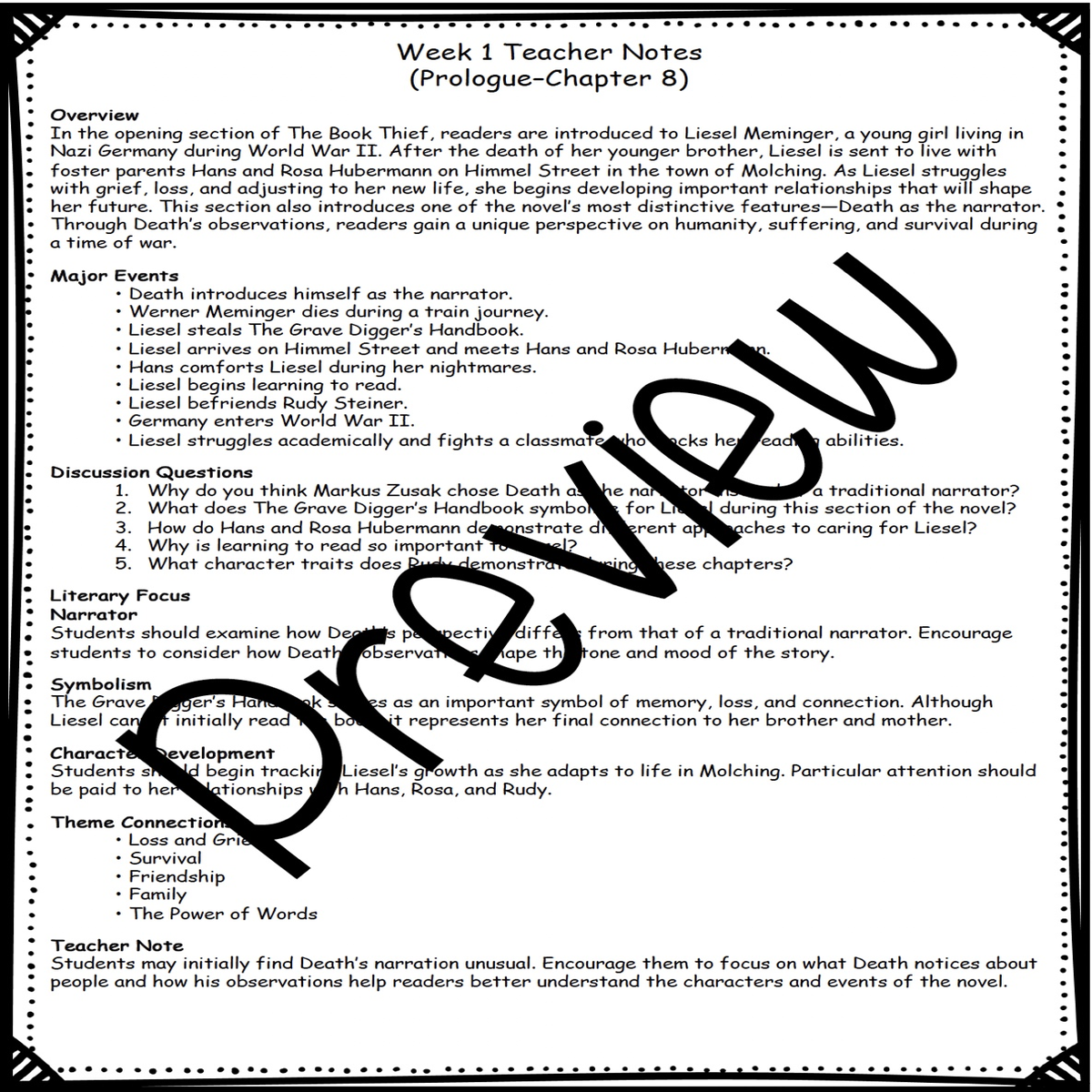
1. Weekly Teacher Notes
Each instructional week includes teacher notes to help educators prepare lessons and guide discussions.
Teacher notes provide:
- Reading overviews and important plot developments
- Major events and character relationships
- Literary elements and instructional focus areas
- Theme connections
- Discussion questions
- Suggestions for guiding student analysis
These notes help teachers and homeschool parents approach the novel with clear instructional goals while reducing preparation time.
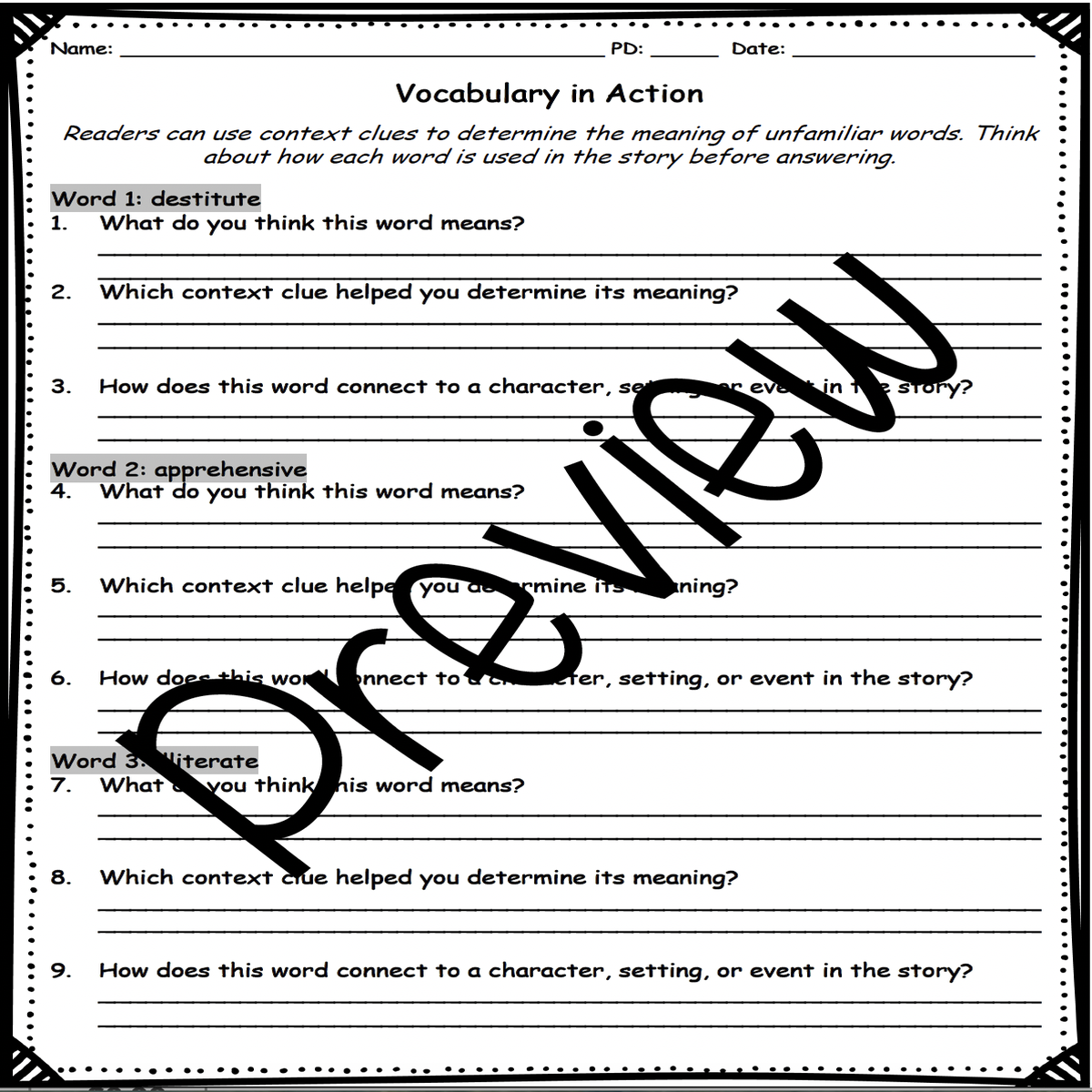
2. Vocabulary in Action
Strengthen students’ vocabulary and contextual reading skills with activities that encourage them to:
- Determine unfamiliar word meanings using context clues
- Analyze vocabulary within the context of the novel
- Connect vocabulary to characters, settings, and events
- Develop stronger reading comprehension
- Explain their thinking through written responses
Rather than simply memorizing definitions, students explore how language contributes to meaning.
3. Thinking About the Story
Reading comprehension worksheets guide students through important events, conflicts, and character interactions.
Students examine:
- Significant plot developments
- Character motivations and decisions
- Relationships between major characters
- Cause-and-effect relationships
- Important details that contribute to the novel’s themes
Questions encourage students to move beyond recalling information by explaining their interpretations and supporting their responses with details from the text.
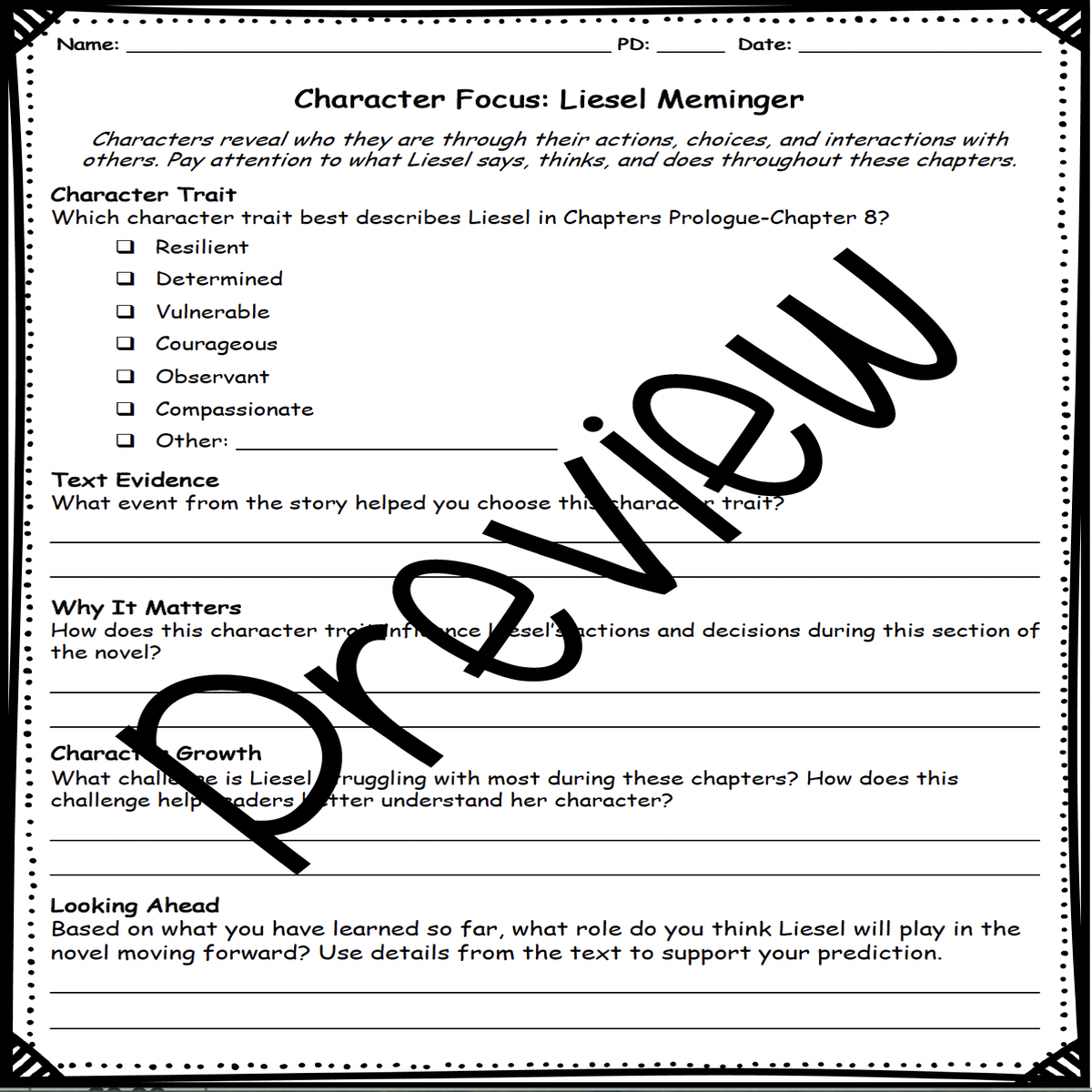
4. Character Focus
Help students develop stronger character analysis skills as they examine the personalities, motivations, relationships, and growth of important characters.
Activities encourage students to:
- Identify and analyze character traits
- Examine motivations and personal conflicts
- Support interpretations with textual evidence
- Evaluate how relationships influence decisions
- Track character development throughout the novel
- Make predictions about future character actions
Students explore characters such as Liesel Meminger, Hans Hubermann, Rosa Hubermann, Rudy Steiner, and Max Vandenburg.
5. Theme Focus
Guide students through meaningful analysis of the major themes developed throughout The Book Thief.
Themes explored include:
- The power of words and storytelling
- Friendship and loyalty
- Courage and compassion
- Humanity during times of crisis
- Hope and resilience
- Loss and survival
- The importance of memory
- Personal sacrifice and moral responsibility
Students analyze how Markus Zusak develops these ideas through characters, events, symbolism, and the novel’s historical setting.
6. Short Response Writing
Develop students’ analytical writing skills with structured short-response activities.
Writing prompts encourage students to:
- Explain important literary ideas
- Analyze character decisions
- Interpret significant events
- Support responses with textual evidence
- Explore connections between themes and characters
- Communicate interpretations clearly
These activities provide opportunities to strengthen written expression while reinforcing reading comprehension.
7. Ask Yourself / Think About
Encourage meaningful reflection with thought-provoking questions that connect the novel to broader human experiences.
Students consider questions involving:
- Empathy and compassion
- Personal growth
- Friendship and relationships
- Resilience during difficult circumstances
- The importance of education and literacy
- Moral choices and individual responsibility
- Understanding different perspectives
These activities work well for independent reflection, classroom discussions, homeschool conversations, and written responses.
SIX-WEEK NOVEL STUDY BREAKDOWN
This literature unit is organized into six instructional weeks, providing a structured approach to reading and analyzing The Book Thief.
Week 1: Prologue–Chapter 8
Focus: Loss, Survival, and New Beginnings
Students are introduced to Liesel Meminger, her arrival on Himmel Street, and the unusual narrative perspective of Death.
Activities focus on:
- Understanding Death as the narrator
- Liesel’s experiences with grief and loss
- Character relationships and development
- The importance of literacy
- Symbolism and the power of books
- Themes of survival, friendship, and family
Week 2: Chapters 9–24
Focus: The Power of Words and Historical Context
Students examine the influence of language, propaganda, and censorship during Nazi Germany.
Activities encourage students to explore:
- The importance of words and storytelling
- Historical context and its influence on characters
- Character motivations and relationships
- Developing themes of courage and compassion
- Literary analysis and evidence-based responses
Week 3: Chapters 25–32
Focus: Friendship, Compassion, and Resilience
Students continue examining the relationships that shape Liesel’s experiences.
Instruction emphasizes:
- Character relationships and development
- Friendship and loyalty
- Compassion during difficult circumstances
- The influence of personal experiences
- Theme analysis and reflective writing
Week 4: Chapters 33–40
Focus: Courage, Loyalty, and Personal Conviction
Students examine how characters respond to difficult circumstances and the moral choices they face.
Activities focus on:
- Character motivations
- Friendship and loyalty
- Courage and personal responsibility
- Character development
- Literary interpretation and critical thinking
Week 5: Chapters 41–56
Focus: Humanity, Sacrifice, and Survival
Students explore how the novel develops its messages about human behavior during times of crisis.
Activities encourage analysis of:
- Compassion and sacrifice
- Moral choices
- Loss and resilience
- Character relationships
- The development of major themes
- Evidence-based literary analysis
Week 6: Chapters 57–Epilogue
Focus: Memory, Hope, and the Power of Storytelling
The final instructional week encourages students to reflect on the novel’s conclusion and the larger messages developed throughout the story.
Students examine:
- Character growth and transformation
- The importance of memory
- The power of words and storytelling
- Hope and resilience
- The novel’s central themes
- Connections between the beginning and ending of the story
The six-week structure allows teachers and homeschool educators to organize reading assignments while maintaining consistent opportunities for comprehension, discussion, and analysis.
ENGLISH LANGUAGE ARTS SKILLS DEVELOPED
This The Book Thief novel study supports essential high school ELA skills, including:
- Reading comprehension
- Close reading
- Vocabulary acquisition
- Context clues
- Character analysis
- Theme development
- Symbolism
- Literary interpretation
- Point of view and narration
- Textual evidence
- Critical thinking
- Analytical writing
- Written reflection
- Literary discussion
- Historical context and literature connections
Students practice interpreting literature while developing stronger reading, writing, and communication skills.
PERFECT FOR HIGH SCHOOL ENGLISH TEACHERS
Planning a The Book Thief literature unit doesn’t have to mean spending hours creating reading comprehension worksheets, vocabulary activities, and discussion questions.
This organized novel study provides instructional materials that can be incorporated into:
- High school English Language Arts classes
- Whole-class novel studies
- Literature circles
- Small-group reading instruction
- Independent reading assignments
- Reading intervention
- Enrichment activities
- Homework and independent practice
- Substitute lesson plans
- Literary discussions
- Evidence-based writing practice
The weekly instructional structure allows teachers to focus on guiding student learning rather than creating every activity from scratch.
Teacher notes and an included answer key provide additional support for instruction and reviewing student work.
IDEAL FOR HOMESCHOOL LITERATURE CURRICULUM
Looking for a structured high school literature study for your homeschool student?
This six-week The Book Thief novel study provides homeschool parents with organized activities that encourage students to read carefully, think critically, and develop stronger analytical writing skills.
The resource includes:
- Structured weekly reading activities
- Reading comprehension worksheets
- Vocabulary development exercises
- Character analysis activities
- Theme exploration
- Short-response writing prompts
- Reflective thinking questions
- Teacher notes
- An answer key
Homeschool educators can adjust the pacing to meet their student’s learning needs while following the organized instructional sequence.
Whether your student is completing an independent literature study or participating in guided discussions, this resource provides a framework for exploring the novel in greater depth.
COMMON CORE STATE STANDARDS ALIGNMENT
This novel study supports English Language Arts instruction aligned with Common Core State Standards for Grades 9–12.
Reading Literature
RL.9-10.1–6
RL.11-12.1–6
Students analyze literary texts, cite evidence, examine themes, interpret characters, and evaluate literary techniques.
Writing
W.9-10.1, 2, 4, 9
W.11-12.1, 2, 4, 9
Students develop written responses, organize ideas, and support interpretations with evidence from literature.
Language
L.9-10.4–6
L.11-12.4–6
Students strengthen vocabulary acquisition and interpret word meanings through context.
Speaking and Listening
SL.9-10.1, 4
SL.11-12.1, 4
Students participate in literary discussions and communicate their understanding of complex texts.
PRODUCT DETAILS
Title: The Book Thief Novel Study
Author: Markus Zusak
Resource Type: Novel Study / Literature Unit / Reading Comprehension Worksheets
Recommended Grade Levels: 9–12
Subject: English Language Arts / Literature
Instructional Duration: 6 Weeks
Total Pages: 83
Format: Printable PDF Digital Download
Teacher Notes: Included
Answer Key: Included
Instructional Settings: Traditional Classroom, Homeschool, Independent Study, Literature Circles
Preparation: Print the activities or distribute the PDF digitally for students to complete.
Important: This purchase includes instructional materials only. A copy of The Book Thief by Markus Zusak is required and is not included.
WHY CHOOSE THIS THE BOOK THIEF NOVEL STUDY?
The Book Thief is a powerful novel that encourages students to examine humanity, compassion, resilience, and the influence of words during challenging historical circumstances.
This comprehensive literature unit helps students move beyond basic comprehension toward meaningful literary analysis.
Through structured reading activities, vocabulary development, character studies, theme exploration, and reflective writing, students develop the skills necessary to interpret complex literature.
For teachers, the organized six-week format reduces instructional preparation time.
For homeschool parents, the resource provides structured literature activities that support independent learning and guided instruction.
For students, the activities create opportunities to think critically, support ideas with textual evidence, and connect literature to larger questions about human experiences.
Spend less time preparing lessons and more time helping students discover the power of literature.
Add this complete 6-week
The Book Thief Novel Study to your teaching resources today!
305HippieChic
Print. Think. Write. Learn.