
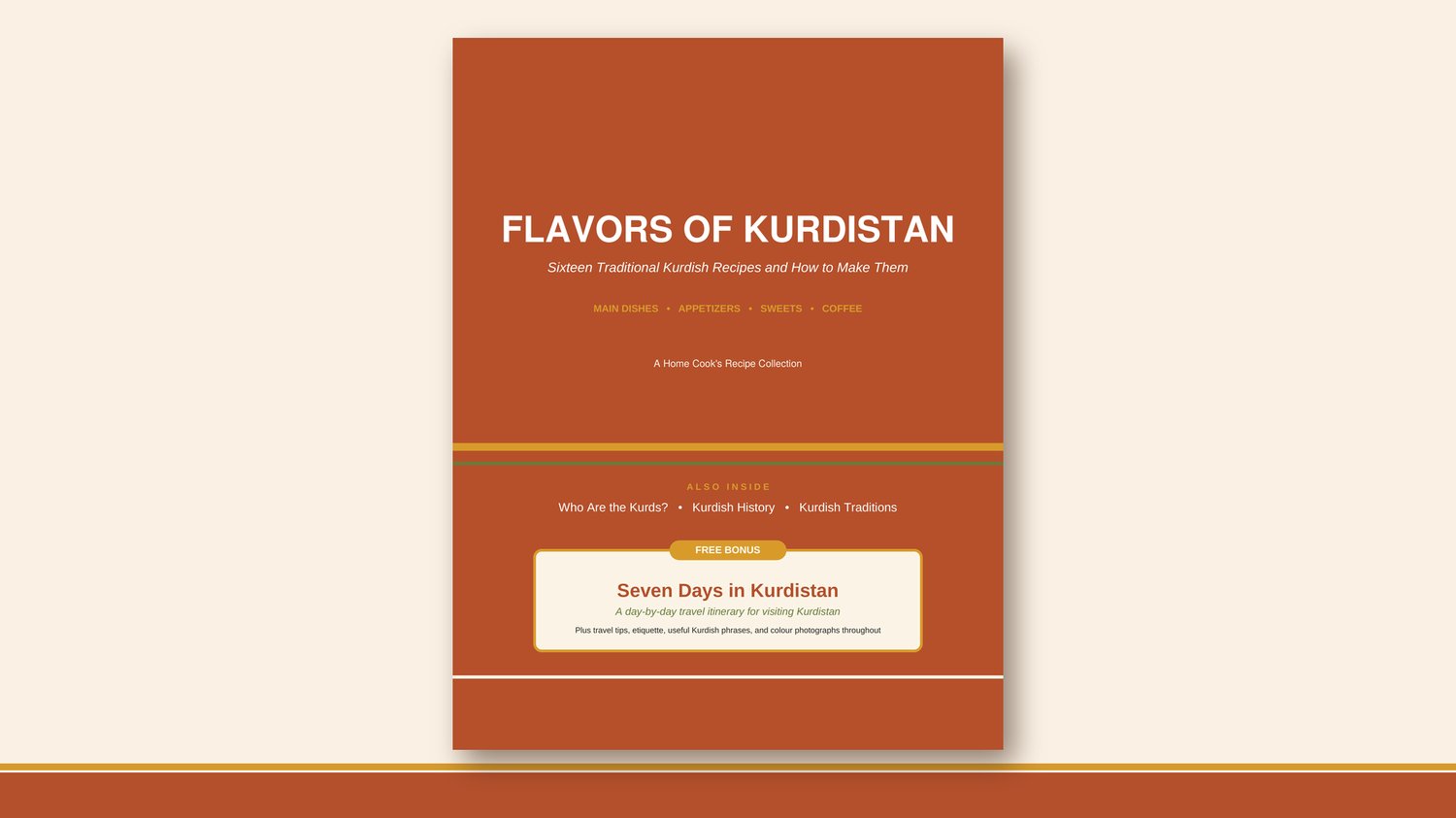
Flavours of Kurdistan Plus Free 7 days Travel Itinerary, HIstory and Culture
Kurdish cuisine reflects the mountains, rivers, and orchards of the region where Kurdish communities have lived for
centuries, spanning parts of Turkey, Iraq, Iran, and Syria. It leans on rice, bulgur, yogurt, fresh herbs, dried fruit, walnuts,
and slow-simmered meats, with sour notes from pomegranate, sumac, and unripe grapes balancing rich, savory stews.
This collection gathers the dishes that appear again and again at Kurdish tables: stuffed vegetables, filled dumplings,
fragrant rice, a tangy herb stew, spiced meatballs, a warming lentil soup, a chilled yogurt drink, and a honey-soaked
pastry to finish the meal. Alongside them you will find three simple appetizers, two traditional sweets, and three ways to
make coffee, from Kurdish terebinth coffee to Turkish and Arabic coffee. Each recipe includes prep and cook times, a full
ingredient list, a photograph, and clear step-by-step instructions so you can recreate them at home.
A note on ingredients: dried limes, sumac, pomegranate molasses, and terebinth coffee paste can usually be found at
Middle Eastern or Turkish grocers or ordered online. Where a substitution is easy, it is noted in the recipe.
Who are the Kurd's
The Kurds are an ethnic group native to a mountainous region of western Asia that is often called Kurdistan, the "land of
the Kurds." It is not a single country but a cultural homeland that straddles the borders of Turkey, Iraq, Iran, and Syria,
with smaller communities in Armenia, Azerbaijan, and the Caucasus. Its backbone is the great arc of the Zagros and
Taurus mountain ranges, the source of the Tigris and Euphrates, where snowmelt feeds orchards, vineyards, and
summer pastures.
Estimates of the total Kurdish population vary widely, usually between about 30 and 45 million people, because censuses
in the region rarely record ethnicity. By most counts the largest share lives in Turkey, followed by Iran, Iraq, and Syria.
The Kurds are frequently described as one of the largest ethnic groups in the world without a state of their own.
Language.
Kurdish is an Iranian language, a distant cousin of Persian, and is spoken in several major varieties. Kurmanji (Northern
Kurdish) is spoken across Turkey, Syria, and northern Iraq and is usually written in a Latin alphabet. Sorani (Central
Kurdish) dominates around Erbil and Sulaymaniyah in Iraq and in western Iran, and is written in an adapted Arabic script.
Southern Kurdish dialects, and the related Zazaki and Gorani (Hawrami) languages, add further richness.
Kurdish History and Kurdish Traditions (five pages) PLUS a Free 7 days itinerary for visiting Kurdistan.