
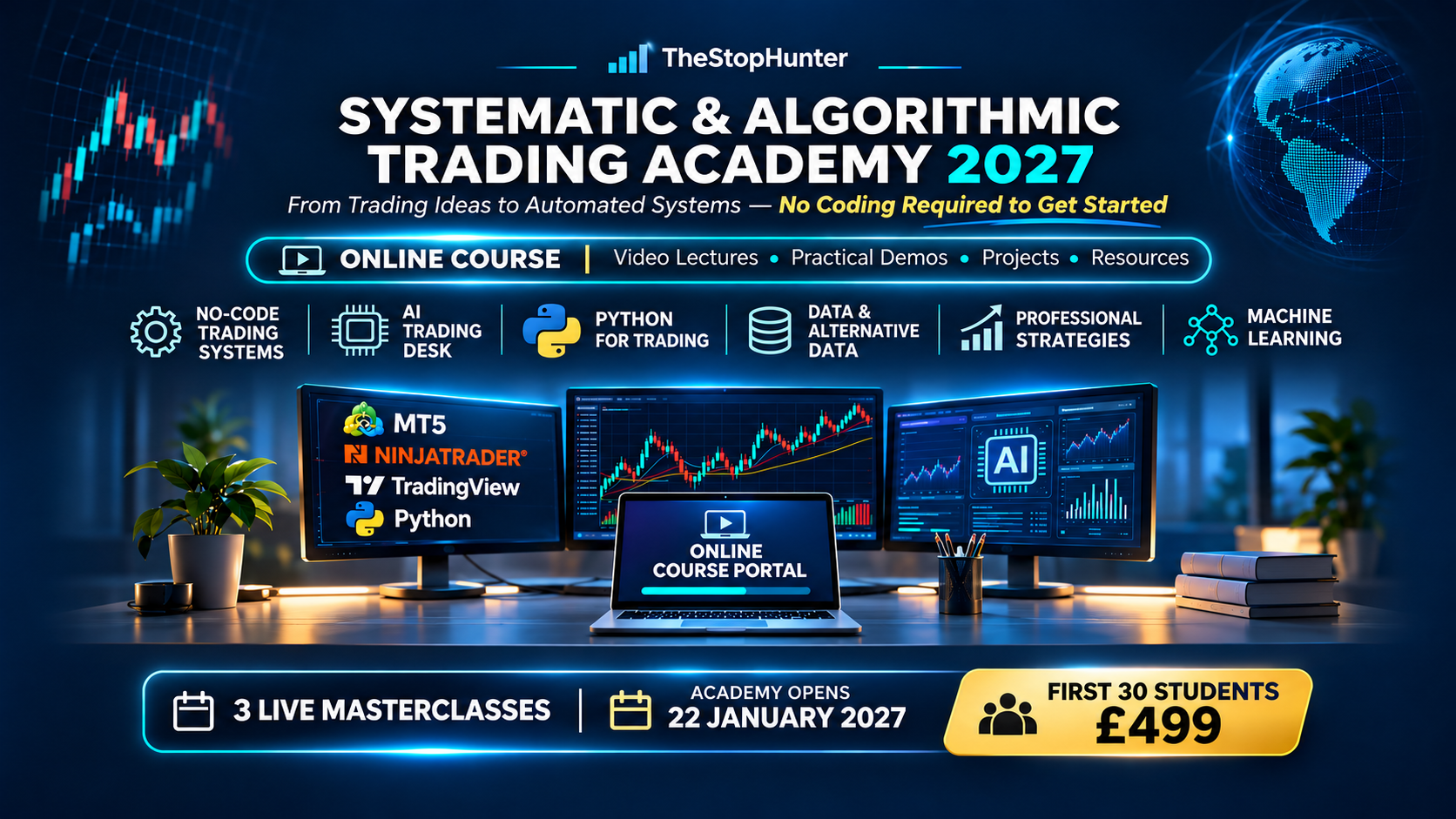
THE PROFESSIONAL SYSTEMATIC TRADER 2027
Build Trading Systems. Create Your Own AI Trading Desk. Discover Professional Strategies. Automate Your Trading.
From Retail Trader to Systematic Trader — With or Without Coding.
An exclusive systematic and algorithmic trading programme with Stephen Hoad, bringing together more than 25 years of professional trading experience, modern trading technology and practical strategy development.
FIRST 30 FOUNDING STUDENTS — JUST £499
THEREAFTER — £999
ACADEMY OPENS FRIDAY 22 JANUARY 2027
Includes seven comprehensive learning pillars, a dedicated Data & Alternative Data Lab, a Prop Firm Challenge Lab and three exclusive live Saturday masterclasses.

THE FUTURE OF TRADING IS SYSTEMATIC. ARE YOU READY?
Still spending hours watching charts, waiting for trading setups and making decisions manually?
Perhaps you have a full-time job and simply cannot spend six or eight hours a day watching the markets.
Perhaps you've been trading for years but want to develop a more disciplined, repeatable approach.
Or perhaps you've seen the explosion in artificial intelligence, automated trading and machine learning and wondered how you could start using these technologies yourself.
What if you could change the way you trade?
Imagine being able to:
- Build trading systems that identify opportunities using predefined rules.
- Develop automated strategies using MetaTrader 5, NinjaTrader or TradingView workflows.
- Create your own AI-powered trading desk, with market scanners, research tools and dashboards.
- Use technology to monitor the markets while you're doing something else.
- Explore professional trading strategies, including options, market making, commodities and volatility.
- Discover how machine learning can help evaluate trading opportunities.
- Use market data and alternative data to investigate signals that aren't visible on conventional price charts.
- Develop systematic approaches to prop firm challenges.
- Backtest and assess your strategies before risking real money.
- Understand how to operate and monitor automated trading systems.
You don't have to become a programmer to start becoming a systematic trader.
And you don't need the budget of a hedge fund to begin developing sophisticated trading skills.
Today's retail trading platforms, data services and increasingly accessible AI tools have created opportunities that were much harder for individual traders to explore in the past.
The challenge is knowing what's possible, which tools to use and, most importantly, how to distinguish a genuine trading opportunity from an attractive but unreliable backtest.
That's where The Professional Systematic Trader 2027 comes in.
LEARN FROM A PROFESSIONAL TRADER — NOT JUST A SOFTWARE TUTORIAL
I'm Stephen Hoad, founder of TheStopHunter.
I've spent more than 25 years working in professional financial markets, including trading roles with Koch, Merrill Lynch, WestLB and Mitsubishi UFJ.
My background spans commodities, derivatives, options, market making, technical analysis, systematic trading, risk management and trading-system development.
Throughout my career, I've worked with trading strategies, research techniques, data and risk frameworks that go far beyond the conventional indicators commonly taught to retail traders.
Today, I'm combining that experience with modern trading technologies, including automated systems, Renko charting, Python, artificial intelligence and quantitative research.
This programme is an opportunity to learn how a professional trader approaches the development, testing and management of systematic strategies — using tools available to individual traders.
We're not going to pretend that every trading idea works.
We're going to investigate them, test them, challenge them and understand what would be required to put them into practice.
That professional approach is what distinguishes this programme.
DON'T WAIT FOR ANOTHER NEW YEAR'S RESOLUTION
Every January, traders make the same promises.
This year, they'll become more disciplined.
This year, they'll stop overtrading.
This year, they'll develop a proper trading strategy.
This year, they'll finally learn how to automate.
And then life gets in the way.
Work. Family. Commitments. The markets. Another year spent doing much the same thing.
Why wait until January to decide you want to trade differently?
The Professional Systematic Trader 2027 opens on 22 January, but you can secure your place now and start planning how you'll move towards a more systematic approach.
Whether you're looking to reduce the time you spend watching screens, develop new skills or investigate the possibilities of AI and automation, this programme is designed to give you a structured way forward.
Stop putting off the trader you want to become.
HOW THE PROGRAMME WORKS
1. YOUR ONLINE LEARNING PORTAL
The Professional Systematic Trader 2027 is delivered through a dedicated online course portal hosted on Payhip.
The academy opens Friday 22 January 2027.
You'll be able to log in and access structured learning material covering the seven pillars of systematic and algorithmic trading.
The portal includes:
- Video lectures and practical demonstrations.
- Step-by-step platform walkthroughs.
- Downloadable presentation slides.
- Strategy research examples and specifications.
- Backtesting and risk-management templates.
- Supporting resources, worksheets and reference material.
- Guided projects and practical learning exercises.
- New teaching material released according to the published programme schedule.
Learn at your own pace, revisit lessons and concentrate on the platforms and strategies most relevant to your trading interests.
2. THREE EXCLUSIVE LIVE MASTERCLASSES
In addition to the online course, you'll join Stephen for three live 3½-hour Saturday masterclasses.
These are designed to take the learning further through substantial demonstrations, practical projects and modern trading technology.
Saturday 13 February 2027 — 2:00–5:30 pm UK
Build Your Own Systematic Trading Desk — No Coding Required.
Saturday 6 March 2027 — 2:00–5:30 pm UK
Build Your Own AI-Powered Trading Desk.
Saturday 27 March 2027 — 2:00–5:30 pm UK
Can Machine Learning Find a Trading Edge?
3. RECORDINGS, SLIDES & RESOURCES INCLUDED
Can't attend live? The masterclasses will be recorded and made available inside the learning portal.
You'll also receive the presentation slides, supporting research material and relevant practical resources.
One enrolment includes the online course, all three live masterclasses, their recordings, slides and supporting learning materials.
There is no additional charge for the live sessions or their recordings.
THE SEVEN PILLARS OF SYSTEMATIC TRADING
PILLAR 1 — BUILD TRADING SYSTEMS WITHOUT CODING
MetaTrader 5 • NinjaTrader • TradingView
Turn your trading ideas into strategies that follow rules instead of emotions.
You don't necessarily need to know Python, MQL5 or NinjaScript to begin developing systematic trading strategies.
Modern trading platforms already include tools that allow traders to configure rules, evaluate strategies and, where supported, automate execution.
We'll explore:
- The difference between discretionary, systematic and automated trading.
- Translating trading ideas into precise entry and exit rules.
- NinjaTrader's Strategy Builder and automated strategy capabilities.
- MetaTrader 5's Expert Advisor Wizard and Strategy Tester.
- TradingView strategies, indicators, screening and alerts.
- No-code and low-code strategy development.
- Trend, momentum, breakout and mean-reversion systems.
- Stops, targets, trading filters and position sizing.
- Backtesting and interpreting results.
- Choosing the right platform for your trading objectives.
Practical outcome: Learn how to construct and test a supported rules-based trading strategy using familiar retail trading technology.
The programme distinguishes between native automated execution and alert-based workflows, which may require additional integrations.
PILLAR 2 — BUILD YOUR OWN AI TRADING DESK & RESEARCH TOOLS
AI Assistants • Market Scanners • Dashboards • Trading Workflows
What if you could create trading tools that once required a dedicated research team?
Artificial intelligence offers traders new ways to organise information, investigate opportunities, develop strategies and automate parts of their daily workflow.
But AI isn't a magic trading signal.
The real advantage comes from combining appropriate data, well-designed trading rules and intelligent tools.
Discover how to:
- Create an AI-assisted trading research workflow.
- Build a personal market-analysis assistant.
- Develop market scanners that identify systematic opportunities.
- Organise watchlists, trends, momentum and volatility data.
- Produce structured market and trading reports.
- Use AI to help design and refine systematic strategies.
- Explore AI-assisted scripting and strategy development.
- Create trading dashboards and performance reports.
- Connect appropriate data sources to research workflows.
- Validate AI-generated analysis and avoid fabricated results.
Practical outcome: Learn how to assemble an affordable AI-assisted trading desk that helps you find, evaluate and organise potential trading opportunities.
SPECIAL FEATURE — THE DATA & ALTERNATIVE DATA LAB
Discover Trading Information Beyond the Price Chart
What if the information you're looking for isn't on your chart?
Professional trading research frequently starts with understanding the data available, its reliability and what it might reveal about market behaviour.
Price and volume are important, but they aren't the only sources of information worth investigating.
In this dedicated section, we'll explore how ordinary traders can work with a broader range of financial and alternative datasets.
Market Data & Trading Infrastructure
- Historical versus real-time data.
- Exchange data, broker feeds and third-party APIs.
- OHLCV data, futures data and options chains.
- Bid/ask spreads, volume and market depth.
- Data cleaning, missing values and incorrect timestamps.
- Market sessions, time zones and futures contract rolls.
- Free, low-cost and professional data sources.
- Understanding API access and data licensing.
Alternative Data & New Trading Opportunities
- Commitment of Traders (COT) positioning.
- Futures term structure and calendar spreads.
- Options open interest and implied volatility.
- Market breadth and relative strength.
- Economic announcements and macroeconomic data.
- News and sentiment analysis.
- Earnings, company fundamentals and financial statements.
- Seasonality and calendar effects.
- Relevant public positioning, sentiment and event datasets.
- Using AI to classify and summarise appropriate alternative information.
Practical Applications
We'll examine how different datasets can be incorporated into systematic trading research.
For example:
Can COT positioning improve a futures trend-following strategy?
Can options volatility help identify unusual market conditions?
Can market breadth improve a stock-market scanner?
Can news sentiment provide useful information beyond price alone?
The objective is to investigate these questions with data rather than assume every additional variable improves a strategy.
Practical outcome: Understand how to source, evaluate and combine market and alternative data for systematic research, and recognise when expensive or unreliable data adds little value.
This lab also introduces the possibilities of using data APIs and other suitable trading-technology services without requiring students to subscribe to every provider featured.
PILLAR 3 — DISCOVER PROFESSIONAL TRADING STRATEGIES & HIDDEN MARKET OPPORTUNITIES
Commodities • Options • Market Making • Renko • Volatility • Relative Value
Discover trading approaches that go far beyond conventional retail indicators.
Drawing on more than 25 years of professional trading experience, we'll investigate how trading opportunities can arise from market structure, volatility, behaviour, economic relationships and statistical patterns.
Topics include:
- How professional traders develop trading hypotheses.
- Futures curves, carry, contango and backwardation.
- Commodity seasonality and supply-and-demand relationships.
- Opening-range and volatility breakout strategies.
- Renko momentum and structural price behaviour.
- Order-flow and footprint analysis.
- Relative-value and statistical arbitrage concepts.
- Systematic options and volatility strategies.
- Market-making economics, spread capture and inventory risk.
- Multi-market and cross-asset opportunities.
- Translating selected professional trading concepts into retail-accessible research.
We'll also examine documented strategy investigations, including what happens when promising ideas fail realistic testing.
Practical outcome: Discover different sources of potential trading edge and learn how to investigate them systematically.
PILLAR 4 — FIND, TEST & IMPROVE YOUR TRADING EDGE
Backtesting • Optimisation • Monte Carlo • Walk-Forward Analysis
A trading strategy isn't an edge simply because its backtest makes money.
One of the most important skills a systematic trader can develop is understanding how to evaluate evidence.
Learn how to:
- Design meaningful historical strategy tests.
- Choose and prepare appropriate market data.
- Account for spreads, commissions, slippage and trading costs.
- Evaluate expectancy, win rate, profit factor and drawdowns.
- Interpret Sharpe ratio and other performance statistics.
- Optimise parameters without simply curve-fitting.
- Perform out-of-sample and walk-forward evaluations.
- Understand Monte Carlo simulation and stress testing.
- Investigate market regime changes.
- Assess whether a strategy deserves further testing.
Practical outcome: Learn how to assess trading systems using a professional research framework and recognise misleading historical results.
PILLAR 5 — AUTOMATE YOUR TRADING & BUILD A PORTFOLIO OF BOTS
Automated Strategies • Expert Advisors • Portfolio Trading
Why restrict yourself to monitoring one strategy on one market?
Systematic trading opens up the possibility of researching and operating multiple strategies, subject to the appropriate capital, technology and controls.
We'll explore:
- Moving from trading signals to automated execution.
- Expert Advisors and platform-based automation.
- Automated entries, exits and position management.
- Rule-based trade management and safety checks.
- Building and testing multiple trading strategies.
- Combining different trading approaches.
- Correlation and diversification.
- Portfolio allocation and exposure limits.
- Monitoring automated strategy performance.
- Understanding when automated systems should be paused or reviewed.
Practical outcome: Understand how several systematic strategies can be evaluated and managed together rather than operating as disconnected trading bots.
PILLAR 6 — TRADE & MANAGE RISK LIKE A PROFESSIONAL
Position Sizing • Capital Allocation • Drawdown Control
Finding a trading opportunity is only part of the job. Managing the risk is what keeps you in the game.
Professional trading involves disciplined capital allocation, understanding potential losses and planning for conditions that don't behave as expected.
Learn about:
- Position sizing and risk per trade.
- Volatility-based risk controls.
- Capital requirements, leverage and margin.
- Maximum drawdowns and loss limits.
- Portfolio exposure and correlated risks.
- Risk allocation across different strategies.
- Stop-loss design and execution risks.
- Monitoring strategy performance.
- Recognising deteriorating trading systems.
- Professional risk processes and operational controls.
Practical outcome: Develop a structured approach to managing risk across individual trading strategies and systematic portfolios.
PILLAR 7 — LAUNCH & OPERATE YOUR OWN AUTOMATED TRADING DESK
Brokers • Execution • VPS Hosting • Monitoring
Building a trading bot is one thing. Operating it reliably is another.
This section brings together the practical considerations involved in moving from research into simulated automated trading.
We'll cover:
- Choosing compatible platforms and brokers.
- Understanding market-data requirements.
- Configuring demonstration trading environments.
- Moving from historical testing to simulated execution.
- Desktop, cloud and VPS hosting options.
- Running automated systems without constant screen watching.
- Monitoring positions, orders and execution.
- Handling connectivity failures and platform restarts.
- Duplicate orders, rejected trades and technical errors.
- Emergency shutdown procedures.
- Maintaining trading-system records and operating checklists.
Practical outcome: Understand how to configure, supervise and evaluate a supported automated strategy in a simulated trading environment, including its operating risks.
SPECIAL PROJECT — THE SYSTEMATIC PROP FIRM CHALLENGE LAB
Can You Build a Trading Strategy Around Prop Firm Evaluation Rules?
Prop firm evaluations often involve more than achieving a profit target.
Traders may face daily loss limits, maximum drawdowns, consistency restrictions, permitted-strategy rules and other operating conditions.
A strategy that performs well in a conventional backtest may still be unsuitable for a specific evaluation.
In this practical project, we'll explore how to:
- Examine published prop firm evaluation rules.
- Translate objectives and restrictions into systematic trading constraints.
- Understand static and trailing drawdown limits.
- Evaluate trading frequency and risk per trade.
- Simulate profit targets and consistency requirements.
- Design automated risk-control frameworks.
- Use Monte Carlo techniques to examine possible evaluation outcomes.
- Investigate challenge-suitable strategies using MT5 or NinjaTrader.
- Simulate an evaluation and identify potential rule breaches.
- Explore monitoring and automated shutdown safeguards.
The challenge: Design and investigate a systematic trading approach under a clearly specified, illustrative prop firm rulebook.
The focus is on robust strategy evaluation and risk management, not guaranteed passes or circumventing restrictions.
Students must verify the current permissions and conditions of any actual firm before using automation.
THREE EXCLUSIVE LIVE MASTERCLASSES
Three Saturdays. Three Extraordinary Trading Experiences.
The video academy provides the structured knowledge.
The live masterclasses take that knowledge further, showing what becomes possible when you combine systematic trading, modern technology and professional trading expertise.
Each session runs from 2:00 pm to 5:30 pm UK time and is included with your enrolment.
All three are recorded, with presentation slides and supporting resources provided.
MASTERCLASS 1 — SATURDAY 13 FEBRUARY 2027
BUILD YOUR OWN SYSTEMATIC TRADING DESK — NO CODING REQUIRED
MetaTrader 5 vs NinjaTrader vs TradingView
What if you could become a systematic trader using tools that are already available to you?
In this practical masterclass, we'll demonstrate how to move from a discretionary trading idea to a testable, rules-based trading system.
We'll investigate:
- How to formalise a trading strategy.
- Building supported strategies using platform tools.
- MT5 Expert Advisors and testing workflows.
- NinjaTrader's Strategy Builder.
- TradingView's systematic strategies and alert capabilities.
- Configuring entries, exits, stops and risk.
- Comparing results and platform limitations.
- Exploring simulated automated execution where supported.
THE WOW FACTOR: See how far you can move towards a functioning systematic trading operation without needing to become a software developer.
MASTERCLASS 2 — SATURDAY 6 MARCH 2027
BUILD YOUR OWN AI-POWERED TRADING DESK
AI Trading Assistants • Market Scanners • Dashboards • Research Tools
Could you assemble your own intelligent trading operation using affordable technology?
In this live masterclass, we'll explore how to connect systematic research processes, market data and AI-assisted tools into a practical trading workflow.
We'll demonstrate:
- Designing a personal AI trading desk.
- Building a rules-based market scanner.
- Using real data to investigate potential opportunities.
- AI-assisted market analysis and reporting.
- Strategy research workflows.
- Creating dashboards and monitoring tools.
- Bringing market information, signals and risk together.
- Understanding how these tools can support systematic trading decisions.
THE WOW FACTOR: See how an individual trader can build sophisticated, connected trading and research capabilities without requiring institutional-scale infrastructure.
MASTERCLASS 3 — SATURDAY 27 MARCH 2027
CAN MACHINE LEARNING FIND A TRADING EDGE?
Predictive Models • Trading Probabilities • Market Regimes
Can machine learning really improve a conventional trading strategy?
Or does it simply produce more complicated versions of the same unreliable backtests?
In this live research challenge, we'll investigate how machine-learning models can be applied to historical trading data.
We'll examine:
- How machine-learning trading models are developed.
- Selecting and evaluating trading features.
- Classifying different market conditions.
- Modelling probabilities of defined trading outcomes.
- Comparing machine-learning models with conventional rules.
- Identifying overfitting and data leakage.
- Evaluating results on unseen historical data.
- Understanding model deterioration and practical limitations.
THE WOW FACTOR: Watch a real research experiment compare a conventional systematic strategy with a machine-learning approach — and discover what the evidence actually reveals.
WHAT'S INCLUDED?
Your enrolment includes:
- Access to the dedicated online course portal.
- Structured video lectures across seven learning pillars.
- The Data & Alternative Data Lab.
- The Systematic Prop Firm Challenge Lab.
- Practical MT5, NinjaTrader and TradingView demonstrations.
- AI and machine-learning educational examples.
- Professional strategy research case studies.
- Downloadable slides, templates, worksheets and supporting resources.
- Guided practical exercises and projects.
- Three live Saturday masterclasses.
- Recordings of all three masterclasses.
- Masterclass presentation slides and relevant research resources.
- Access to the complete 2027 course materials as they are released.
Academy opens Friday 22 January 2027.
The new course content will be released in stages according to the published teaching schedule.
Existing specialist products — including Python for Trading, Renko Bot Build, the MT5 Renko EA Builder, PRISM indicators, other software and books — are separate products and are not included with enrolment.
They are not required to complete the core supported systematic-trading learning route.
WHO SHOULD JOIN?
The Trader With a Full-Time Job
You want to develop trading systems that identify opportunities through predefined rules, rather than requiring constant manual chart watching.
The Discretionary Trader Ready for Something More
You've spent years looking at charts and indicators. Now you want a structured method for developing and testing trading ideas.
The Trader Who Doesn't Want to Learn Programming
You want to use MT5, NinjaTrader, TradingView and accessible tools to begin building systematic strategies.
The Trader Interested in AI & New Technology
You want to discover how AI, machine learning, data APIs and automation can be applied realistically to trading.
The Aspiring Algorithmic Trader
You want to understand the entire journey from strategy idea to testing, simulated execution and monitoring.
The Prop Firm Trader
You want a more structured approach to evaluation constraints, drawdowns, consistency and systematic risk management.
The Experienced Trader Looking for New Ideas
You're interested in professional strategy concepts, market making, options, relative value, alternative data and quantitative research.
No programming experience is required to get started.
A basic understanding of financial markets and trading is recommended.
THE FOUNDING STUDENT OFFER
FIRST 30 STUDENTS — £499
AFTER THE FIRST 30 ENROLMENTS — £999
I'm launching The Professional Systematic Trader 2027 with a special founding offer.
The first 30 students who enrol receive access to the complete programme at £499.
After those 30 places have been taken, the enrolment price increases to £999.
Founding students receive the same curriculum, live masterclasses, recordings and supporting learning materials as subsequent students.
No reduced content. No lesser programme. Just a substantial founding-student saving.
WHY ENROL NOW?
Because the programme begins in January, but the opportunity to secure the founding price is available now.
Because another year of discretionary trading won't automatically develop your systematic trading skills.
And because learning to use modern trading technology takes time, practice and a structured approach.
You don't need another New Year's resolution. You need a plan.
THE KEY DATES
Academy Opens: Friday 22 January 2027
Live Masterclass 1: Saturday 13 February 2027
Live Masterclass 2: Saturday 6 March 2027
Live Masterclass 3: Saturday 27 March 2027
All live sessions: 2:00–5:30 pm UK time
All recordings and slides included.
STOP WATCHING THE FUTURE OF TRADING FROM THE SIDELINES.
START BUILDING THE SKILLS TO TAKE PART IN IT.
Trading is evolving.
You can continue trading the way you always have.
Or you can begin learning how to develop, research, test and manage systematic trading strategies using tools and technologies that are increasingly accessible to individual traders.
The Professional Systematic Trader 2027 gives you a structured pathway to do exactly that.
Learn from a professional trader with over 25 years of experience.
Explore systematic trading, artificial intelligence, machine learning, professional strategies, market and alternative data, automation and portfolio risk management.
And discover what's possible when you combine those skills.
FIRST 30 FOUNDING STUDENTS — JUST £499
THEREAFTER — £999
ACADEMY OPENS 22 JANUARY 2027
THREE LIVE MASTERCLASSES INCLUDED
ENROL NOW — SECURE YOUR FOUNDING STUDENT PLACE
FAQs
-
No. You'll learn how supported platform tools can be used to create and evaluate systematic strategies. Some advanced lessons introduce programming and machine-learning concepts, but no coding experience is required to begin.
-
The programme includes demonstrations of supported strategy development, testing and simulated automation. You'll learn the process and the practical limitations. It does not guarantee that every student can build any bespoke strategy or operate it profitably with real capital.e.
-
No. Students can concentrate on the platform most relevant to their interests. The demonstrations explain the different capabilities and limitations.
-
Yes. The course is delivered online, with recorded lessons you can work through at your own pace. All three live masterclasses are recorded. Systematic trading may reduce some manual monitoring tasks, but live systems still require appropriate supervision and risk management.
-
Not necessarily. The programme includes accessible learning routes and examples using supported platform capabilities. Some optional advanced workflows may require additional software, market data or subscriptions. Those requirements will be identified where relevant.
-
No. Both are separate specialist courses. They are available independently if you decide to explore more advanced programming or system development.
-
No. It's a separately licensed software product. The academy includes its own supported strategy-building examples.
-
Every masterclass will be recorded, with the recording, slides and supporting resources made available through the course portal.
-
Yes. The academy opens on 22 January 2027, with new materials released according to the published schedule. The confirmed content-release information and applicable purchase, cancellation and refund terms will be provided before checkout.
-
No course can guarantee trading success or future profitability. The aim is to develop your understanding and practical capabilities in systematic research, strategy testing, automation and risk management.