


The Physics of the Rainbow
From Geometric Optics to Electromagnetic Scattering and Inverse Rainbow Physics
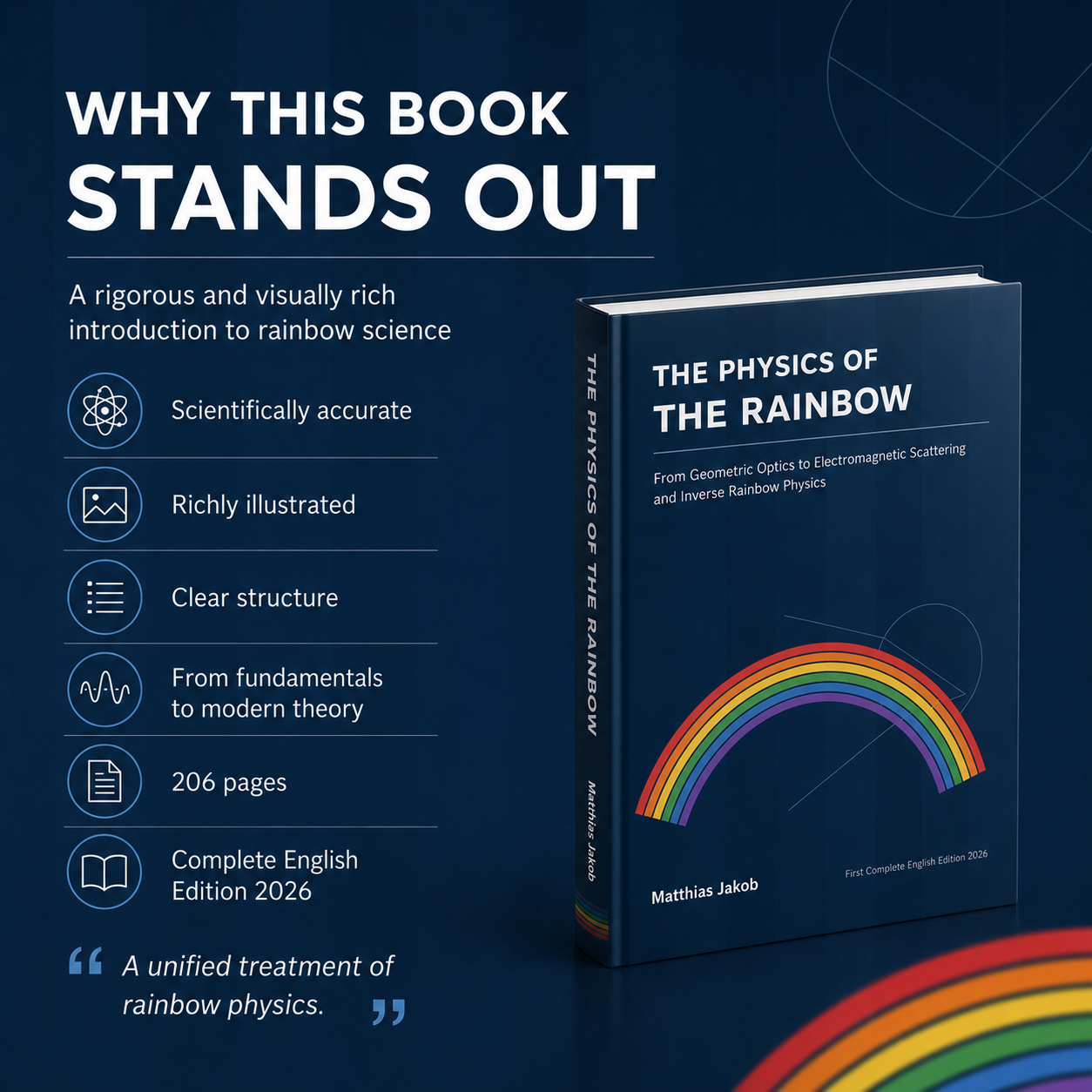
The rainbow is one of nature's most familiar optical phenomena, yet its complete physical description connects an unusually broad range of ideas: geometrical ray optics, caustics, wave interference, electromagnetic scattering, polarization, numerical modeling, inverse problems, atmospheric physics, and experimental measurement.
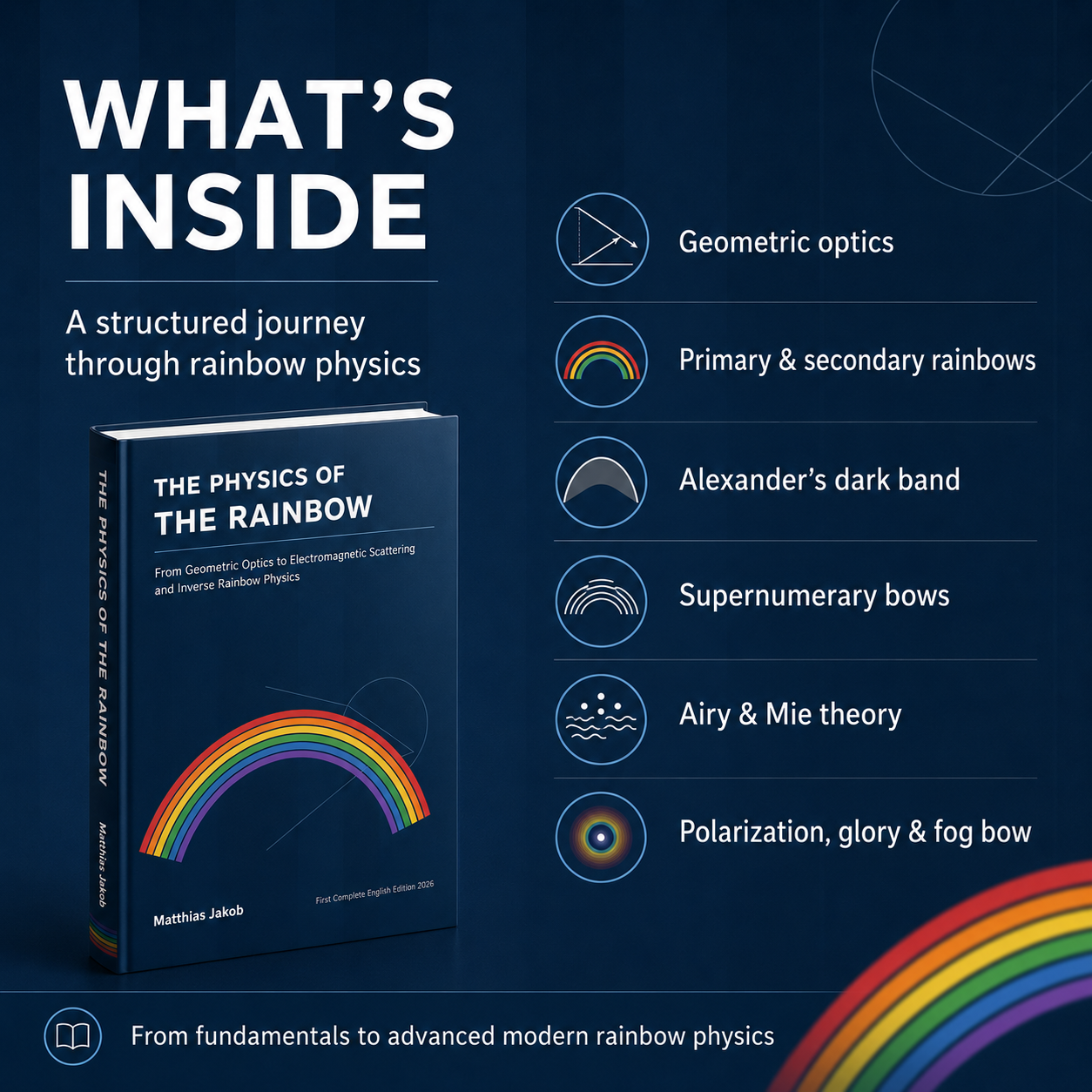
The Physics of the Rainbow develops these connections step by step. Beginning with the geometry of primary and secondary rainbows, it derives the stationary deflection condition and explains Alexander's dark band and the observed color order. The discussion then moves beyond geometrical optics to Airy theory and supernumerary bows, followed by a systematic introduction to Lorenz-Mie theory, Debye expansions, semiclassical methods, and complex-angular-momentum ideas.
The book also treats realistic rainbow observation and reconstruction. It develops polychromatic color synthesis, atmospheric extinction and background models, camera-based inversion, Bayesian uncertainty analysis, nonspherical raindrops, polarization, laboratory experiments, and quantitative image analysis. A large final section places the rainbow within the broader family of atmospheric optical phenomena, including fogbows, moonbows, glories, coronae, halos, mirages, twilight effects, and polarimetric signatures.
The emphasis throughout is not only on equations, but on model hierarchy: what each approximation explains, where it breaks down, how numerical and experimental results should be compared, and what physical information can be reconstructed from measured rainbow structure.
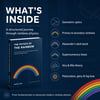
KEY TOPICS
- Primary and secondary rainbow geometry
- Dispersion and Alexander's dark band
- Caustics and Airy theory
- Supernumerary bows
- Lorenz-Mie electromagnetic scattering
- Debye and semiclassical descriptions
- Polarization and Fresnel physics
- Numerical rainbow synthesis and colorimetry
- Inverse rainbow optics and microphysical retrieval
- Camera calibration and uncertainty analysis
- Nonspherical raindrops
- Laboratory and observational methods
- Fogbows, glories, coronae, halos, mirages, and related atmospheric optics
WHO THIS BOOK IS FOR
Physics teachers, university students, researchers, advanced learners, and scientifically curious readers who want a mathematically serious but physically connected treatment of the rainbow.
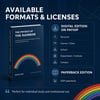
DIGITAL EDITION
First Complete English Edition 2026
206 pages | A4 PDF | Full-color scientific figures
LICENSE
Choose the license that matches your intended use. The purchased license variant and the supplied LICENSE.pdf determine the permitted scope of use.