

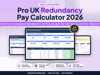







Pro UK Redundancy Pay Calculator
You have to make roles redundant. Who qualifies, how many weeks does each person get, which weekly cap applies, what is the notice and holiday pay, and how much is tax-free? Get one figure wrong and you either overpay or face a claim. This calculator works it all out for every employee, with the April 2026 caps built in.
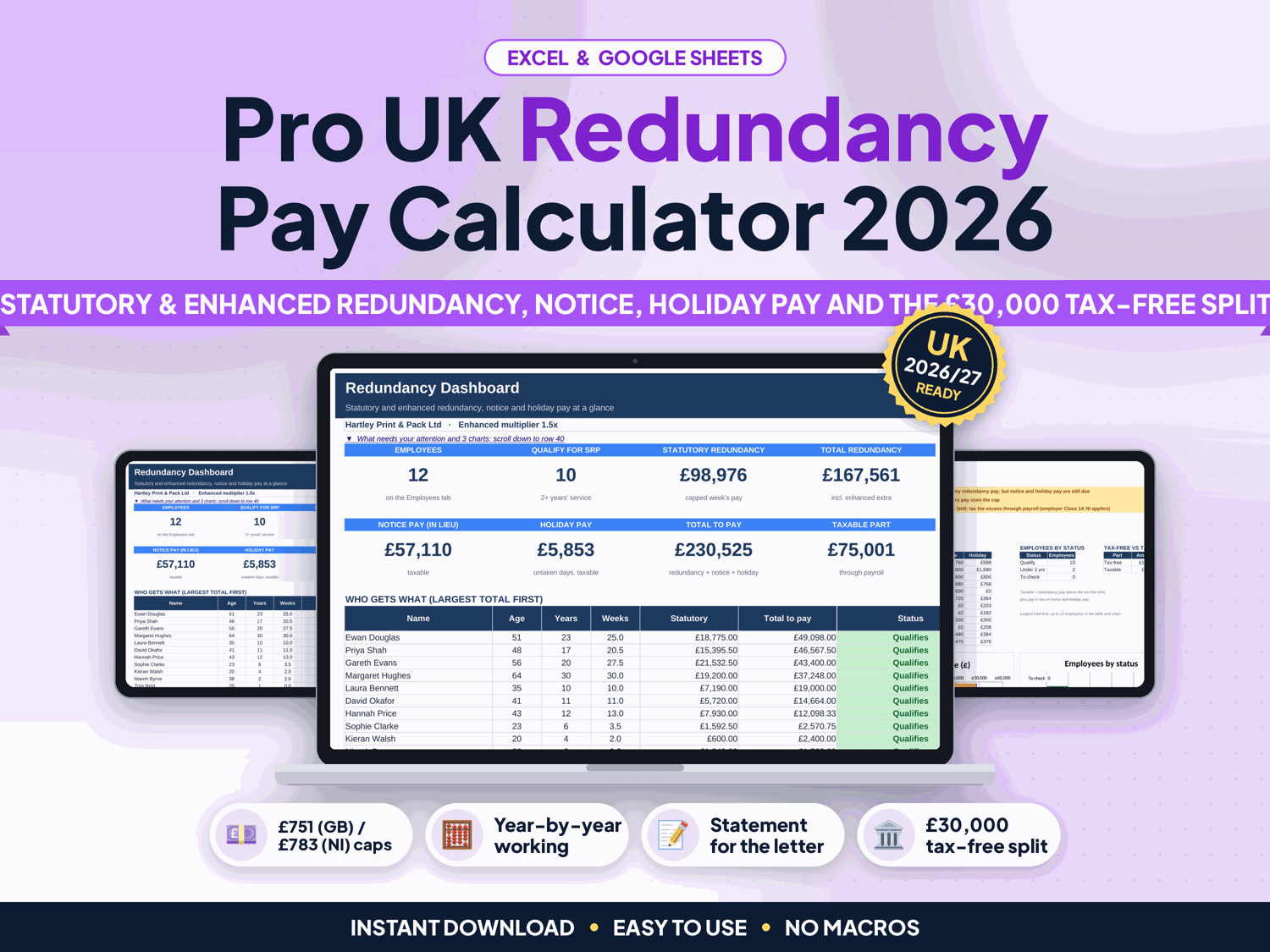
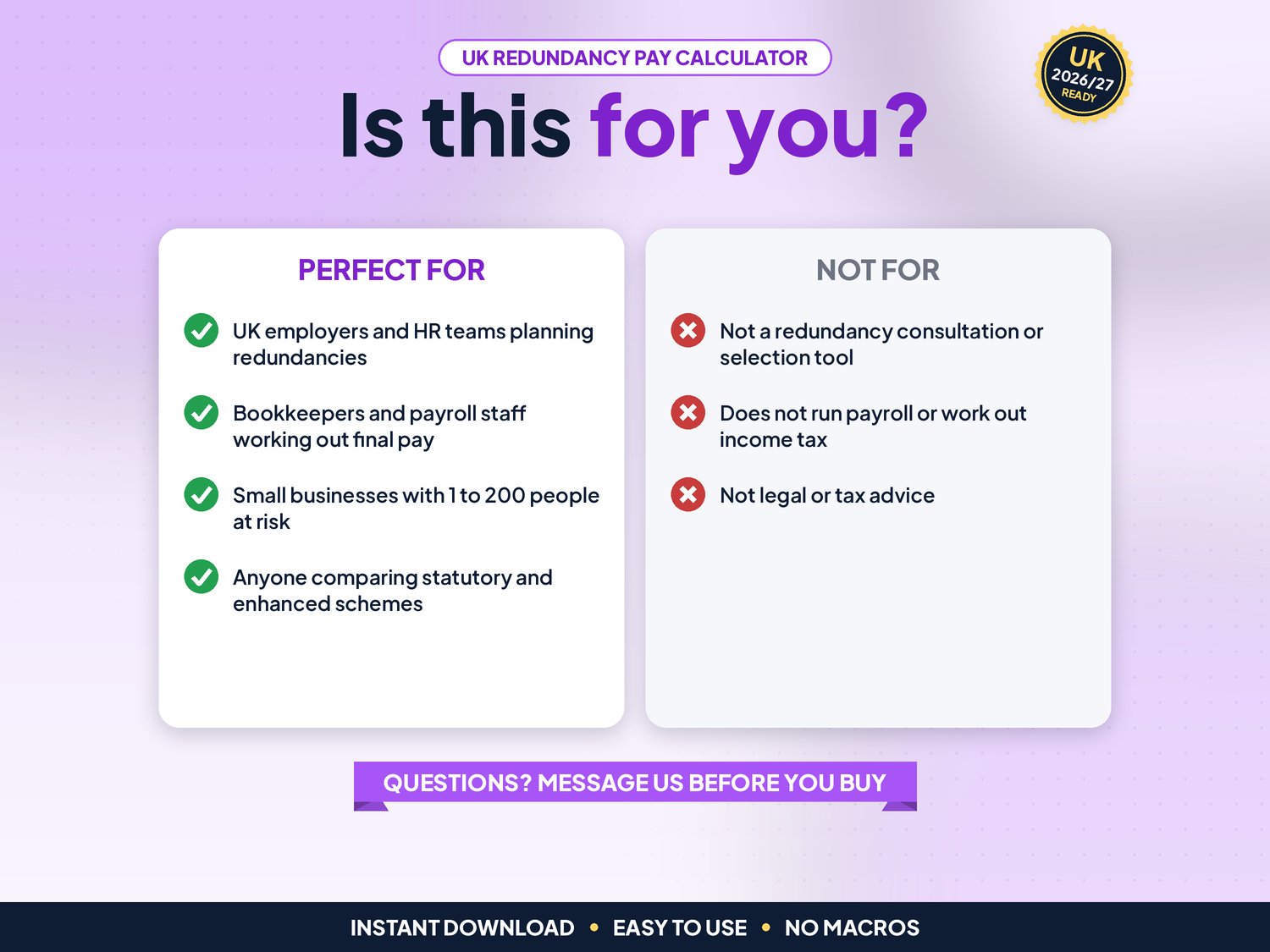
Made for UK employers, HR teams, bookkeepers and payroll staff. Add each person once and see statutory redundancy pay, your enhanced scheme, pay in lieu of notice, untaken holiday and the tax-free and taxable parts, plus a printable statement for each redundancy letter.
▶ Easy Start Here guide included – video tutorial coming to our YouTube channel
Works in Microsoft Excel and Google Sheets, with no macros.
What it does for you
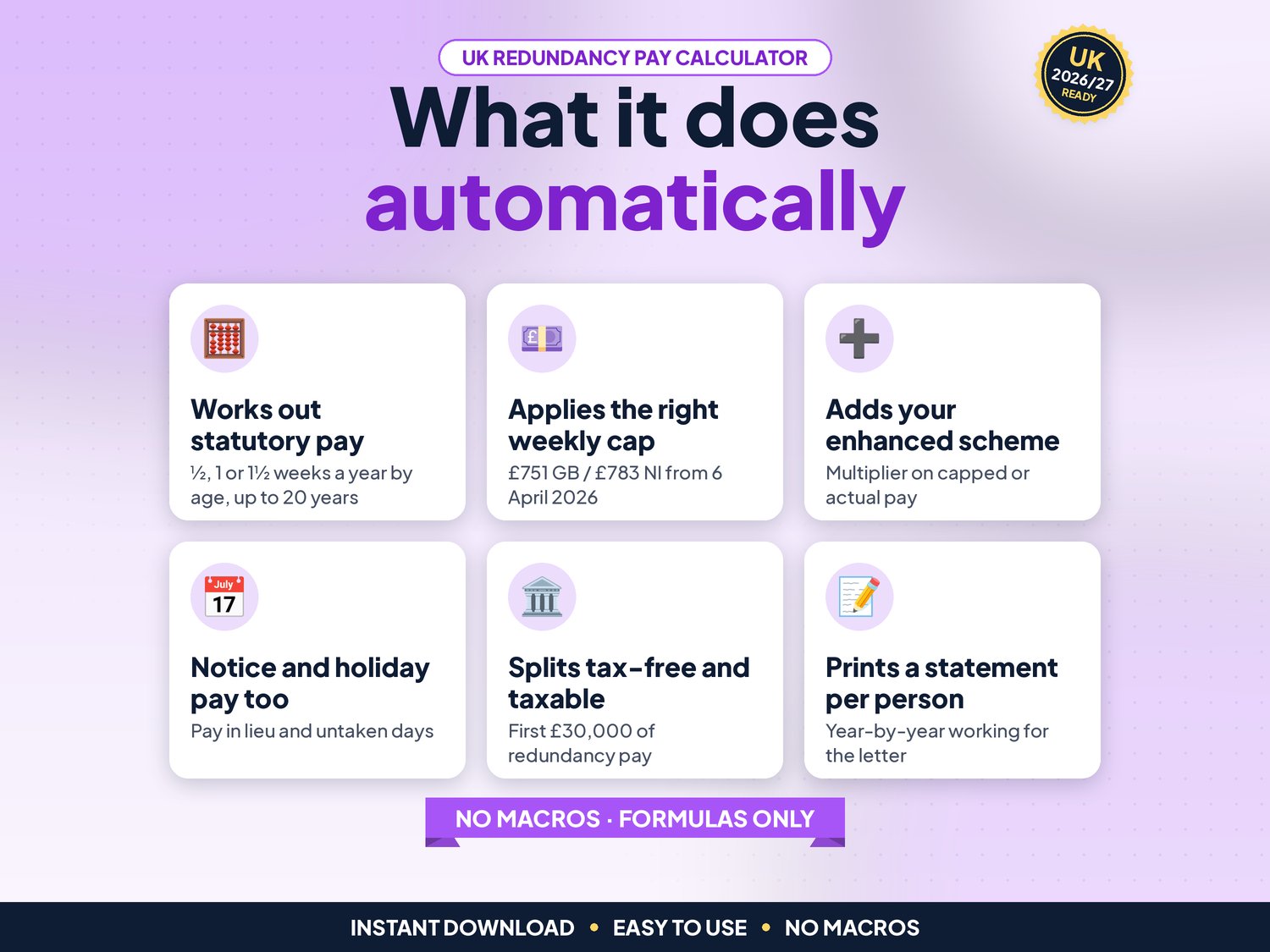
- Statutory redundancy pay for each employee: 2 full years' service needed, ½ week's pay per full year under 22, 1 week aged 22 to 40 and 1½ weeks aged 41 or older, counting back up to 20 years
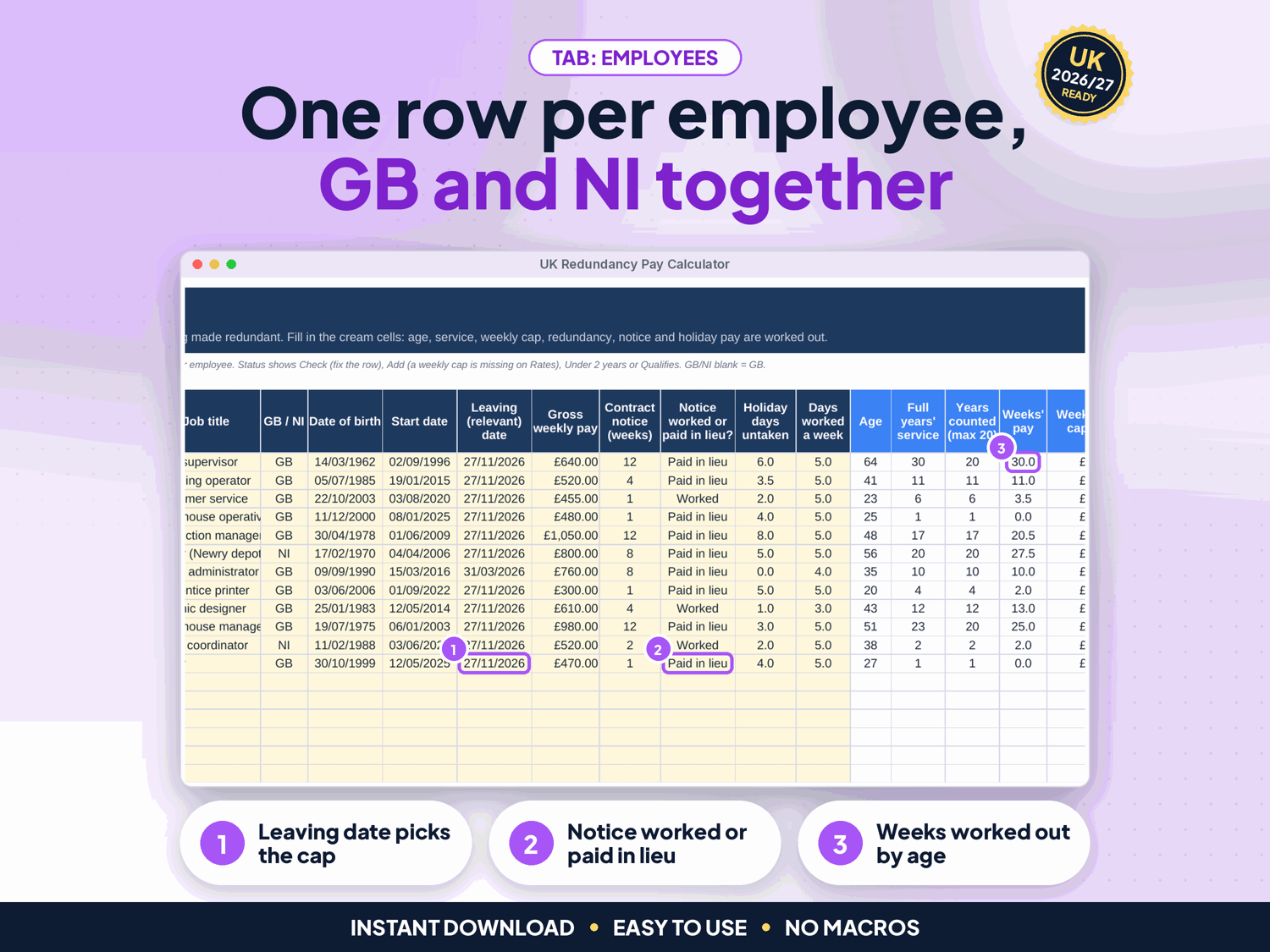
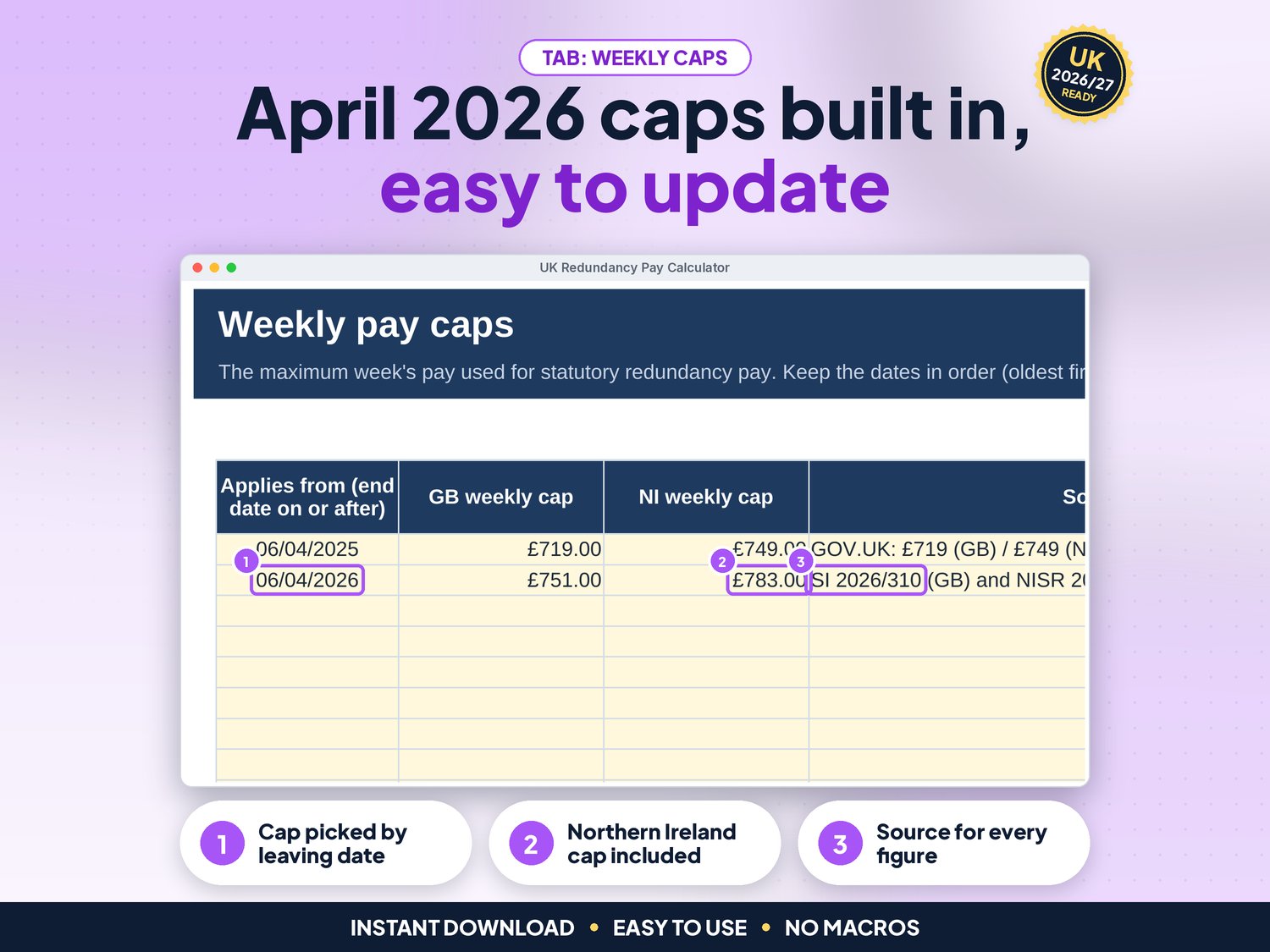
- Weekly cap picked by the leaving (relevant) date and country: £751 (GB) and £783 (Northern Ireland) from 6 April 2026, £719 / £749 before. Add next April's caps on the Rates tab
- Optional enhanced scheme: multiply the statutory weeks (e.g. 1.5x or 2x) on capped or actual pay
- Notice: statutory minimum or longer contract notice, worked or paid in lieu, plus pay for untaken holiday
- Tax split: the first £30,000 of redundancy pay (statutory plus enhanced) shown as usually tax-free; notice and holiday pay shown as taxable through payroll
- Clear Check messages for text in a date or pay cell, leaving dates with no cap on the Rates tab, a Rates tab out of order and missing details
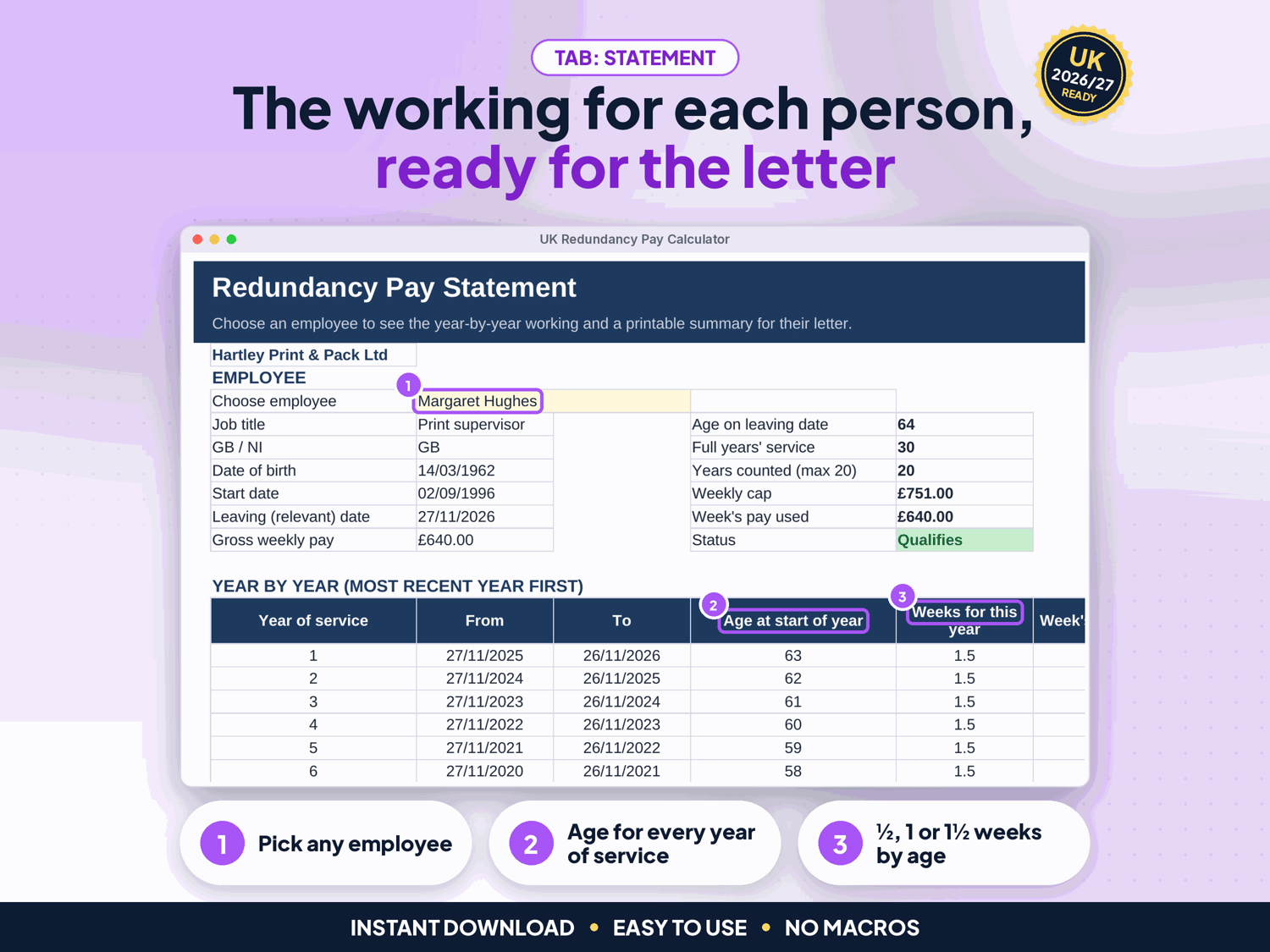
- Redundancy Pay Statement: pick an employee for the year-by-year working (age, weeks per year, week's pay) and a summary for their redundancy letter
- Dashboard: totals, who gets what (largest first), a "What needs your attention" list (under 2 years, above the cap, above the tax-free limit) and 3 charts
- Up to 200 employees, GB and Northern Ireland in the same file
How it works (3 steps)
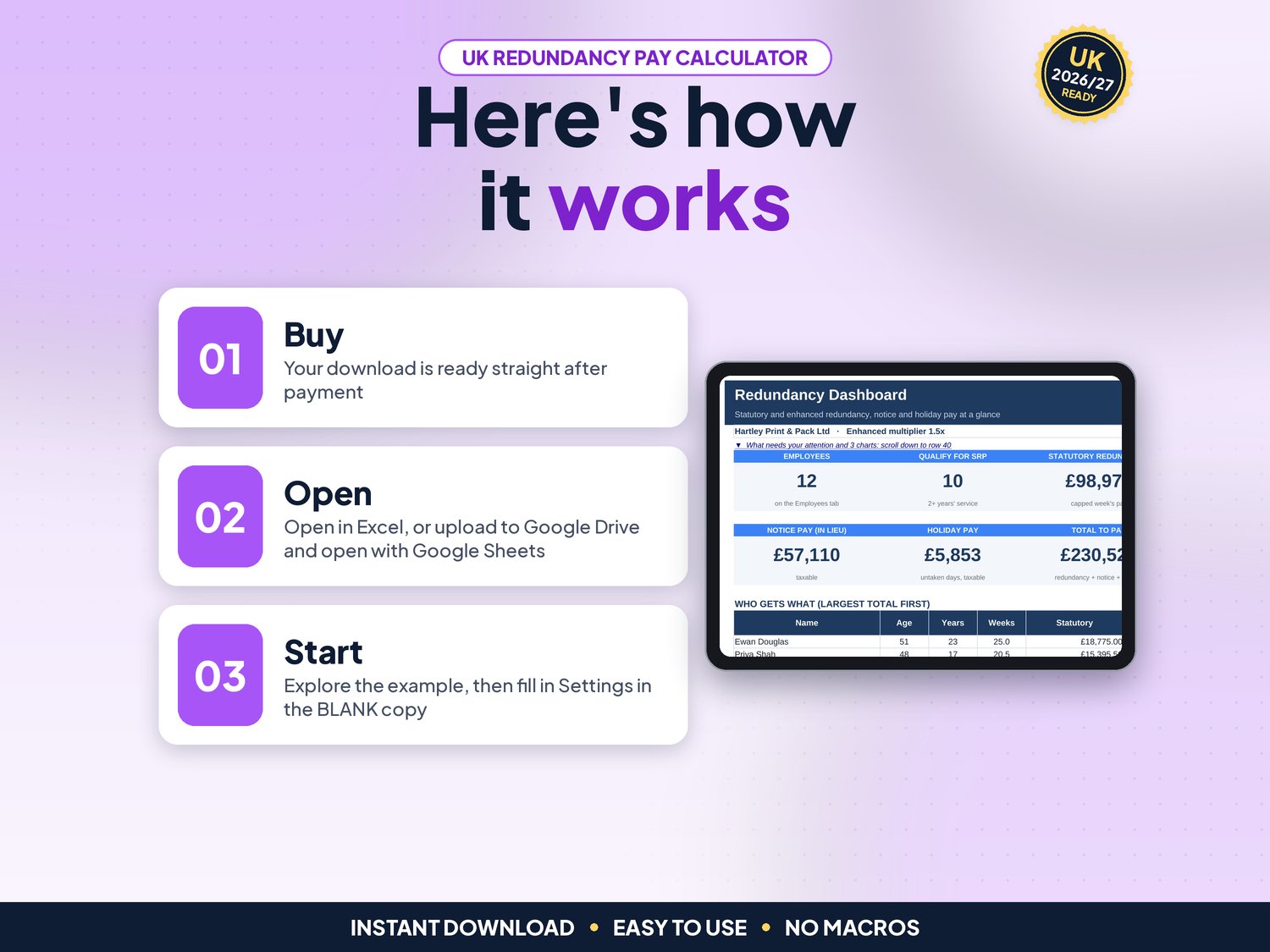
- Set up once: your business name, any enhanced scheme and the tax-free limit on Settings (about 2 minutes)
- Add each employee: date of birth, start and leaving date, average weekly pay, notice and untaken holiday
- Check and pay: read the Dashboard, fix anything flagged, then print the Statement for each employee
What's included
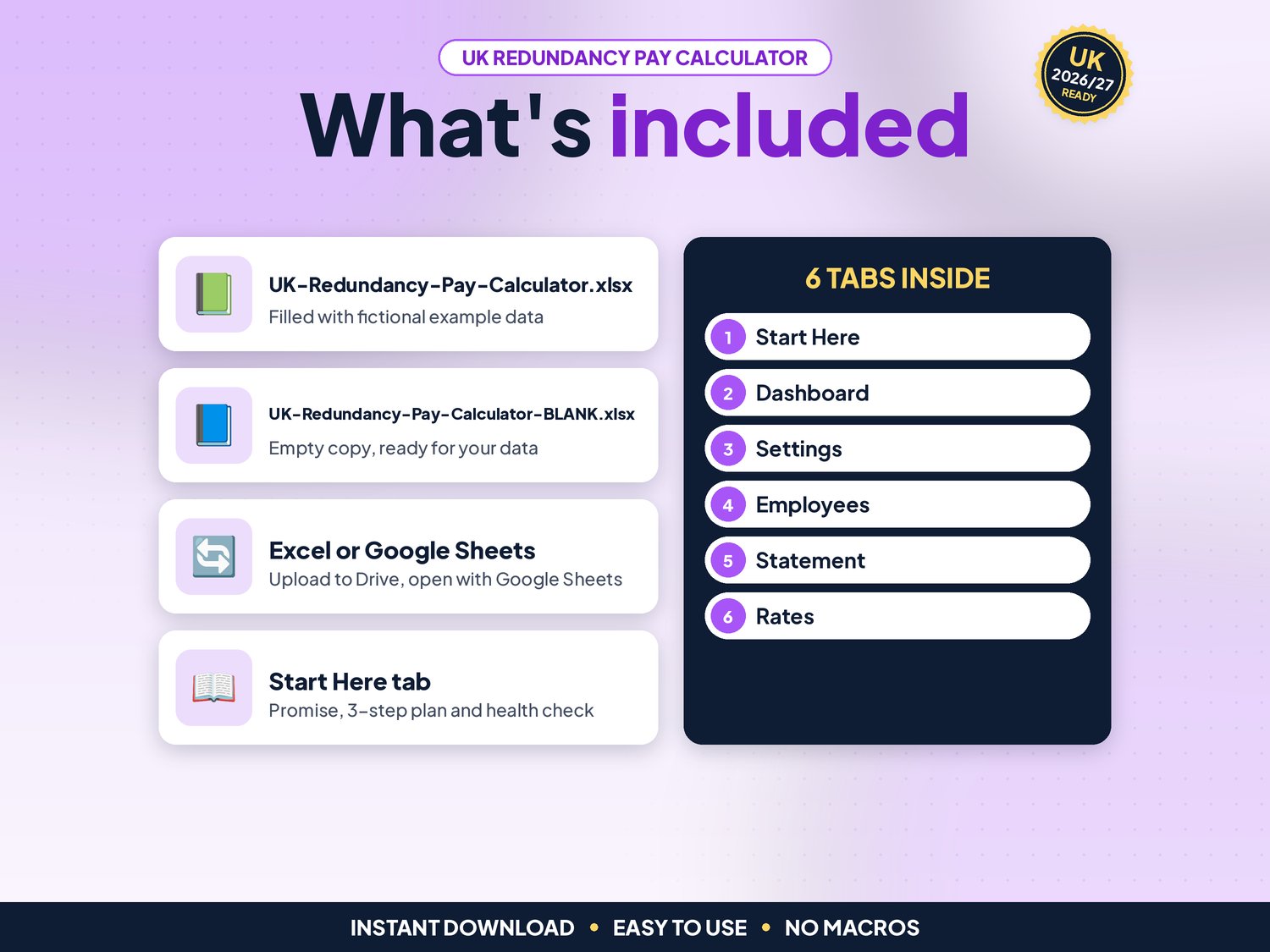
- UK-Redundancy-Pay-Calculator.xlsx: filled with fictional example data (12 employees, GB and NI) so you can see how it works
- UK-Redundancy-Pay-Calculator-BLANK.xlsx: an empty copy, ready for your own team
- Works in Google Sheets: upload the .xlsx to Google Drive, right-click > Open with > Google Sheets, then File > Save as Google Sheets (tested: formulas and charts kept)
- Start-here.pdf: one-page quick-start guide, including how to open it in Google Sheets
Compatibility
- Microsoft Excel 2010 or newer (Windows & Mac) and Microsoft 365
- Google Sheets (free Google account). Set File > Settings > Locale to United Kingdom for £ and UK dates
- Not designed for Apple Numbers or mobile-only editing. A computer is recommended
- No macros, add-ons or subscriptions
Instant download
This is a digital product. Nothing physical will be shipped. Your download link appears straight after checkout and is also emailed to you. Stuck or have a question? Email info@phkmedia.co.uk and I'll gladly help you set it up.
Good to know
- Cream (pale yellow) cells are for your input. White and grey cells are worked out for you, and the sheets are protected (no password) so formulas are not overwritten by mistake
- A Health check on the Start Here tab and a Check/Status column on every log flag missing or odd entries
- Rules follow GOV.UK 'Redundancy: your rights' (pay, notice periods, tax), re-checked on 02/11/2026. Caps from The Employment Rights (Increase of Limits) Order 2026 (SI 2026/310) and the Northern Ireland Order 2026 (NISR 2026/57)
- Week's pay is the average over the 12 weeks before notice is given; enter it yourself. Part-week, shift and variable pay averaging is not worked out for you
- Statutory notice: at least 1 week after 1 month, then 1 week for each full year from 2 years, up to 12 weeks. The contract can give more
- Tax: the first £30,000 of redundancy pay is usually tax-free; the employer pays Class 1A National Insurance on any excess. Pay in lieu of notice, holiday pay, wages and bonuses are taxed as normal pay. Post-employment notice pay (PENP) is not split out
- Dates show as DD/MM/YYYY
- FAQ: Does it handle employees in Northern Ireland? Yes. Pick NI on the row and the NI cap is used
- FAQ: Will it work next April? Yes. Add the new caps as a row on the Rates tab; older leaving dates keep the old caps. Free updates are sent when the caps change
DISCLAIMER
This calculator is a calculation aid, not legal or tax advice. Check GOV.UK, Acas or HMRC, or take advice, for unusual cases such as variable pay, fixed-term contracts, insolvency or settlement agreements. All names and figures in the example file are fictional.
Licence: Licensed for use within one business. Please do not resell, share or redistribute the files.
AI disclosure: This template and its listing images were designed by PHK MEDIA LTD with the help of AI tools. All formulas were tested and the files were reviewed and finalised by the seller.
© PHK MEDIA LTD
Licence: Licensed for use within one business or household. You may edit and print the files for that business. You may not resell, share or upload them for others.