
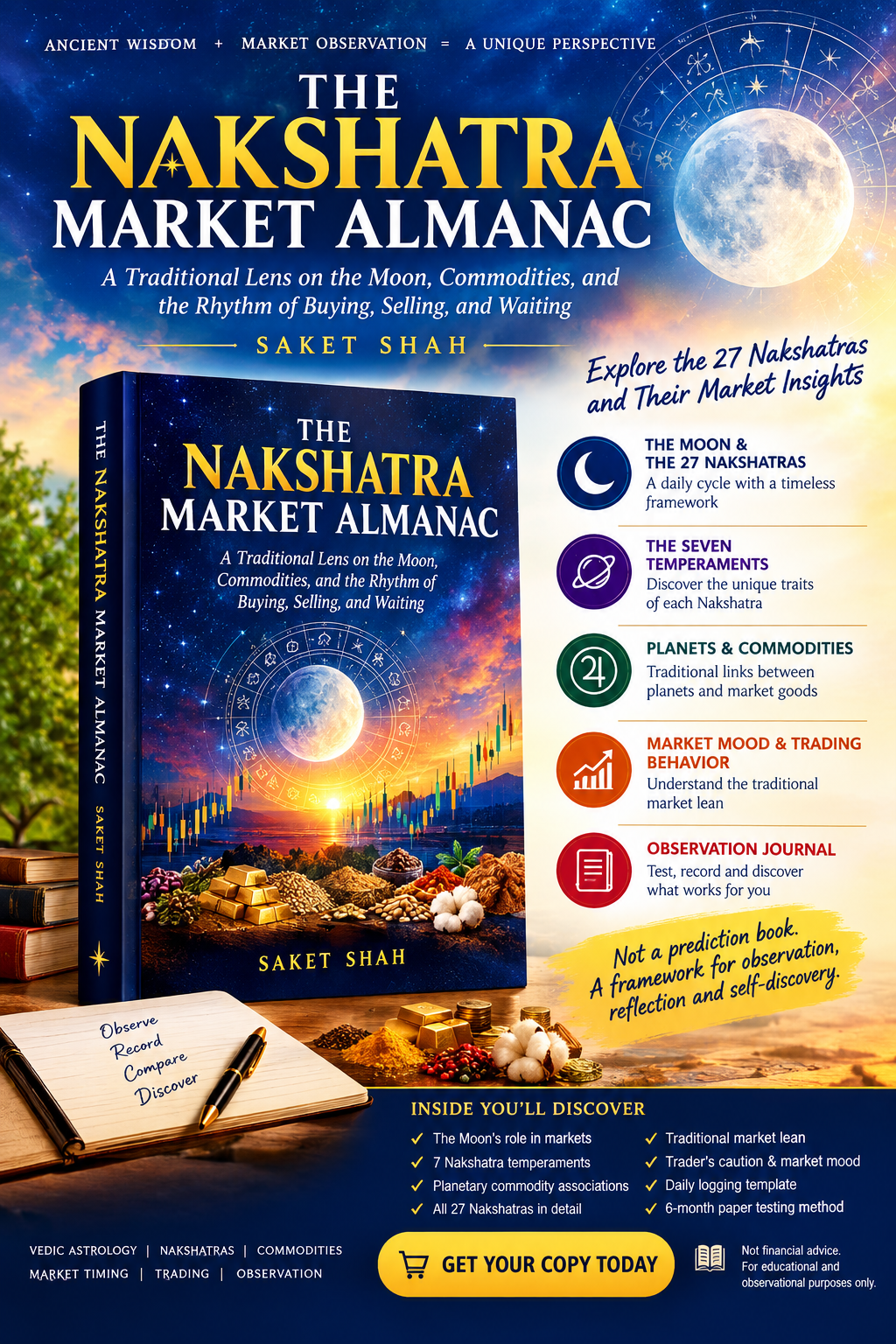
THE NAKSHATRA MARKET ALMANAC A Traditional Lens on the Moon, Commodities, and the Rhythm of Buying, Selling, and Waiting
THE NAKSHATRA MARKET ALMANAC
A Traditional Lens on the Moon, Commodities, and the Rhythm of Buying, Selling, and Waiting
By Saket Shah
What if the ancient 27-Nakshatra cycle could become a structured framework for observing market timing, commodities, trading behavior, and your own decision-making?
Markets move through periods of activity, hesitation, momentum, uncertainty, accumulation, and waiting.
Traditional Indian astrology offers another way of looking at these rhythms: through the Moon's movement across the 27 Nakshatras.
The Nakshatra Market Almanac explores this traditional framework and organizes it into a practical, easy-to-reference system for readers interested in Vedic astrology, Muhurta, market symbolism, commodities, trading psychology, and disciplined observation.
🌙 EXPLORE THE 27-NAKSHATRA MARKET CYCLE
The Moon moves through all 27 Nakshatras in approximately 27.3 days, spending roughly a day in each.
This creates a fascinating daily rhythm.
Instead of treating every market day as identical, this book presents a traditional framework for asking:
- What is the Moon's Nakshatra today?
- What temperament is associated with that Nakshatra?
- Is the traditional tendency toward accumulation, activity, negotiation, buying, waiting, or closing?
- Which commodities are traditionally associated with its planetary ruler?
- What actually happened in the market?
- Did the traditional lens add anything useful—or was the apparent pattern simply coincidence?
The book encourages observation before belief.
🔭 WHY THE MOON?
In Vedic astrology, the Moon is traditionally associated with the mind, mood, appetite, and public sentiment.
Markets are ultimately made of people.
The book therefore explores the traditional reasoning behind watching the Moon as a possible daily observational lens for market behavior.
The Moon's rapid movement through the Nakshatras makes this framework fundamentally different from slower astrological cycles.
It creates a daily 27-part rhythm that can be observed, recorded, compared, and tested.
⭐ THE SEVEN NAKSHATRA TEMPERAMENTS
A central feature of the book is its organization of the Nakshatras into seven traditional temperaments.
DHruva — Fixed
Associated with stability, endurance, long-term purchases, accumulation, and holding.
Chara — Movable
Associated traditionally with movement, turnover, travel, and active dealing.
Kshipra — Swift
Associated with commerce, quick decisions, and starting trade.
Mridu — Soft
Associated with negotiation, partnerships, cooperation, and measured buying.
Mishra — Mixed
A combination of tendencies where the traditional approach favors caution and avoiding an overly strong stance.
Ugra — Fierce
Traditionally associated with intensity and a tendency toward waiting rather than beginning gentle, lasting ventures.
Tikshna — Sharp
Associated traditionally with cutting, severing, endings, and waiting rather than new beginnings.
This gives the reader a simple framework for understanding the traditional temperament behind each Nakshatra.
🪐 PLANETS, NAKSHATRAS & COMMODITIES
The book also explores traditional planetary associations with categories of goods.
Among the associations discussed are:
Sun → Gold, wheat, copper, government-linked goods
Moon → Silver, rice, milk, dairy, liquids
Mars → Red lentils, copper, metals, machinery, defense-linked goods
Mercury → Green gram, spices, paper, trade and communication
Jupiter → Gold, turmeric, gram, yellow goods
Venus → Sugar, cotton, silk, luxury goods
Saturn → Iron, coal, edible oils and, in some traditions, crude oil
Rahu → Petroleum, chemicals, technology and foreign/sudden-origin goods
Ketu → Medicinal herbs, roots, pharmaceuticals and spices
These are presented as traditional associations rather than price forecasts.
📖 ALL 27 NAKSHATRAS — ORGANIZED FOR EASY REFERENCE
The Almanac takes the framework further by giving each of the 27 Nakshatras its own entry.
You will encounter:
- Ashwini
- Bharani
- Krittika
- Rohini
- Mrigashira
- Ardra
- Punarvasu
- Pushya
- Ashlesha
- Magha
- Purva Phalguni
- Uttara Phalguni
- Hasta
- Chitra
- Swati
- Vishakha
- Anuradha
- Jyeshtha
- Mula
- Purva Ashadha
- Uttara Ashadha
- Shravana
- Dhanishta
- Shatabhisha
- Purva Bhadrapada
- Uttara Bhadrapada
- Revati
Each entry connects the Nakshatra with its ruling planet, traditional temperament, traditional market lean, themed goods, market mood, trader's caution, and a logging prompt.
For example, Ashwini is presented as Ketu-ruled and Kshipra, with a traditional lean toward quick decisions and buying, while Rohini is Moon-ruled and Dhruva, with a traditional lean toward accumulation and holding.
🧭 TURN ASTROLOGY INTO AN OBSERVATION JOURNAL
One of the most useful ideas in this book is not simply believing the traditional framework.
It is testing it.
The book recommends recording:
- The Moon's Nakshatra
- Its traditional temperament
- The traditional lean
- What the market actually did
- What you expected
- What really happened
It specifically encourages readers to record the days when the traditional lean was wrong, rather than remembering only successful examples.
That makes the Almanac useful not only as an astrology reference, but also as a structured observation and journaling framework.
📊 PAPER FIRST. DATA FIRST. MONEY LAST.
The book takes a deliberately cautious approach.
Its suggested method is to test the framework on paper for at least six months before risking real money.
You can compare the traditional lens against a simple baseline and ask whether any apparent pattern is genuinely meaningful or could simply be luck.
The book also highlights an important distinction:
Did the Moon help—or did the act of pausing and becoming more disciplined help?
That question makes the Almanac as much about self-observation and trading behavior as it is about astrology.
🎯 WHO IS THIS BOOK FOR?
This Almanac may appeal to:
🔹 Vedic Astrology Students
Readers interested in Nakshatras, planetary rulerships, Muhurta, and traditional classifications.
🔹 Astrology & Market Enthusiasts
Readers curious about the historical intersection of astrology and markets.
🔹 Commodity Researchers
Readers interested in traditional associations between planets, Nakshatras, and commodity categories.
🔹 Traders Interested in Journaling
Anyone who wants a structured way to observe timing, behavior, expectations, and outcomes.
🔹 Students of Traditional Indian Astrology
A compact reference for exploring the 27 Nakshatra cycle through a specific traditional lens.
🔹 Skeptical Experimenters
Readers who do not want to simply accept a claim—but would rather record observations and examine the results themselves.
⚡ WHAT MAKES THIS ALMANAC DIFFERENT?
This is not presented as a magical prediction system.
It does not promise guaranteed market calls.
It does not claim that an astrological configuration can eliminate market risk.
Instead, it presents a traditional framework and asks you to observe, record, compare, and test.
That distinction is fundamental to the book.
📝 A PRACTICAL DAILY FRAMEWORK
The book's structure makes it possible to create a simple daily routine:
1. Find today's Moon Nakshatra
Use a Panchang or ephemeris.
2. Identify the Nakshatra's temperament
Fixed? Movable? Swift? Soft? Mixed? Fierce? Sharp?
3. Identify the ruling planet
Then review the traditional commodity associations.
4. Read the traditional lean
Buying? Holding? Trading? Negotiating? Waiting? Closing?
5. Record your expectation
Write it down before watching the market.
6. Record what actually happened
Do not edit the record afterward.
7. Review the data over time
Look for patterns—but remain aware that small samples can easily create misleading impressions.
🌟 A 27-DAY JOURNEY THROUGH TRADITIONAL MARKET SYMBOLISM
From Ashwini to Revati, the book takes you through the complete Nakshatra cycle.
You will explore traditional themes involving:
🌙 Moon symbolism
⭐ 27 Nakshatras
🪐 Planetary rulership
📈 Market mood
🛒 Buying and selling symbolism
🧺 Commodity associations
📊 Trading behavior
📝 Observation and logging
⏳ Timing and waiting
🔍 Testing and comparison
It is designed as a reference that you can return to repeatedly as the Moon moves through the Nakshatra cycle.
💡 USE IT AS A LENS—NOT A GUARANTEE
The book's most important message is one of restraint.
There is no established evidence that the Moon's Nakshatra predicts price movements.
This Almanac therefore presents the material as cultural and historical material and as a framework that readers can observe and test for themselves.
For actual financial decisions, readers should use appropriate professional advice and independent financial analysis.
📚 WHAT YOU'LL GET
Inside this 40-page Almanac:
✅ Introduction to the Moon as a traditional market lens
✅ The seven Nakshatra temperaments
✅ Traditional planetary commodity associations
✅ Individual reference pages for all 27 Nakshatras
✅ Traditional market lean for each Nakshatra
✅ Market mood themes
✅ Trader's caution for every Nakshatra
✅ Daily logging prompts
✅ A six-month paper-testing framework
✅ A method for comparing results with chance
✅ Guidance on separating market effects from personal behavior
✅ A thoughtful afterword on using the Nakshatra calendar as a rhythm for attention
🌌 THE NAKSHATRA MARKET ALMANAC
Ancient timing traditions meet modern observation.
Explore the 27 Nakshatras.
Study their traditional temperaments.
Follow their planetary associations.
Observe the market.
Keep a record.
Test the idea.
And discover whether this traditional lens teaches you something about the market—or something about yourself.
GET YOUR COPY TODAY
The Nakshatra Market Almanac
By Saket Shah
A traditional lens on the Moon, commodities, and the rhythm of buying, selling, and waiting.
SEO KEYWORDS
Nakshatra Market Almanac, Vedic astrology and stock market, astrology and trading, Nakshatra trading, Vedic astrology market timing, Moon Nakshatra, 27 Nakshatras, Nakshatra astrology, Muhurta astrology, financial astrology, commodity astrology, astrology and commodities, Vedic market astrology, Indian astrology trading, Moon cycle trading, planetary commodity associations, Nakshatra market timing, Hindu astrology, Jyotish astrology, traditional astrology, astrology trading journal, Nakshatra calendar, Vedic astrology book, Nakshatra reference book, astrology market research, astrology and financial markets, Moon astrology, commodity market astrology, Indian astrology book, Saket Shah.
IMPORTANT NOTE
This book is educational, cultural, and observational in nature. It is not financial advice, and it does not provide recommendations to buy, sell, or hold any asset. Markets involve substantial risk, and readers should make financial decisions based on their own research and, where appropriate, advice from a licensed financial professional.