




AI Act Explained: What Every Employer and Business Must Know
Course 1 of the AI Business and Legal Academy
Author and speaker: Dr. Marlena Wach, Attorney-at-Law and Senior Legal Counsel
Format: Recorded training in English
Estimated duration: Approximately 45 minutes
Level: Introductory — no legal or technical background required
Your employees are already using AI. Does your business understand the responsibilities that come with it?
From drafting emails and reviewing contracts to screening job applications and answering customer questions, AI is becoming part of everyday business. Each use raises different questions: What information can employees share? When does an AI tool require closer scrutiny? Who is responsible for checking its results?
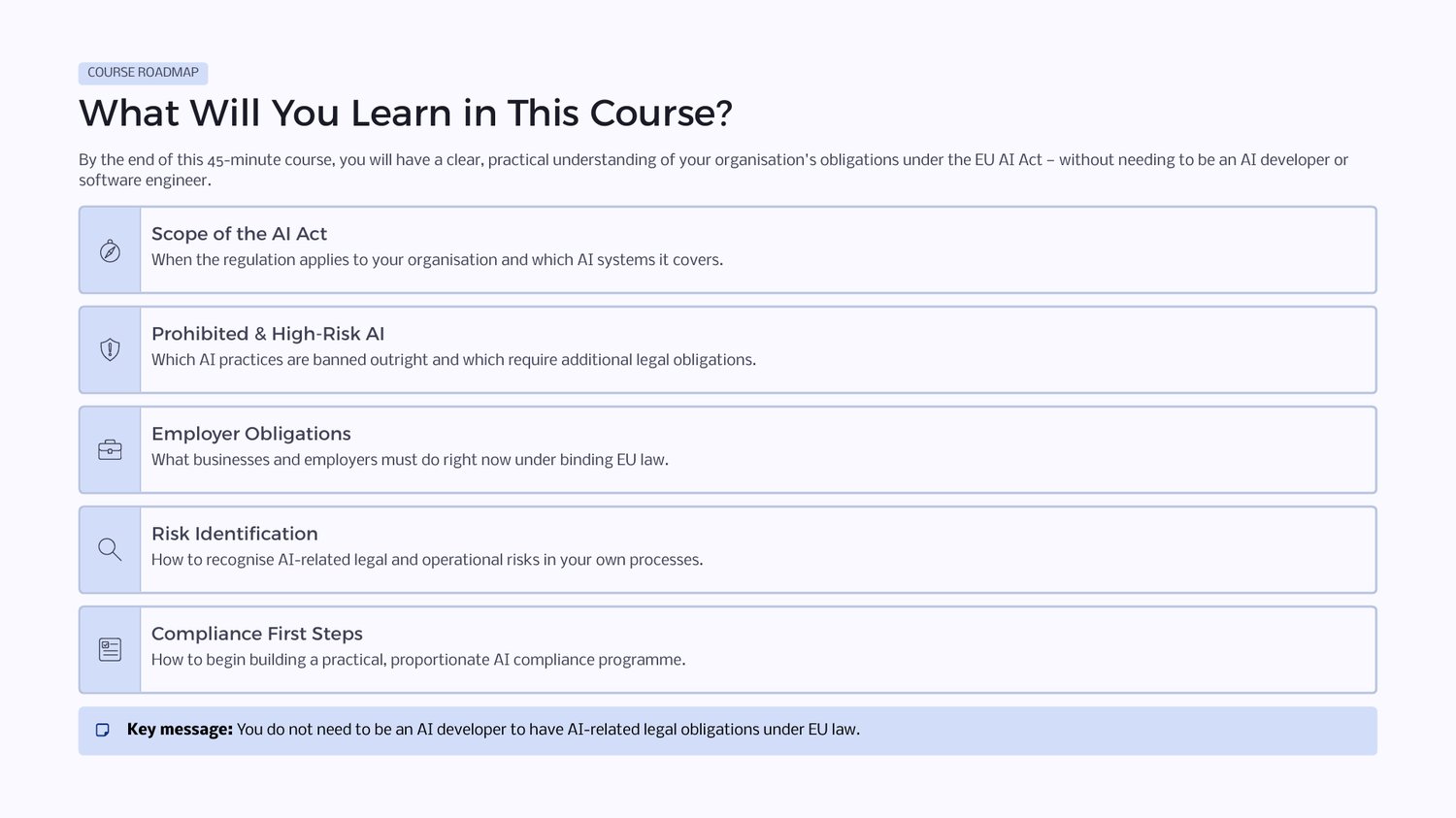
This practical introductory course explains the EU AI Act in clear, everyday English. Through familiar workplace examples, Dr. Marlena Wach helps participants understand how the regulation relates to their organisation, recognise situations that need legal or compliance review, and identify sensible first steps towards responsible AI use.
The course covers business responsibilities, prohibited and high-risk AI uses, AI literacy, transparency, data protection and supplier risks. It also explains the distinction between legal obligations, recommended organisational measures and requirements subject to implementation timelines.
Who is this course for?
This course is designed for business owners, employers, managers, HR teams, legal and compliance professionals, IT leaders, and employees using AI in their daily work. It is particularly relevant to organisations introducing AI into recruitment, marketing, customer service and office processes.
Course contents
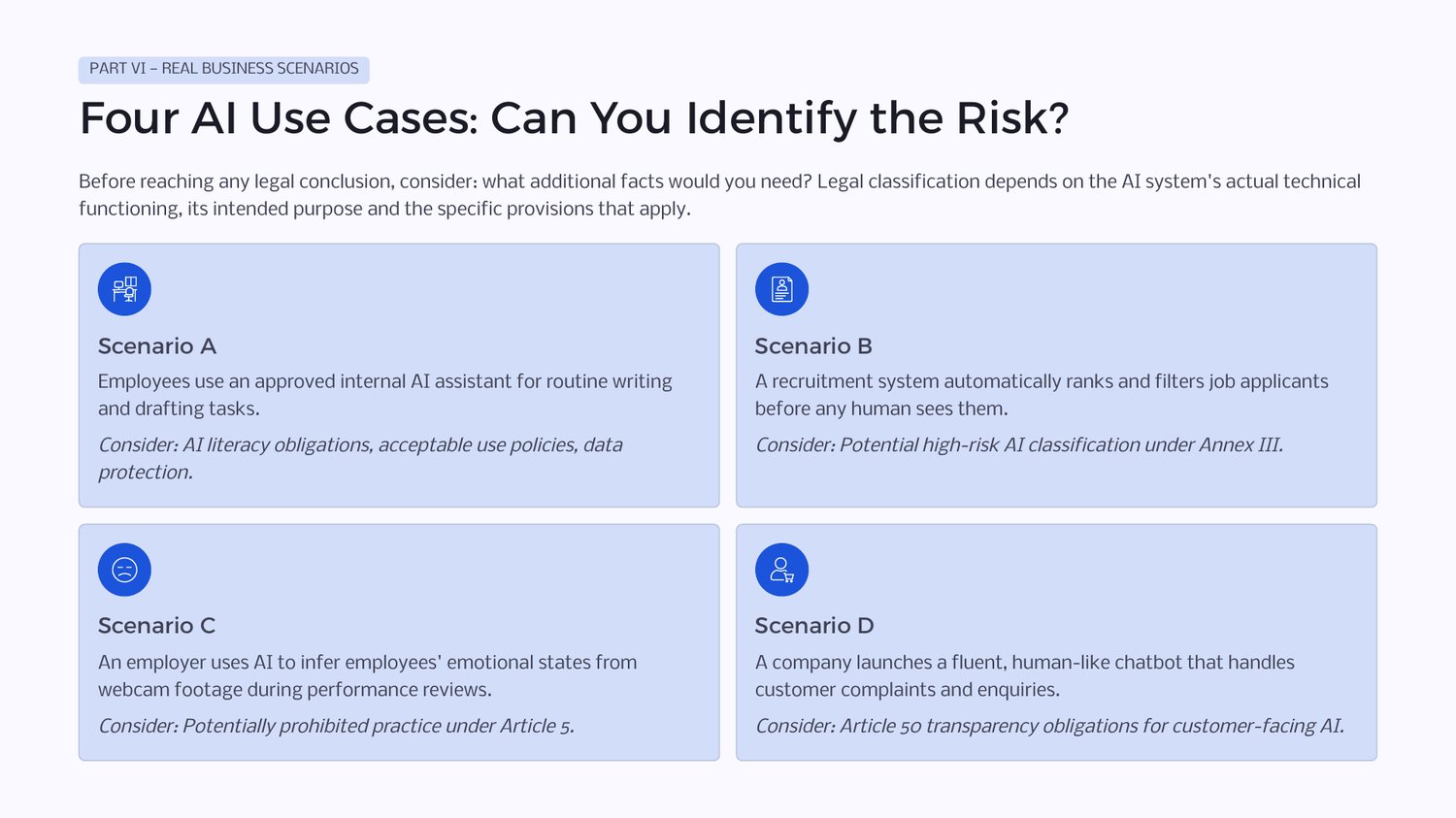
- AI in the everyday workplace: Explore common uses of AI and understand why drafting an email, ranking candidates and operating a customer chatbot raise different questions.
- What counts as an AI system? Understand the basic features of AI, how it differs from ordinary software, and why AI agents introduce additional considerations.
- Who is responsible: providers and deployers. Learn the difference between developing or supplying an AI system and using one within an organisation.
- When the EU AI Act applies. Explore how a company’s activities, customers and use of AI outputs can bring it within the regulation’s scope, including outside the EU.
- Understanding the risk-based approach. Learn how intended purpose and potential effects on people influence the assessment of an AI system.
- Prohibited AI practices. Recognise warning signs involving manipulation, social scoring, facial recognition databases and certain workplace emotion-recognition uses.
- High-risk AI and business responsibilities. Examine examples from recruitment, employment, creditworthiness and education, alongside the different responsibilities of providers and business users.
- Human oversight and AI literacy. Understand meaningful human review and the knowledge employees need to recognise mistakes, question results and seek help.
- Transparency and AI-generated content. Explore disclosure considerations for chatbots, realistic synthetic images, voices, videos and certain public-interest content.
- AI, GDPR and confidential information. Understand how personal data protection and confidentiality affect everyday AI use, including entering documents or customer information into AI tools.
- AI suppliers and third-party risks. Identify initial questions about data retention, model training, security, contracts, deletion and supplier support.
- Implementation, enforcement and practical next steps. Understand the relevance of implementation dates and enforcement, apply the course to four workplace scenarios, and explore five actions businesses can take to organise responsible AI use.
What will you learn?
By the end of the course, you will be able to:
- Explain the EU AI Act’s basic approach in straightforward business language.
- Distinguish between an AI provider and an organisation using an AI system.
- Recognise AI uses that may be prohibited or require a high-risk assessment.
- Explain why human oversight and role-appropriate AI literacy matter.
- Identify privacy, confidentiality and transparency questions before introducing an AI tool.
- Ask suppliers relevant initial questions about their products and data practices.
- Distinguish legal requirements from recommended measures and future obligations.
- Identify practical first steps for your organisation, including reviewing AI uses, assigning responsibilities, training staff and establishing clear internal rules.
Practical value
You will leave with a clearer understanding of what to check, which questions to ask and when to involve legal, privacy or compliance colleagues—helping you make more informed decisions about AI in your workplace.