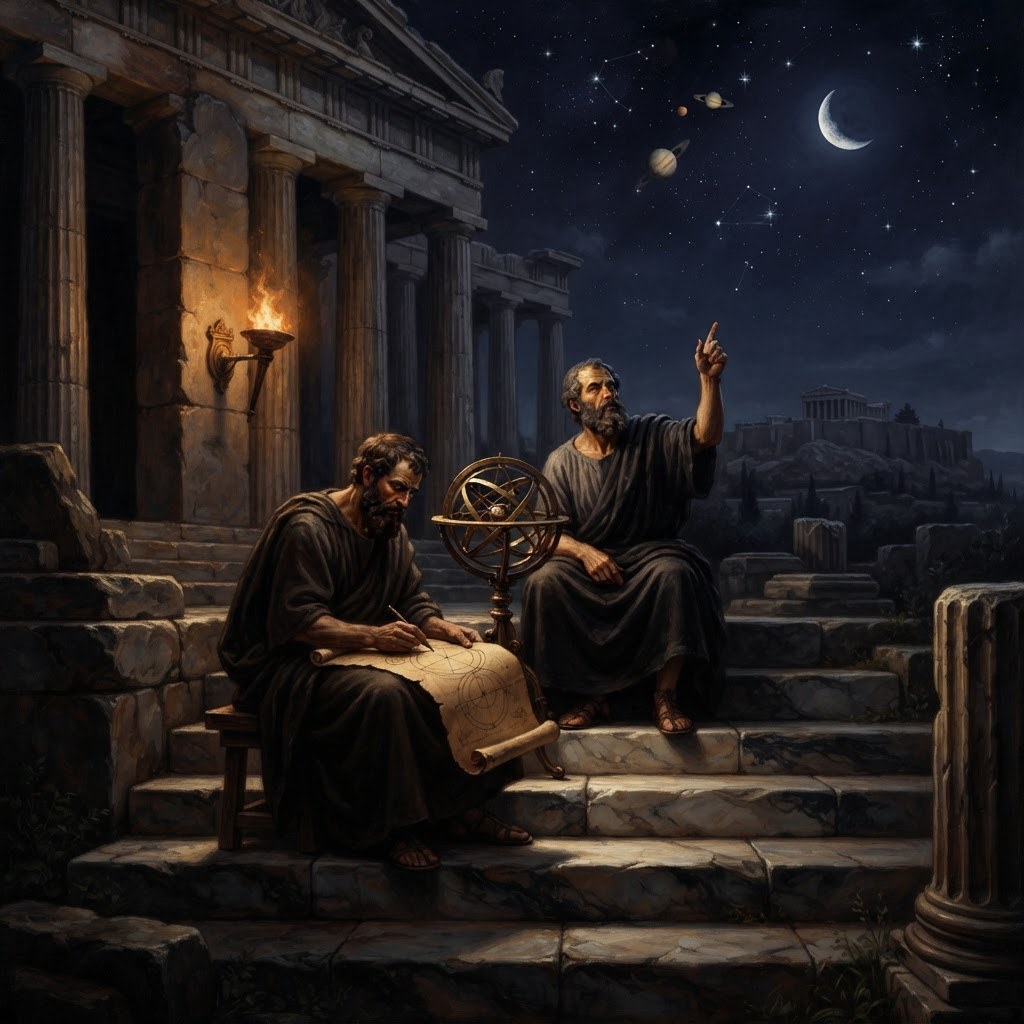
History of Astronomy: Greek Astronomy
They argued the Earth into a sphere, measured its circumference with a well and a shadow, hung the planets on interlocking crystal spheres, and then replaced the spheres with wheels within wheels that could predict the sky for centuries ahead. This volume of the History of Astronomy series tells the story of Greek astronomy whole: the merchant-philosophers of Miletus who first treated eclipses as arithmetic instead of omens, the Pythagorean faith that the heavens are number, Aristotle's two-spheres universe, Eudoxus's mathematics, Eratosthenes at Alexandria, Aristarchus's two-thousand-year-early heliocentrism, Hipparchus discovering the sky's slow wobble and cataloguing the stars, and Ptolemy's great synthesis, plus the afterlife of it all: the Babylonian inheritance, the transmission through Arabic into Latin Europe, the bronze computer pulled from the sea at Antikythera, and the star catalogue recovered from under a medieval prayer book by X-ray light. Subtitle: From Myth to Science. History of Astronomy: Greek Astronomy is part of History of Astronomy in the Aira Astralis library by Aira Astralis.