
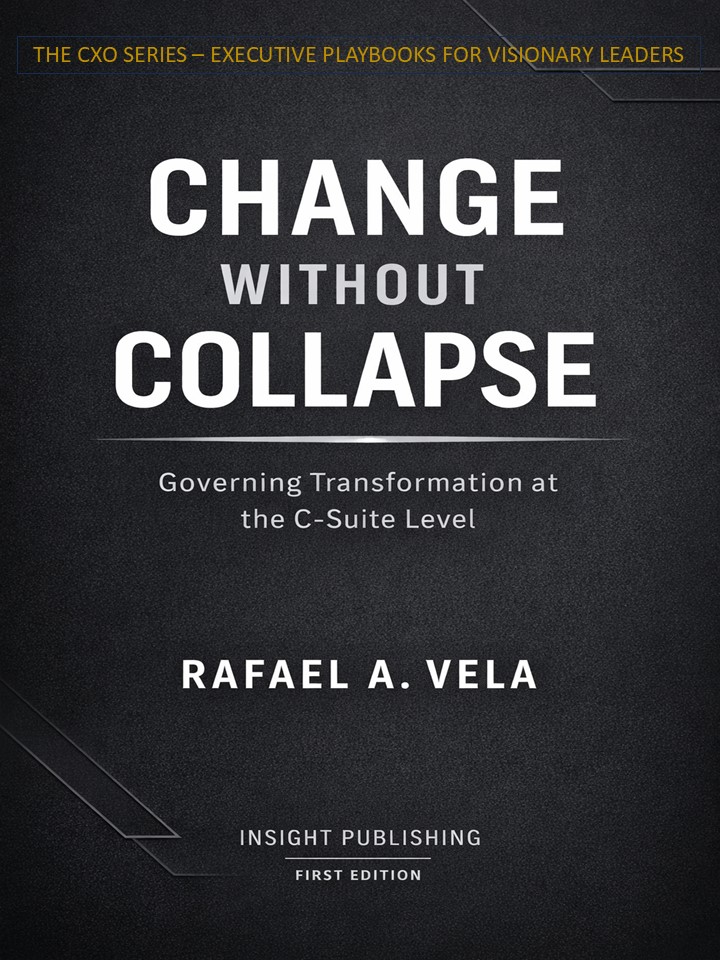
Change Without Collapse - Governing Transformation at the C-Suite Level
Most transformations fail not because leaders lack ambition, but because organizations are pushed beyond their capacity to absorb change.
Change Without Collapse reframes transformation as an executive governance responsibility. Written for the C-suite, it shows how unmanaged change behaves like unmanaged risk—and how misalignment at the top quietly destabilizes execution, culture, and trust.
You will learn how to:
• Recognize change saturation before it turns into resistance
• Govern transformation through sequencing, timing, and judgment
• Preserve organizational capacity while sustaining momentum
This is not about accelerating change. It is about governing transformation without breaking the organization.
TABLE OF CONTENTS
Part I — The Executive Reality of Change
Chapter 1 — The Myth of Infinite Organizational Capacity - 21
• Why organizations cannot absorb unlimited change - 21
• Change saturation, fatigue, and hidden resistance - 23
• The executive blind spot: mistaking compliance for adoption - 24
Chapter 2 — Change as an Executive Accountability - 27
• Why delegating change weakens executive control - 27
• Collective C-Suite responsibility versus functional ownership - 29
• When misalignment at the top destabilizes the enterprise - 30
Part II — Governing Change, Not Announcing It
Chapter 3 — Change as a Governed System - 35
• Why unmanaged change behaves like unmanaged risk - 35
• From initiatives to portfolios of change - 38
• Governance mechanisms that prevent overload - 39
Chapter 4 — Sequencing, Timing, and Executive Judgment - 43
• Why the order of change matters more than intent - 44
• Parallel versus sequential transformation - 45
• Knowing when delay is leadership, not weakness - 47
Part III — Organizational Limits and Design Choices
Chapter 5 — Structural Friction and Organizational Reality - 51
• How structure amplifies or absorbs change pressure - 51
• Centralization, decentralization, and execution stress - 55
• When operating models sabotage transformation - 58
Chapter 6 — Culture, Trust, and the Cost of Overreach - 63
• Defining Overreach in Executive Change - 63
• Why trust is consumed faster than it is rebuilt - 65
• Cultural erosion as a consequence of unmanaged change - 67
• Aligning behavior, incentives, and declared priorities - 69
Part IV — The C-Suite in Motion
Chapter 7 — Executive Alignment and Decision Discipline - 73
• Why disagreement at the top magnifies resistance below - 73
• Decision clarity versus false consensus - 75
• The role of the CEO as integrator, not hero - 77
Chapter 8 — Leading Through Resistance Without Escalation - 79
• Understanding resistance as a signal, not defiance - 79
• When pressure accelerates failure - 81
• Executive responses that stabilize rather than polarize - 82
Part V — Sustaining Transformation Without Breakdown
Chapter 9 — Measuring Adoption, Not Activity - 85
• Why milestones and dashboards lie - 85
• Indicators of real behavioral change - 88
• Knowing when change has truly taken hold - 90
Chapter 10 — The Executive Stewardship of Change - 93
• Change as a continuous leadership responsibility - 93
• Preserving organizational capacity over time - 94
• Leaving behind a stronger system, not a fatigued one - 96
Conclusion — Governing Change Before It Governs You - 98
• Appendix A: Executive Change Capacity Diagnostic - 102
• Appendix B: C-Suite Change Governance Checklist - 107
• Appendix C: Indicators of Change Saturation and Organizational Stress - 112