
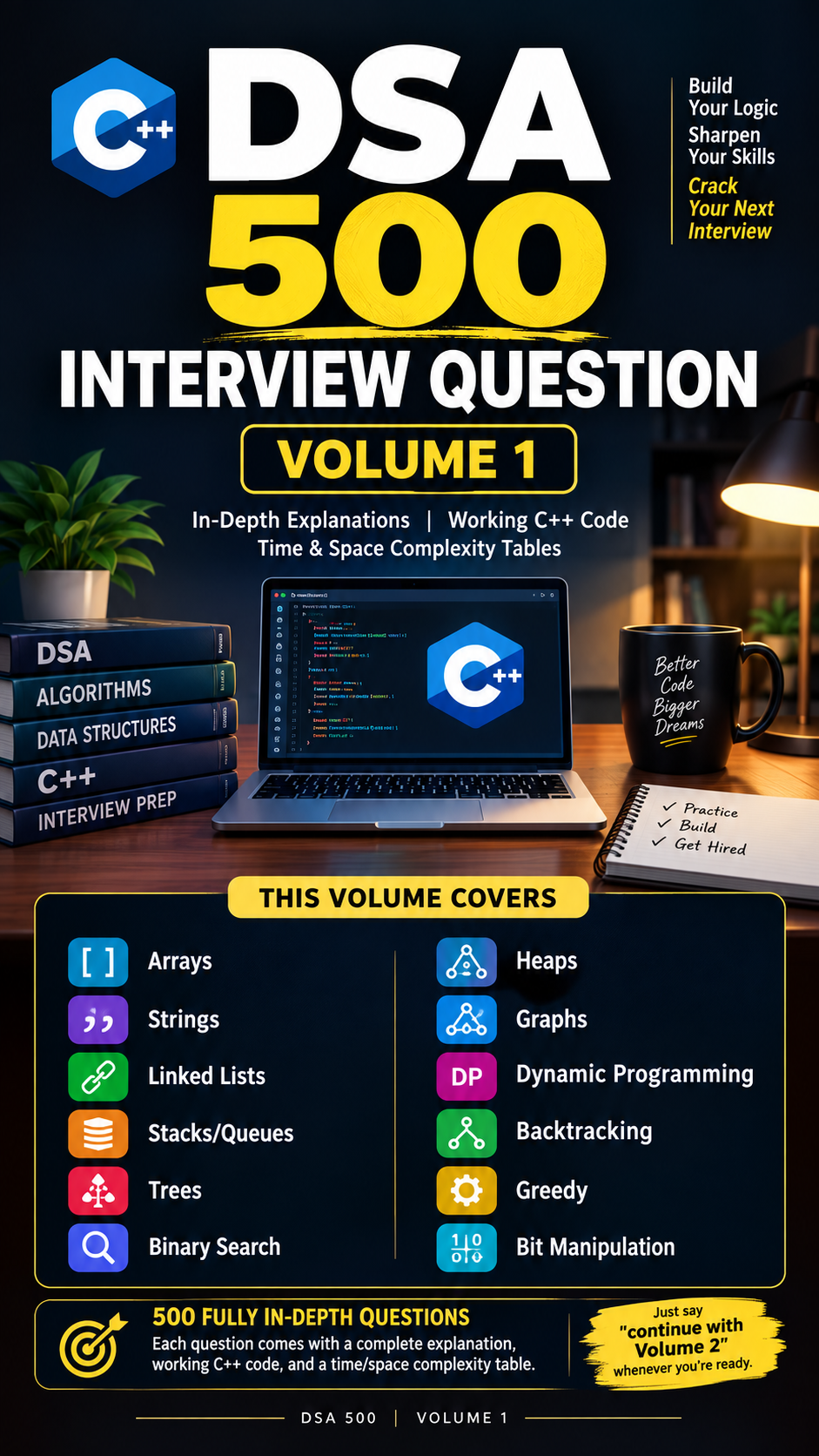


DSA 500 Interview Questions – Volume 1: The Complete Data Structures & Algorithms Interview Guide with 40 In-Depth Problems, Step-by-Step Explanations, Working C++ Solutions, Time & Space Complexity, and Essential Coding Patterns
DSA 500 Interview Questions – Volume 1
Master Data Structures & Algorithms with Real-World C++ Interview Problems
Preparing for a software engineering interview can feel overwhelming when you don't know which Data Structures and Algorithms problems to practice, what approach to use, or how to explain your solution during an actual interview.
DSA 500 Interview Questions – Volume 1 is designed as a practical, interview-focused guide to help you build strong problem-solving skills through carefully structured questions, detailed explanations, working C++ solutions, and clear time and space complexity analysis.
This is Volume 1 of a complete 500-question DSA interview series, covering Questions 1–40 across some of the most important topics frequently encountered in coding interviews.
Whether you're preparing for your first programming interview, improving your competitive programming skills, revising DSA for campus placements, or preparing for software engineering roles, this book provides a structured way to practice essential concepts and problem-solving patterns.
What You'll Find Inside
Every question is designed to go beyond simply giving you a code solution.
You'll learn:
- What the problem is asking
- How to analyze the problem
- The key idea behind the solution
- Step-by-step problem-solving logic
- The appropriate data structure or algorithm
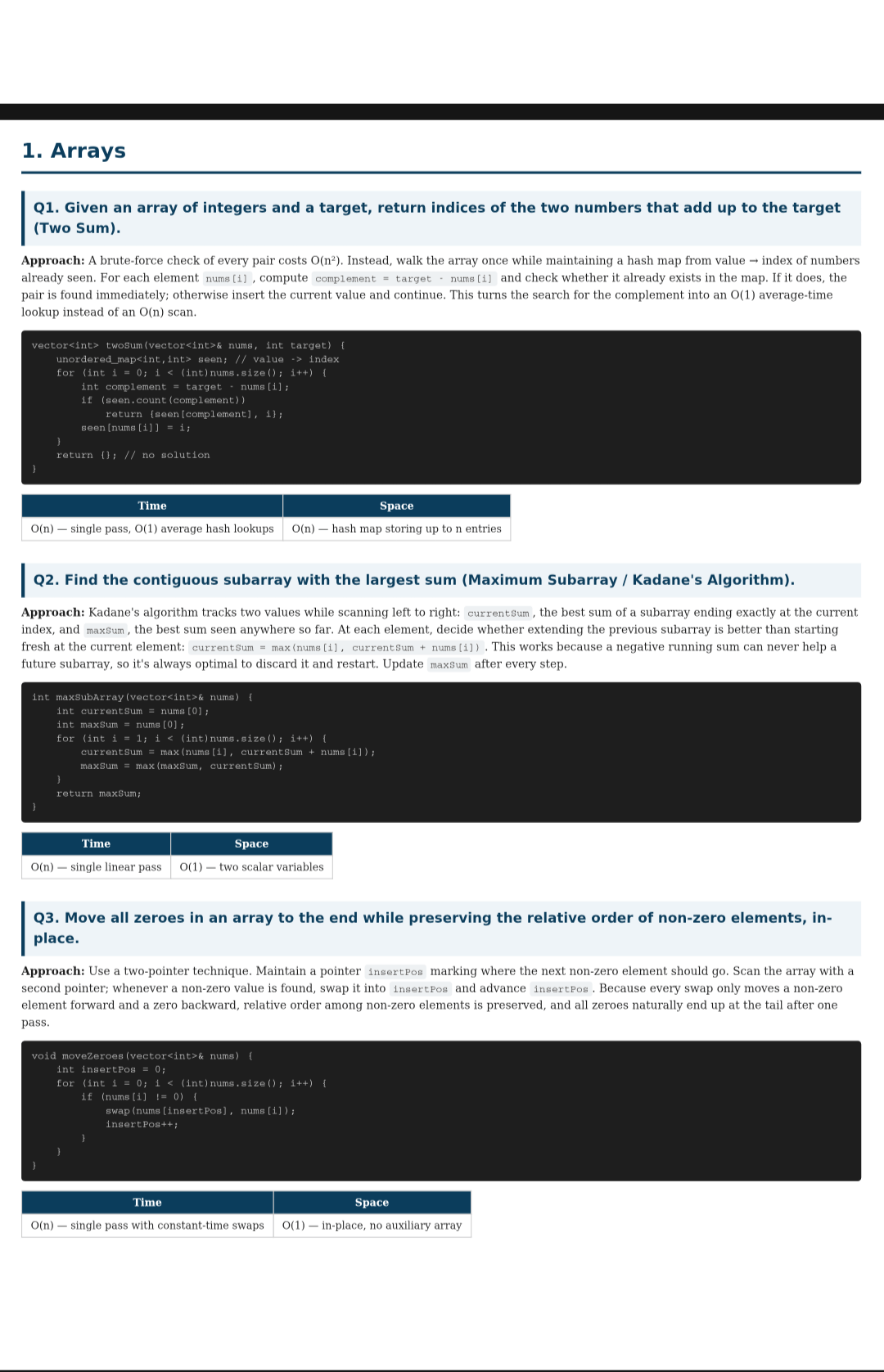
- A complete working C++ implementation
- Time complexity
- Space complexity
- Important observations and interview considerations
The goal is not just to help you memorize solutions, but to help you understand how to think about DSA problems.
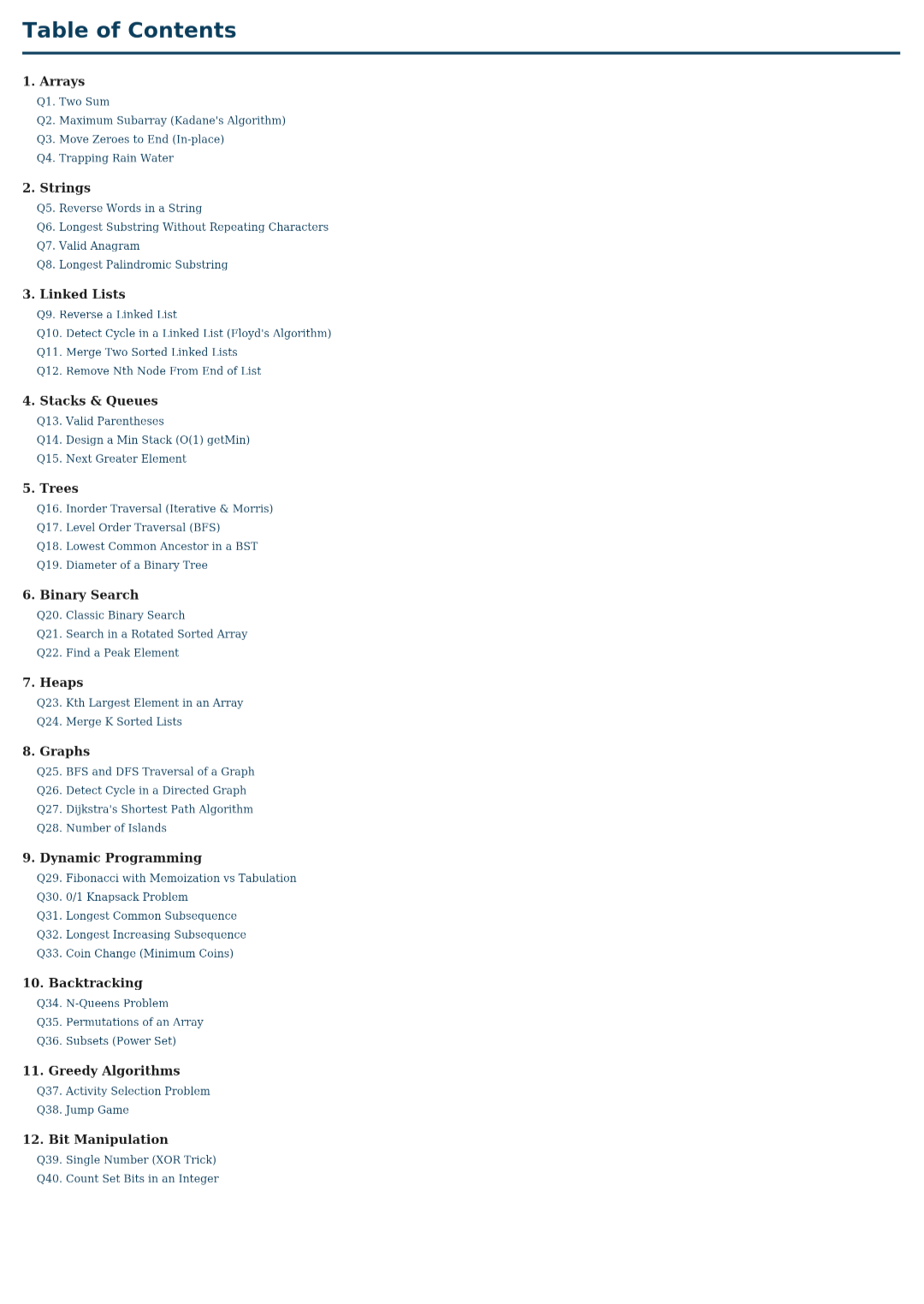
Topics Covered in Volume 1
Arrays
Build a strong foundation with array-based problems involving searching, manipulation, traversal, optimization, and common interview patterns.
Strings
Practice essential string-processing techniques and learn how to approach problems involving characters, substrings, frequency analysis, and transformations.
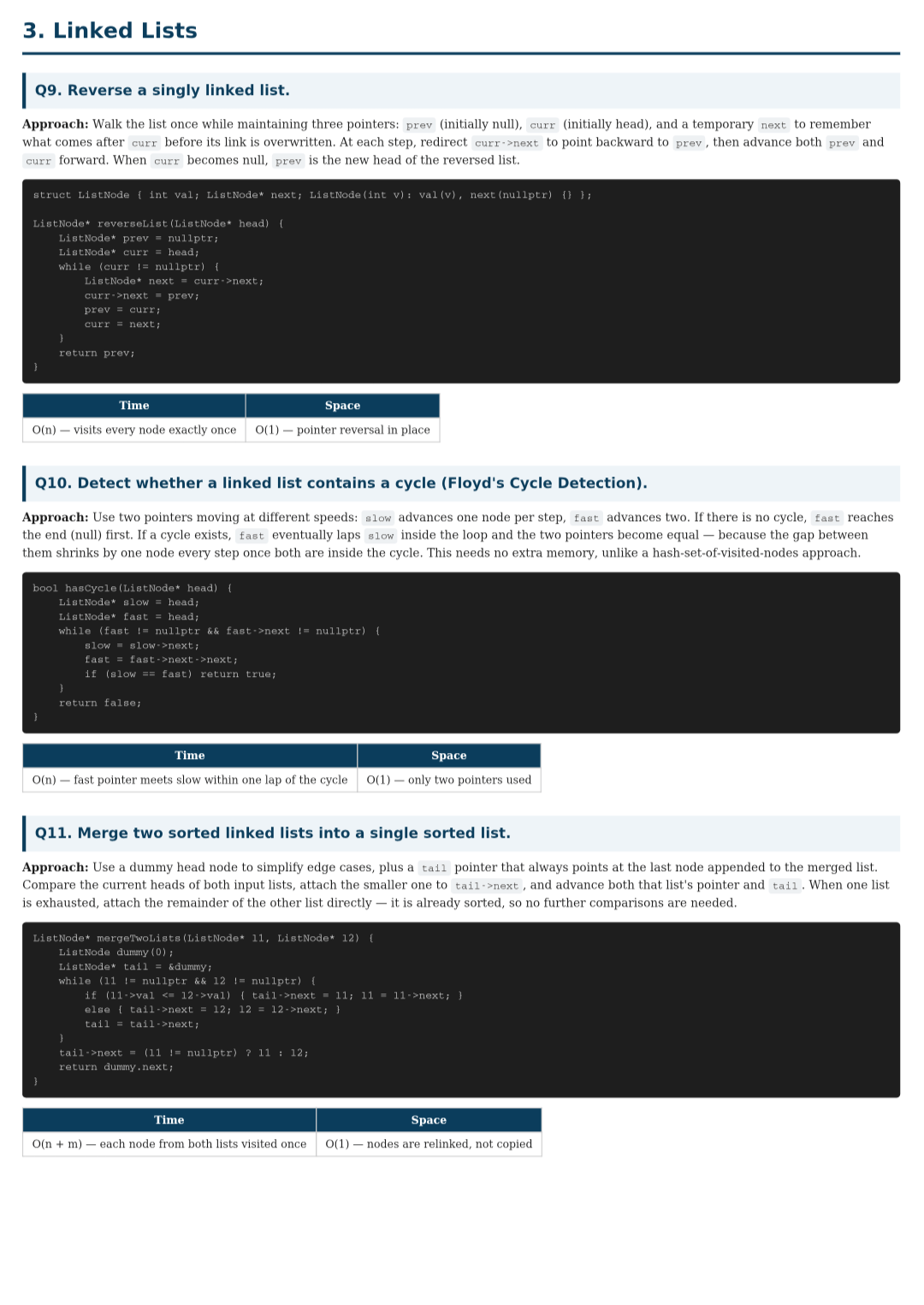
Linked Lists
Understand linked-list fundamentals and practice problems involving traversal, insertion, deletion, reversing, and pointer-based problem solving.
Stacks & Queues
Learn how stacks and queues can be used to solve problems involving ordering, processing sequences, and managing data efficiently.
Trees
Develop your understanding of tree structures and learn common interview techniques for traversals, searching, and tree-based problem solving.
Binary Search
Master one of the most important optimization techniques in DSA. Learn how to recognize when binary search can reduce an inefficient solution to a highly efficient one.
Heaps
Explore heap-based techniques and understand how priority-based data structures can be applied to common interview problems.
Graphs
Build the foundation for solving graph problems using important traversal and graph-processing concepts.
Dynamic Programming
Learn how to recognize overlapping subproblems, define states, build transitions, and optimize solutions using dynamic programming techniques.
Backtracking
Understand systematic search through possible solutions and learn how backtracking can be applied to constraint-based problems.
Greedy Algorithms
Explore problems where making carefully justified local choices can lead to an optimal solution.
Bit Manipulation
Learn useful bitwise techniques and patterns that can produce efficient solutions to specialized programming problems.
Designed for Interview Preparation
Technical interviews are not only about writing code. Interviewers often want to understand how you approach a problem.
This book therefore focuses on the reasoning behind the solution.
For each problem, you'll be encouraged to think about questions such as:
Can the problem be solved more efficiently?
Which data structure fits the problem?
What is the brute-force approach?
Can the solution be optimized?
What is the time complexity?
What is the space complexity?
How would you explain the solution to an interviewer?
Developing this way of thinking is one of the most valuable skills you can build when preparing for coding interviews.
Complete C++ Solutions
All programming solutions are presented using C++, making this volume particularly useful for students and developers preparing for C++-based coding interviews.
The code is intended to be readable and practical, allowing you to study the relationship between the algorithm and its implementation rather than simply copying a solution.
Complexity Analysis
Understanding whether your solution is efficient is a fundamental part of DSA interviews.
Throughout the book, solutions are accompanied by time and space complexity analysis, helping you understand the computational cost of different approaches.
This makes it easier to compare solutions and recognize when an optimization is necessary.
Why 500 Questions Are Split Into Volumes
A truly in-depth collection of 500 DSA interview questions would be extremely large if every question included detailed explanations, complete C++ implementations, examples, and complexity analysis.
Instead of creating one enormous book, the series is divided into manageable volumes.
Volume 1 covers Questions 1–40.
Future volumes continue with additional DSA concepts and progressively more challenging interview patterns.
This approach allows you to study systematically rather than attempting to work through thousands of pages at once.
Who This Book Is For
This book can be useful for:
- Computer science students
- Engineering students
- Beginners learning DSA
- Programmers preparing for coding interviews
- C++ developers
- Campus placement candidates
- Software engineering interview candidates
- Developers revising DSA fundamentals
- Competitive programming learners
- Anyone looking for structured DSA practice
You don't need to memorize every solution.
Instead, use the questions to develop a repeatable problem-solving process.
How to Use This Book
For the best learning experience, try solving each problem yourself before reading the solution.
A useful workflow is:
1. Read the problem carefully.
Understand exactly what is being asked.
2. Attempt a solution.
Start with a straightforward approach, even if it isn't optimal.
3. Analyze your approach.
Think about its time and space complexity.
4. Study the optimized solution.
Compare it with your approach and identify what could be improved.
5. Study the C++ implementation.
Understand how the algorithm translates into code.
6. Revisit the problem later.
Try solving it again without looking at the solution.
This turns the book from a simple question-and-answer collection into a practical DSA training resource.
What's Next?
This is only Volume 1 of the larger DSA 500 Interview Questions series.
The upcoming volumes can continue into areas such as:
- Recursion
- Tries
- Sliding Window
- Two Pointers
- Union-Find / Disjoint Set Union
- Advanced Graph Algorithms
- More Dynamic Programming
- Advanced Trees
- Advanced Searching Techniques
- Design-Oriented Problems
- Additional Interview Patterns
- And many more challenging DSA problems
The objective is to gradually build a comprehensive collection of 500 interview-focused DSA questions.
Start Building Your DSA Interview Skills
Strong DSA skills come from consistent practice, understanding patterns, and learning from different approaches to the same type of problem.
DSA 500 Interview Questions – Volume 1 gives you a structured starting point with practical questions, detailed explanations, working C++ code, and complexity analysis.
Work through the problems, understand the patterns, write the code yourself, and revisit challenging questions until the underlying technique becomes familiar.
Volume 1: Questions 1–40
Topics: Arrays • Strings • Linked Lists • Stacks & Queues • Trees • Binary Search • Heaps • Graphs • Dynamic Programming • Backtracking • Greedy • Bit Manipulation
Language: C++
Format: In-depth explanations + Working Code + Time & Space Complexity
When you're ready for the next collection of problems, continue with Volume 2.