
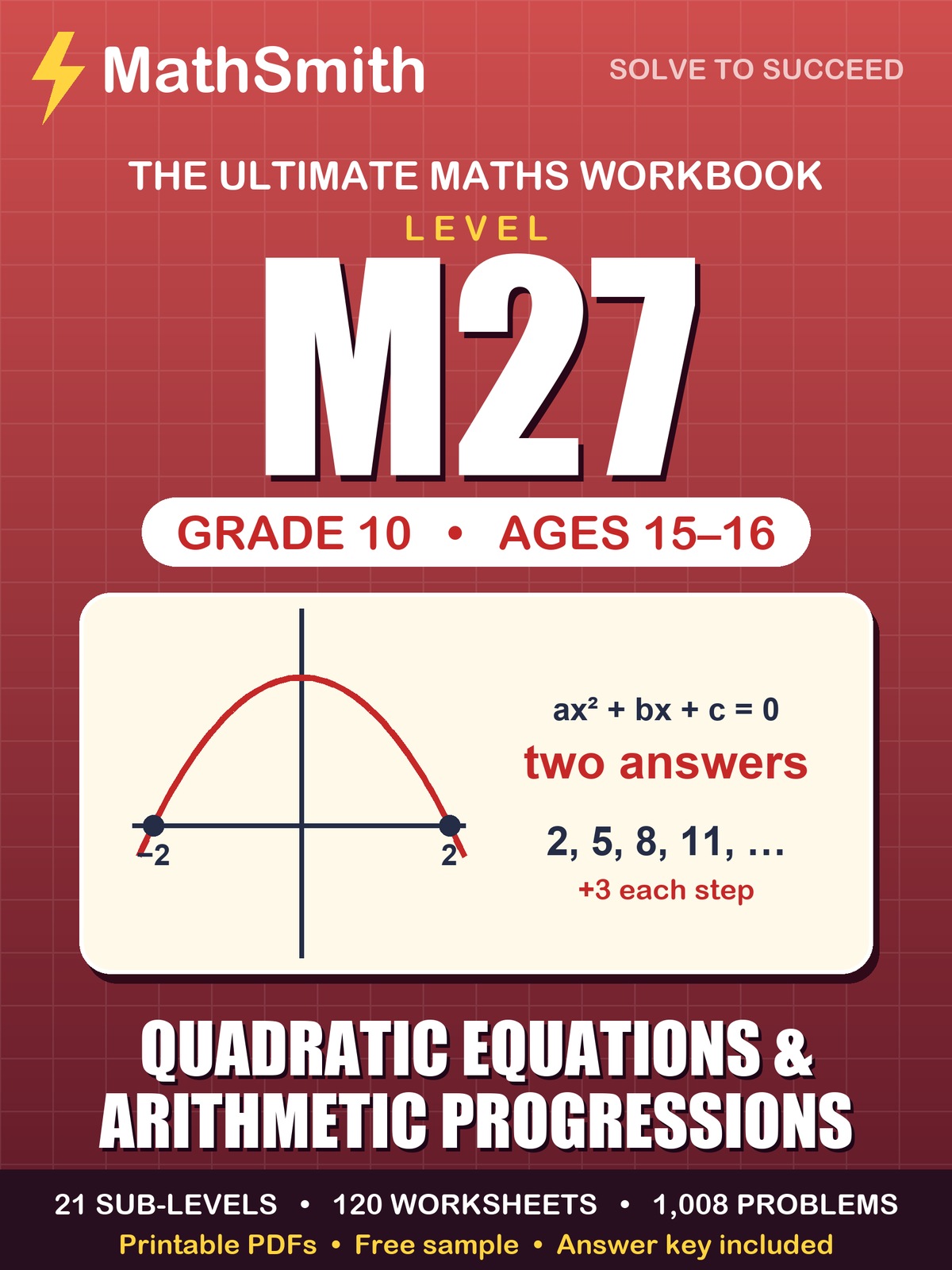
Gr 10 Maths Worksheets (Ages 15-16) | Level M27: Quadratic Equations & Arithmetic Progressions
🎓 Launch offer: 80% OFF every MathSmith workbook with code LAUNCH80 (first 1000 orders). Click Add to Cart, then enter LAUNCH80 in the discount box before you pay.
Not sure which level your child needs? Take the free 40-question placement test: https://ebooks.thecodecrafters.net/placement
See free sample pages first: https://ebooks.thecodecrafters.net/
Help your child build absolute confidence and mastery in mathematics. This comprehensive workbook from MathSmith takes a highly structured, "one-rung-at-a-time" approach to Quadratic Equations and Arithmetic Progressions, ensuring students fully understand concepts before moving forward.
Instead of overwhelming learners with random equations, this workbook uses a carefully scaffolded, predictable learning ladder. It is perfect for homework, structured independent study, or mastery practice.
📊 What Is Included?
1 Complete Level (Level M27)
21 Structured Sub-levels for gradual progression
120 Printable Worksheets
1,008 Total Problems for thorough practice
Full Answer Key online, unlocked by the order ID on your Payhip receipt, for quick, stress-free marking
🗺️ Curriculum Breakdown
This collection focuses deeply on mastering Quadratic Equations and Arithmetic Progressions through a carefully curated system:
What a quadratic equation is, and how it is written down (2 Sub-levels): Two rungs before anything is solved. An equation whose highest power of the unknown is two and nothing higher - which is a claim about NOTATION as much as about arithmetic, so the equation being judged is set rather than typed into the sentence: a lifted digit is not a caret and a cube is not a square. Then the general form, everything on one side with nought on the other and the powers in order, and the reading of a, b and c off it - where b keeps the sign in front of it, which is a reading mistake rather than an arithmetic one and makes the formula print the wrong answer twice over.
Four ways to solve one, and the frame all four share (4 Sub-levels): The level's notation is the FORK: one equation at the top, a Y under it, and two arms, each an equation in its own right and each ending in a box. Factorising, where a product is nought exactly when one of the things multiplied is nought; splitting the middle term once there is a number on the square, where the two numbers found are the split and not the answers; completing the square, which is the model; and the formula, which is completing the square done once and for all with letters. The plus-or-minus sign is the fork folded onto one line, and that is the only reason the formula fits on a page.
What the coefficients say about the answers (2 Sub-levels): Two rungs, both about the number under the root sign. Worked out, it says how many real roots there are before any of them is found - two, one twice over, or none - and whether they will be whole numbers or surds. Set rather than worked out, it gives back the coefficient: the unknown k chosen so that the roots come out equal, which is M26's k met on a quadratic.
The quadratic at work (4 Sub-levels): Four rungs of stories. Turning one into an equation is a rung on its own, because the answer is an EQUATION and not a number and what goes wrong is the naming and the general form. Then numbers and ages, area and dimensions, and speed and time - the last of these the only ones whose unknown starts in a denominator, where multiplying up is the step that makes them quadratic and the step that gets skipped.
The list that goes up by the same step, and the rule that replaces counting (4 Sub-levels): Four rungs on the strip: the terms in a row, each standing over its own position, with the step arced across every gap - and across the gap the dots cover, dashed and carrying no label, because an arc over sixteen terms is not one step. What a progression is, with a box on EVERY arc because the claim is that the step never changes; the nth term, which takes n - 1 steps and not n, since no step is taken to reach the first; the rule read backwards to find the first term, the step or the count; and the strip read the other way round, where the value is given and the position is the box.
Adding one up, and then answering the question that was asked (5 Sub-levels): Five rungs. The progression written out again backwards underneath makes n columns all worth the same, which is the sum and is not a trick - nothing was added or taken away, the row was written a second time. Then the same sum told the last term instead of the step; the whole numbers from 1, which are that sum in a special case and not a new rule; progressions inside stories, where the tenth week and ten weeks altogether are two different questions; and the closing rung, where one of the two roots is thrown away because a width of minus nine metres is a number and not a width.
🎯 Who Is This For?
Parents looking to provide structured math support at home.
Homeschoolers searching for a sequential curriculum to guarantee zero gaps in math skills.
Teachers & Tutors looking for bite-sized, scaffolded printables for classroom morning work or targeted intervention.
📖 How To Use This Workbook
Print the workbook, read each rung's method page, and let your child work inside the printed frame. Then check the answers your way: in the printable answer-key PDF included in this download, or online, one page at a time, with the order ID on your Payhip receipt (valid for six months). Please keep the answer key for the adult marking the work and do not share it with your child: the workbook only works if they have worked each answer out for themselves.
Step-by-step manual and video guide: https://ebooks.thecodecrafters.net/manual/
Check the answers: https://ebooks.thecodecrafters.net/answers
⚙️ Digital Delivery Details
Format: four instant-download PDFs (free sample, sample answers, workbook, full answer key). The answer key is also available online.
Print Ready: Easily printable on home or school printers.
Usage: Licensed for individual family or single-classroom use.