
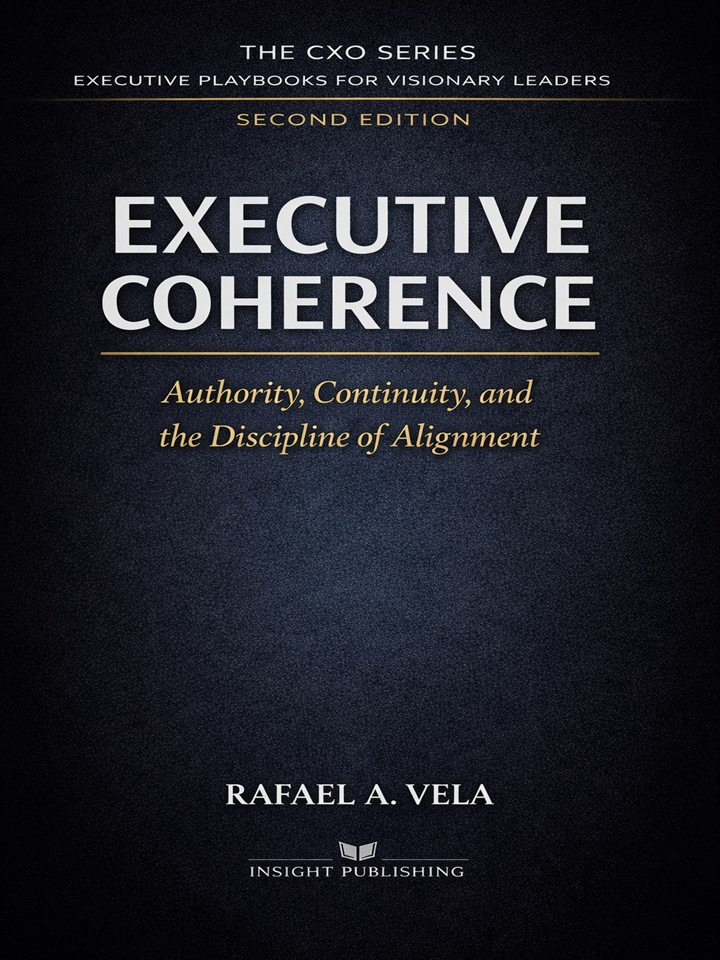
Executive Coherence: Authority, Continuity, and the Discipline of Alignment
This book examines a structural executive failure rarely named directly: the erosion of alignment between authority, decision, and enterprise direction.
Executive Coherence is not about leadership style or cultural aspiration. It studies the architecture that allows organizations to move without fragmenting. It challenges the assumption that strategy alone produces continuity.
The book analyzes how authority diffuses, how escalation distorts intent, and how performance can temporarily mask structural misalignment. Decisions are made, initiatives advance, metrics improve, yet custody of direction weakens.
Fragmentation rarely announces itself as crisis. It accumulates through exceptions, overlaps, and unclarified ownership.
Coherence is not harmony. It is disciplined alignment between declared strategy, decision rights, incentives, and operational execution. Without it, continuity depends on personalities rather than structure.
Executive Coherence is part of the CXO Series, examining the architectural responsibilities of senior leadership under complexity and pressure.
Strategy declares direction. Authority must sustain it.
TABLE OF CONTENTS
Part I — The Drift Problem
Chapter 1 — Strategy Is Clear. Alignment Is Not - 21
• Why execution fails without structural coherence - 21
• The hidden gap between declared strategy and lived decisions - 23
• Why misalignment rarely announces itself - 25
• Coherence as a Designed Condition - 27
• Executive Responsibility - 30
Chapter 2 — Authority Without Custody - 35
• Titles without binding responsibility - 35
• Distributed power and diluted accountability - 37
• Why visible authority matters more than consensus – 41
• The Structural Role of Custody – 42
• Executive Accountability for Authority Design – 45
Chapter 3 — The Fragmentation of Executive Power - 51
• When CXOs optimize locally instead of collectively - 51
• Competing mandates at the top - 53
• The silent erosion of enterprise coherence - 56
Chapter 4 — Optional Leadership and the Loss of Continuity - 61
• Strategy resets disguised as agility - 61
• Why leadership optionality creates organizational drift - 64
• The cost of abandoning long-term consistency - 65
Part II — The Architecture of Coherence
Chapter 5 — The Executive as Custodian - 69
• Why alignment requires identifiable holders - 69
• Authority versus influence at the top - 70
• Custody as a leadership discipline - 71
Chapter 6 — Decision Rights as Alignment Anchors - 73
• How unclear authority accelerates fragmentation - 73
• Designing clean executive decision boundaries - 74
• When shared ownership weakens coherence - 75
Chapter 7 — Continuity as a Strategic Asset - 79
• Why continuity compounds competitive advantage - 79
• Managing trade-offs without redefining direction - 81
• Building institutional memory into governance - 82
Chapter 8 — Governing Cross-Functional Alignment - 85
• The CEO’s role in preventing structural drift - 85
• Incentives that reinforce coherence rather than competition - 88
• Turning executive disagreement into unified action - 90
Part III — Coherence Under Pressure
Chapter 9 — When Performance Masks Fragmentation - 95
• Why short-term success hides structural weakness - 95
• The illusion of stability without alignment - 96
• Detecting early signs of executive drift – 97
• Structural Discipline Over performance Comfort - 99
Chapter 10 — Escalation, Authority, and Enterprise Protection - 101
• When escalation restores coherence - 101
• When it weakens executive trust - 103
• Designing escalation paths that protect continuity - 104
Chapter 11 — Crisis as a Coherence Test - 109
• How pressure exposes authority gaps - 109
• Why fragmented leadership collapses under stress - 111
• Maintaining unity of direction in turbulent environments - 112
Part IV — Designing the Discipline of Alignment
Chapter 12 — Institutionalizing Executive Coherence - 117
• Embedding alignment into governance routines - 117
• Creating continuity across leadership transitions - 119
• Why coherence must be designed, not assumed - 121
Chapter 13 — The Discipline of Visible Authority - 123
• Why custodial clarity prevents strategic erosion - 123
• Aligning incentives with enterprise continuity – 125
• Making coherence measurable - 126
• Visible authority as organizational signal - 127
Conclusion — Coherence as Executive Responsibility - 129
Appendices
• Appendix A: Executive Coherence Diagnostic - 135
• Appendix B: Authority Fragmentation Map - 141
• Appendix C: Continuity Stress Test - 149