
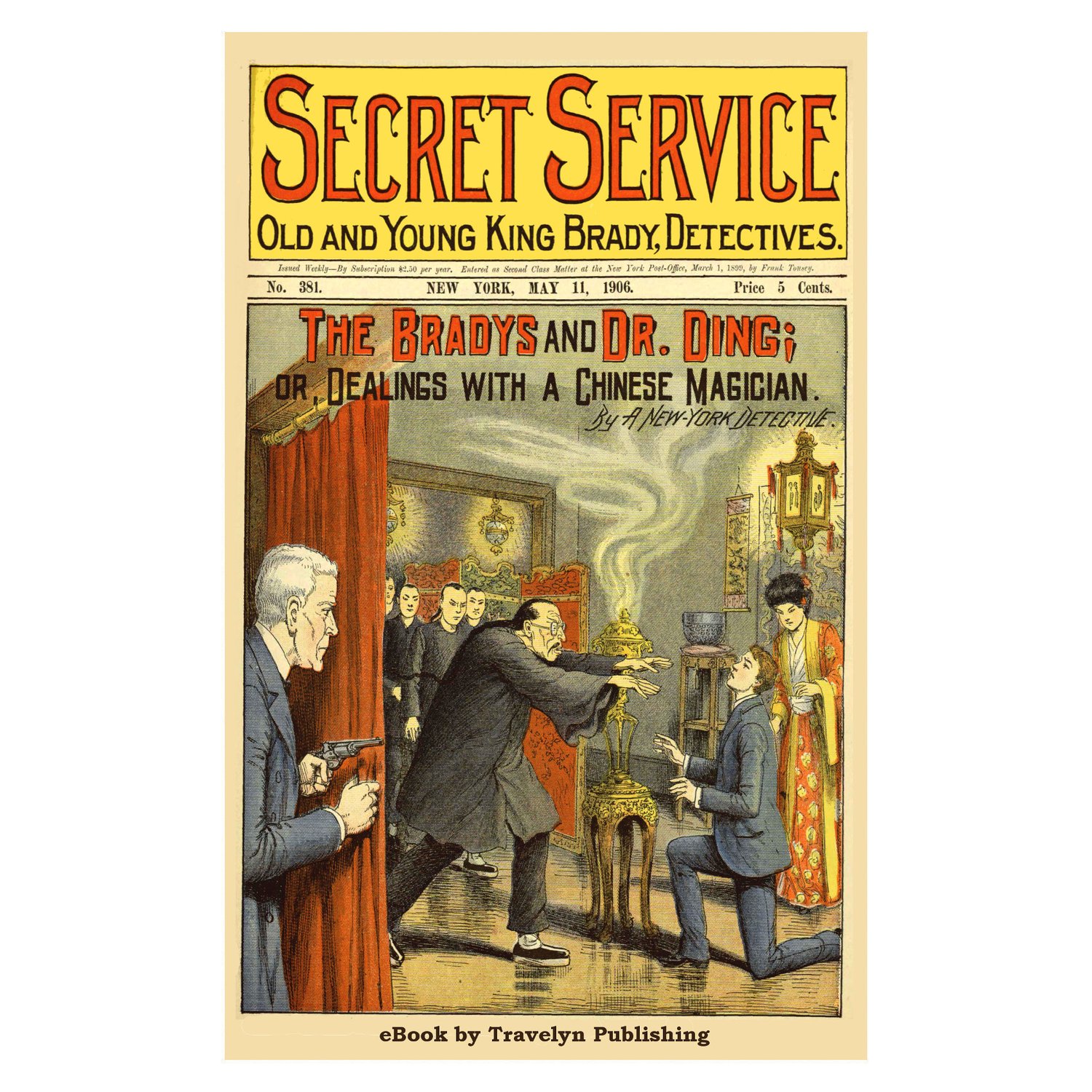
The Bradys and Dr. Ding; or, Dealings with a Chinese Magician
A nickel weekly originally published May 11, 1906, number 381 in the popular “Secret Service” series featuring “Old and Young King Brady, Detectives” which started January 27, 1899, and came out like clockwork every Friday for more than two decades—by which time well more than a thousand issues had been published—The Bradys and Dr. Ding; or, Dealings with a Chinese Magician has the Bradys travelling to San Francisco from their home base in New York City to unravel the mystery of a young woman who went missing in China years before and was thought dead, but then was unexpectedly spotted in a Chinese magician’s act on a stage in New York. When they follow that act to San Francisco, the Bradys learn more about Chinese culture and hypnotism than they ever knew before.
At more than 25,000 words, this novella-sized work of pulp fiction, besides being an interesting and fun read, gives the reader a taste of what the masses were reading in the late 19th and early 20th century time period.
Preparing old books (or, as in this case, weekly magazines) for digital publication is a labor of love at Travelyn Publishing. We hold our digital versions of public domain books up against any others with no fear of the comparison. Our conversion work is meticulous, utilizing a process designed to eliminate errors, maximize reader enjoyment, and recreate as much as possible the atmosphere of the original book even as we are adding the navigation and formatting necessary for a good digital book. While remaining faithful to a writer’s original words, and the spellings and usages of his era, we are not above correcting obvious mistakes. If the printer became distracted after placing an ‘a’ at the end of a line and then placed another ‘a’ at the beginning of the next line (they used to do this stuff by hand you know!), what sort of mindless robots would allow that careless error to be preserved for all eternity in the digital version, too? Not us. That’s why we have the audacity to claim that our re-publications are often better than the originals.