

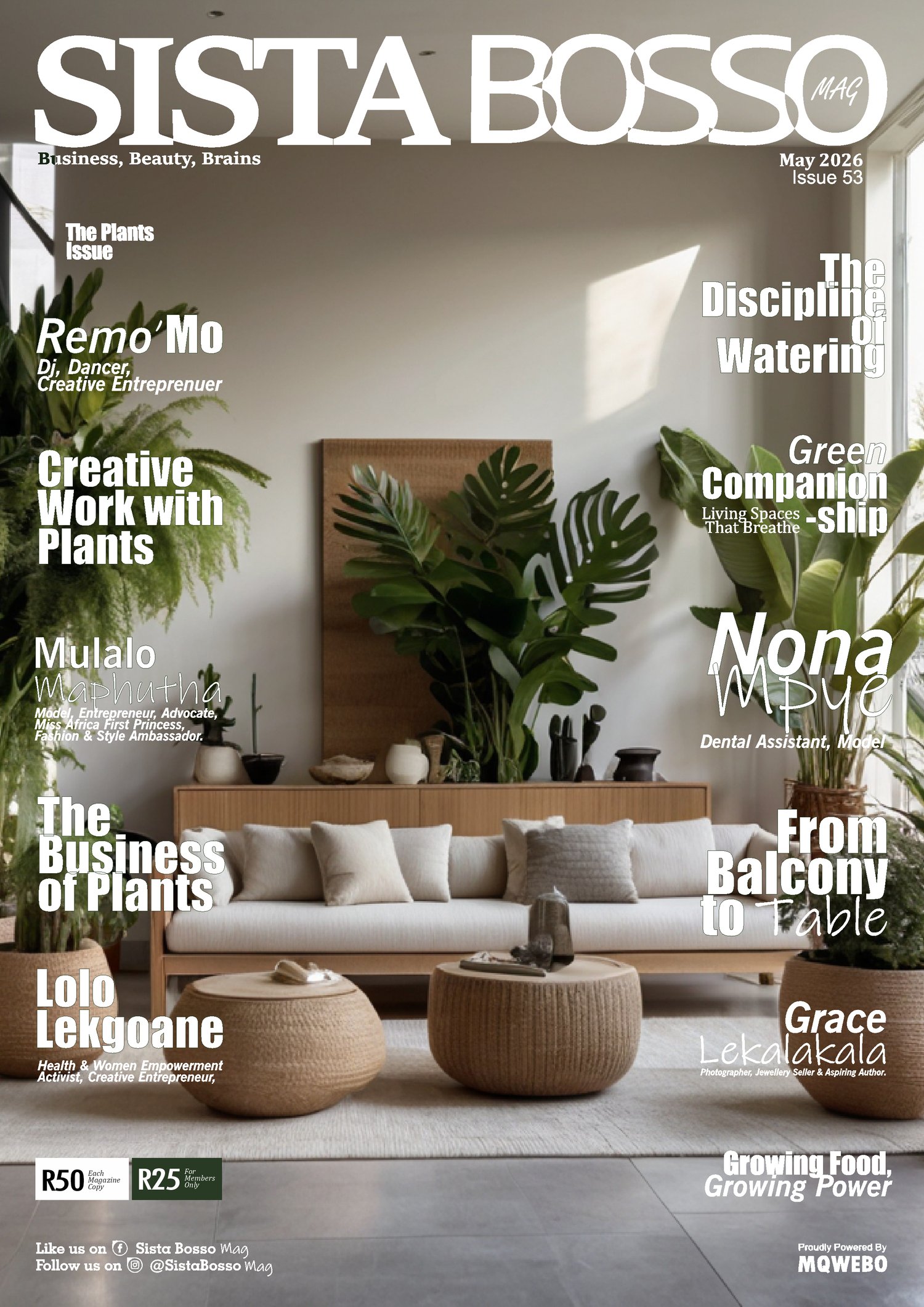
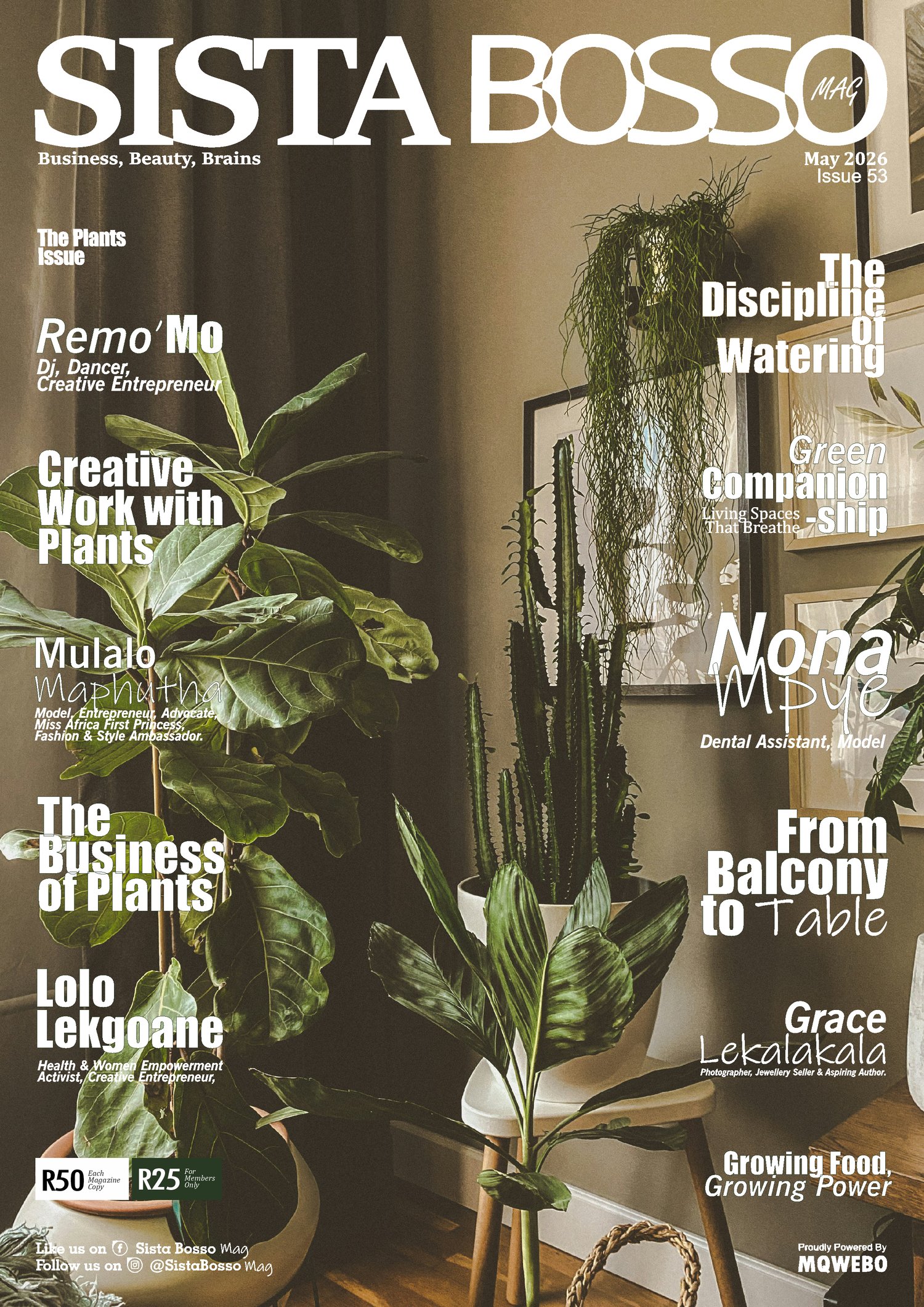
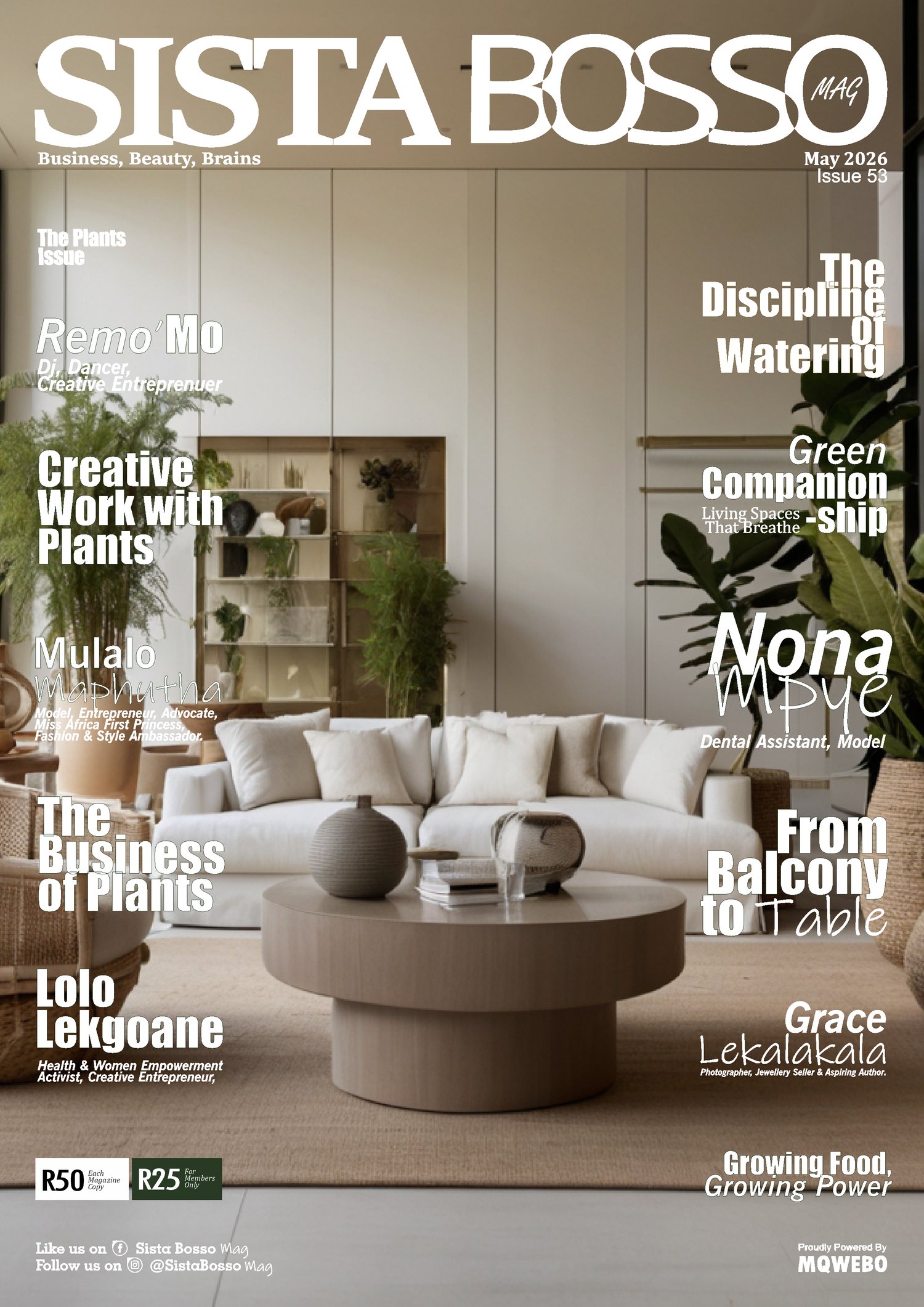



Sista Bosso Magazine May 2026 The Plants Issue
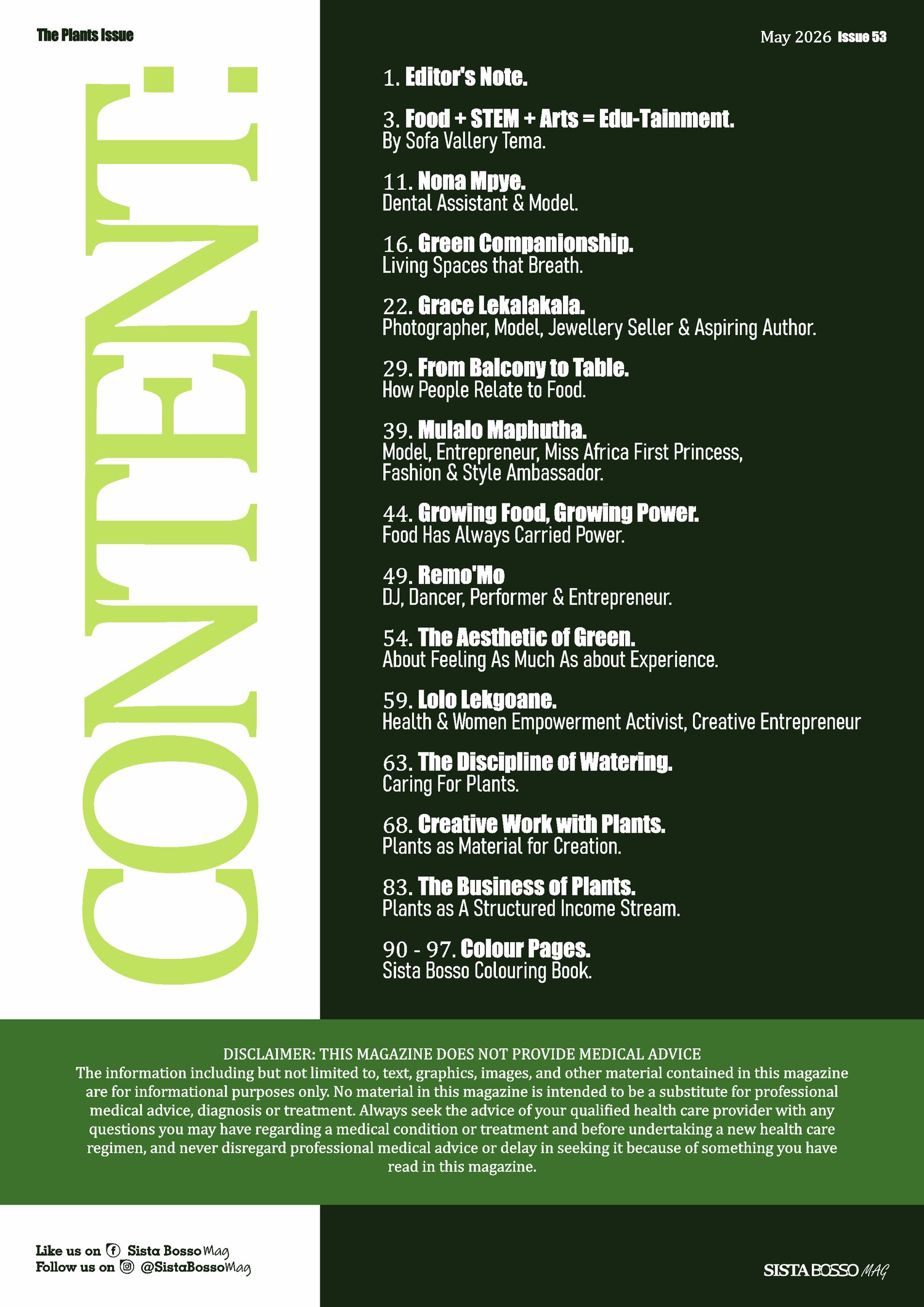
About The Issue: May 2025 Mag Content
Sista Bosso Magazine Issue 53, The Plants Issue
This issue is rooted in something many of us have always known, even before we had the language for it. Growth takes time. Care is intentional. And what we nurture will always reflect back to us.
Plants are not just aesthetic. They are memory, discipline, survival, and power. They carry the knowledge of generations before us, the patience of cycles we did not invent, and the quiet insistence that life, real life, is not rushed. It is cultivated. It is tended. It is shown up for, daily, without applause or announcement.
In this issue we explore plants beyond decor. We look at how they shape the way we live, how they influence what we eat, how they inform the way we create, and how they sit at the centre of some of the most important conversations about power, independence, and sustainability happening right now. From food systems to artistic practice, from wellness to business strategy, this is a conversation about growth in all its forms, and about what it actually takes to sustain it.
We are proud to feature women who embody this in their own lives and work.
Sofa Vallery Tema brings a perspective that sits at the intersection of Food, STEM, and Arts, introducing edutainment as a framework that roots knowledge in everyday culture and lived experience, making learning something you do not just receive but inhabit. Her work challenges the idea that education belongs only in formal spaces, and insists instead that knowledge is most powerful when it lives inside the everyday.
Nona Mpye carries a layered story of balance, navigating her identity as a dental assistant and model with the kind of intentionality that does not always look dramatic from the outside but reveals itself over time as something deeply considered and quietly powerful. Her presence in this issue speaks to the women who are building more than one version of themselves at the same time, holding structure and self expression without letting either one go.
Grace Lekalakala moves fluidly across photography, modelling, jewellery design, and writing, reflecting a creative identity that refuses to be confined to a single lane. Her work evolves through multiple, interconnected forms of expression, each one feeding the others, none of them complete without the rest. She represents a generation of creatives who understand that breadth is not a lack of focus, it is a form of genius.
Mulalo Maphutha, model, entrepreneur, and Miss Africa First Princess, brings visibility, discipline, and the weight of representation to these pages. Her story speaks to what it means to carry a narrative of success that others can see themselves inside, and to do so with the kind of composure that only comes from knowing exactly who you are and what you are here for.
Remo'Mo brings rhythm and energy into the issue in a register entirely her own. As a DJ, dancer, performer, and entrepreneur, her growth lives in culture and movement, in the ability to read a room, hold it, and transform it through experience. She reminds us that not all building happens at a desk, and that creativity expressed through the body and through sound is just as much a business as anything else.
Lolo Lekgoane grounds the issue in purpose, her work in health and women empowerment drawing a direct line between individual wellness and the broader work of building systems that genuinely hold women up. Her presence is a reminder that growth at the community level requires the same consistency and care as growth at the personal level, and that the two are never really separate.
Green Companionship looks at how plants transform living spaces from environments of function into environments of feeling, shifting the conversation from decoration to presence and from objects to relationships. It asks what it means to share your home with something living, and what that living thing gives back to you in ways you may not have even noticed yet.
From Balcony to Table brings the conversation down to the personal and the practical, examining how small scale growing redefines access, sustainability, and the simple but radical act of feeding yourself from something you planted. It is a piece for the woman in the flat, the woman in the yard, the woman who has been told she does not have enough space to grow anything worth eating.
Growing Food, Growing Power takes the conversation further, positioning food not just as nourishment but as history, control, and a form of independence that has always been tied to who holds power and who does not. It looks at the women across South Africa who are returning to the soil not out of nostalgia but out of strategy, and at what it means to reclaim your food as an act of sovereignty.
The Aesthetic of Green moves beyond the visual into the emotional, exploring how green environments influence mood, identity, and the felt experience of moving through a space. It is a styling piece that treats plants not as accessories but as architecture, and that asks you to think about what your space says about what you value and how you want to feel inside it.
The Discipline of Watering is a quieter piece but no less necessary, a reflection on consistency and the daily acts of care that rarely get acknowledged but make everything else possible. It draws the line between what it takes to keep a plant alive and what it takes to keep a dream alive, and finds that the requirements are not as different as we might think.
Creative Work with Plants explores what happens when nature becomes artistic material, how plants move through botanical art, natural dyeing, pressed flower design, and handmade decor as both expression and livelihood. It is a piece for the maker who has been wondering whether her creative practice can also be her income, and the answer it offers is yes, and here is how.
The Business of Plants closes the editorial arc with something sharp and practical, mapping the path from green thumb to income stream and showing how women across South Africa are building real enterprises from the ground. It looks at nurseries, herbal products, plant styling services, and community gardens as legitimate, scalable business models rooted in knowledge, passion, and consistency.
The issue closes with the Sista Bosso Colouring Book, a space for the reader to slow down, participate, and connect with the theme in a way that is personal, unhurried, and entirely their own. It is an invitation to be present with the issue beyond reading it.
This is not just an issue about plants. It is an issue about growth in every sense of the word, and about what it means to tend something with care until it becomes exactly what it was always supposed to be..