

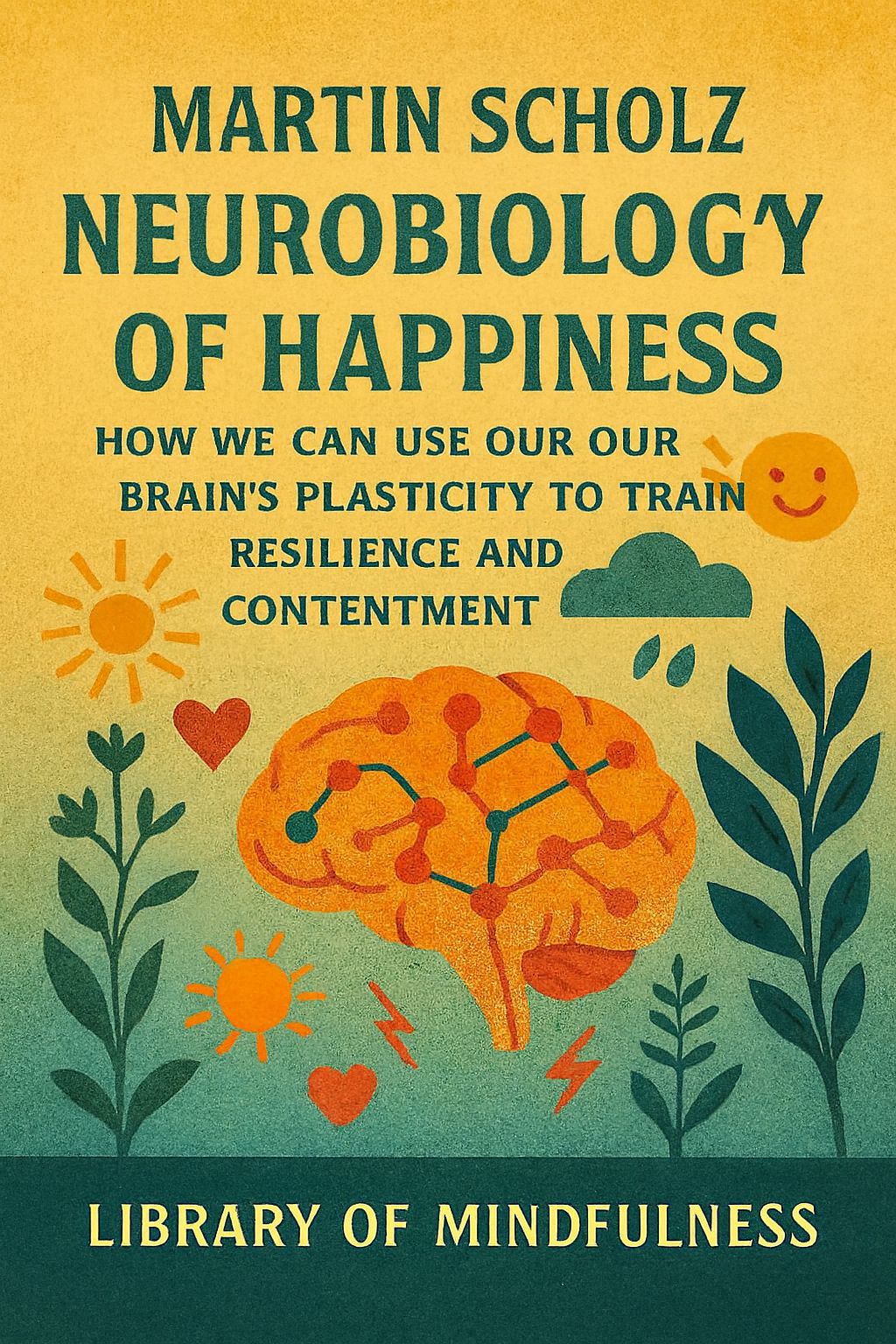
Neurobiology of Happiness
🧠 The Neurobiology of Happiness
How we can use the plasticity of our brain to train resilience and contentment Scientifically based. Suitable for everyday use. Immediately effective.
Why this book?
Happiness is not a coincidence—it is a biological skill that you can train like a muscle. This book translates the latest findings from neurobiology, psychology, and mindfulness research (including neuroplasticity, dopamine/serotonin/oxytocin systems, polyvagal theory, mirror neurons, and the default mode network) into practical, evidence-based strategies that you can use to consciously reshape your brain – without esotericism, but with depth.
“The Neurobiology of Happiness” shows you how small, everyday rituals (e.g., mindfulness exercises, gratitude journaling, social connectedness, micro-movements) directly affect your neurochemistry and brain structure—measurable through biomarkers such as HRV, cortisol levels, and neural connectivity. You will learn how to:
- break stress patterns and recalibrate your nervous system,
- stabilize dopamine, serotonin, and oxytocin naturally,
- reprogram cognitive distortions (e.g., negativity bias, catastrophizing),
- use social warmth and compassion as a biological resource,
- anchor mindfulness and resilience as neural habits.
What to expect: Science meets practice
🔹 Neuroplasticity – The malleable brain: Why every thought, emotion, and action physically changes your brain structure – and how you can consciously use this for greater satisfaction (Hölzel et al., 2011).
🔹 The chemistry of joy: How dopamine (motivation), serotonin (inner security), oxytocin (bonding), and endorphins (pain relief) shape your experience – and which everyday exercises (e.g., gratitude rituals, exercise, touch) naturally promote their release (Kringelbach & Berridge, 2009). 🔹 The inner autopilot – rumination and the default mode network (DMN): Why our brain runs in “rumination mode” 95% of the time – and how mindfulness and meditation reduce amygdala activity and strengthen the prefrontal cortex (Davidson & Lutz, 2008).
🔹 The vagus nerve as the key to calm: How slow breathing, warmth, and social touch activate the parasympathetic nervous system, lower cortisol, and increase heart rate variability (HRV) – measurable effects for greater resilience (Porges, 2009).
🔹 Social neurobiology: Why oxytocin and mirror neurons biologically program us for connection – and how empathic listening, hugs, and compassion meditation activate the reward system (Insel, 2010).
🔹 Recognizing and changing cognitive patterns: How negativity bias, catastrophizing, and self-criticism function as neural highways – and how you can redirect them through cognitive restructuring and self-compassion (Fredrickson, 2001).
🔹 Everyday routines for a happy brain: 5 scientifically based micro-practices (e.g., mindful walking, digital fasting, journaling) that strengthen your neurochemistry and brain structure in the long term without taking up much time.
🔹 For those interested in STEM: In-depth insights into the biophysics behind the strategies – e.g.:
- How C-tactile fibers (skin nerves) convert touch into oxytocin (Science, 2008).
- Why fascia functions as “liquid crystals” – biophysics of biotensegrity (Fascia Research Congress, 2015).
- How somatic markers (Damásio) control decisions and emotions (Self Comes to Mind, 2012).
Who is this book for?
✔ Those interested in science and STEM who want to understand neuroscientific mechanisms (e.g., neuroplasticity, neurotransmitters, stress regulation) and apply them in everyday life.
✔ Professionals in stressful environments (IT, research, management) who want to strengthen resilience and mental clarity through evidence-based rituals – without wasting time.
✔ People with chronic stress, burnout, or sleep disorders who are looking for gentle alternatives to medication – without sacrificing scientific validity.
✔ Psychologists, coaches, and therapists who want to teach patient-friendly, neurobiologically based approaches to stress management and mindfulness.
✔ Parents, teachers, and those interested in education who want to put neurobiological principles (e.g., learning, attention, emotional regulation) into practice.
✔ People with a digital lifestyle who want to compensate for body dissociation (e.g., through working from home, screen work) with micro-rituals.
✔ Readers of other books (e.g., “Body Wisdom” or “Learn to Suffer Without Complaining”) who are looking for in-depth neurobiological explanations for mindfulness, resilience, and social well-being.
Your advantages at a glance
✅ No radical lifestyle changes – instead, 12 scientifically based micro-strategies that fit into any daily routine (e.g., breathing exercises, gratitude journaling, social rituals).
✅ Evidence-based & transparent – Studies from neurobiology, psychology, and behavioral research (including Harvard and the Max Planck Institute) are explained in an understandable way – perfect for those interested in STEM who want to understand the biophysics and physiology behind the methods.
✅ Suitable for everyday use & time-saving – practices for the office, home office, and on the go that don't take any extra time (e.g., 3-breath reset before meetings, mindful walking while commuting).
✅ Focus on measurable effects – HRV, cortisol levels, neural connectivity as biomarkers that show: The rituals work – not just subjectively, but physiologically verifiable.
✅ Lasting effect – increased resilience, stress resistance, and satisfaction – without expensive therapies or radical lifestyle changes.
✅ Social integration – rituals for couples, families, and teams that promote compassion and connection – without becoming a burden.
✅ Bridging the gap between science and practice – Concrete exercises (e.g., body scan, compassion meditation, digital fasting) that have a direct effect on neurochemistry and brain structure – ideal for your science journalism project (Memory n°5).
Start now – with your first conscious impulse!
You don't have to meditate for hours or completely change your habits to gain more peace, mental clarity, and contentment. Sometimes a single mindful moment is enough—a conscious breath while waiting in line, a gentle hand on your stomach before falling asleep, a 3-minute stretch while brushing your teeth.