






Compounded Consensual Product: Utility Maximizer with built-in (Hybrid Content‑Collaborative Filtering®℠🅪™©
Entire fledged furnished proviso-product on specs Auction Modeler®℠🅪™©,
- Die institutionelle, Enterprise Edition, Corporate Structured.
- The Institutional‑Grade, B2B, D.A.O. Enterprise Edition, Corporate Consumers Structured Add-on.
Welfare-Maximizer product:
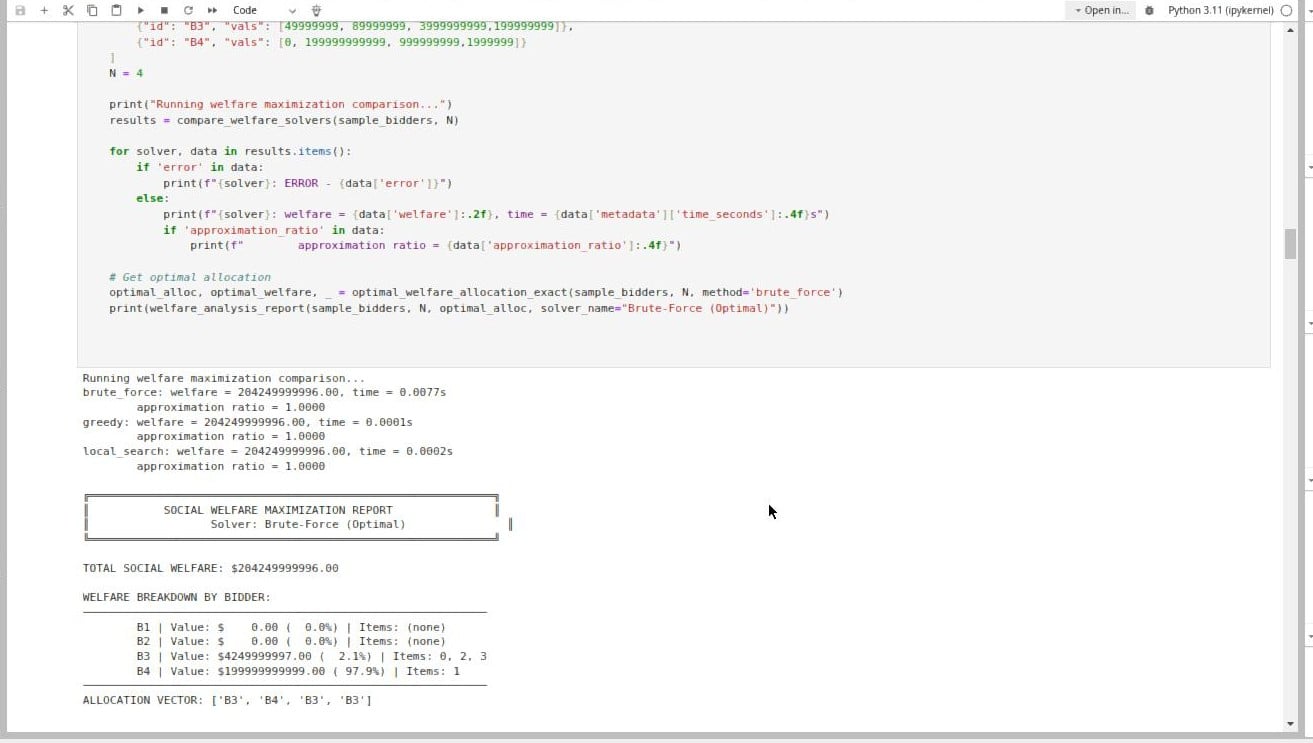
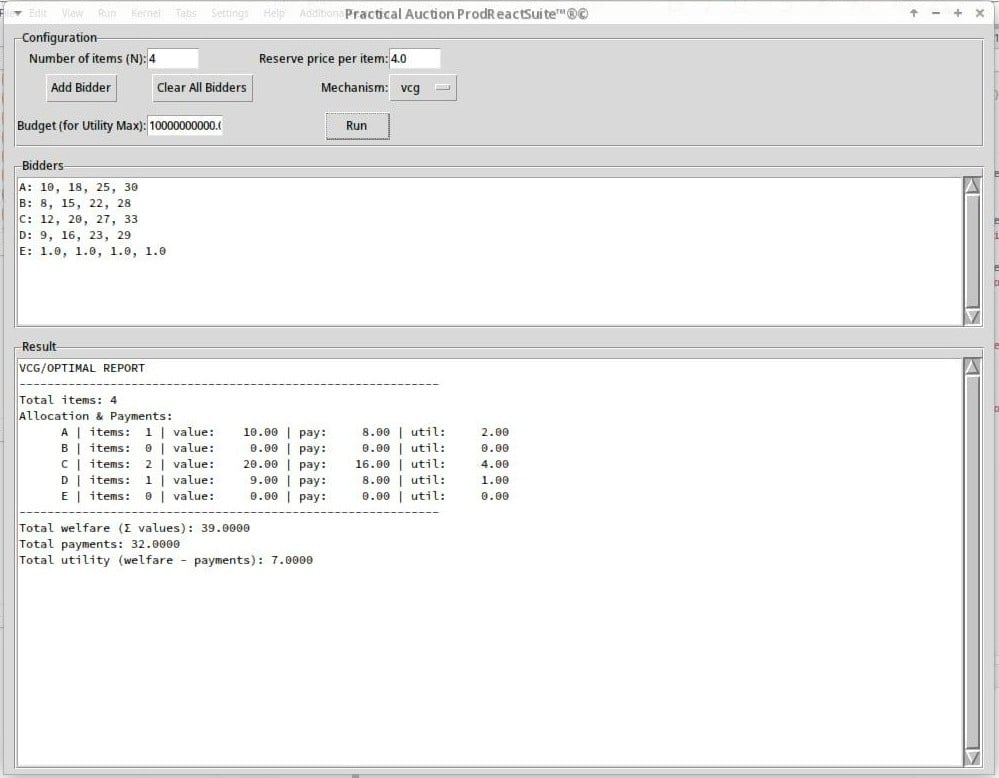
Provides exact and approximate solvers for welfare-maximizing allocations in combinatoric auctions. Supports additive valuations (default) and optional ILP for larger instances.
The advancements encompass: context- and preference-aware neural auctions, machine learning-driven auctions, maximization of consumer surplus, guarantees of liquid welfare, auction utilitarian welfare considering externalities, groupwise-pivotal referral auctions, non-autoregressive generative auctions, learning ranking policies, reinforcement learning applied to bidding strategies, and optimization of dynamic reserve prices.
Novel Hybrid Recommender Implemented in it.
Functions:
optimal_welfare_allocation_exact
individual_utilities_maximizationv
individual_utilities_maximization
Enhanced maximin allocation with:
- Multi-unit transfers
- Entropy regularization for balanced allocations
- Batch optimization mode
- Convergence tracking
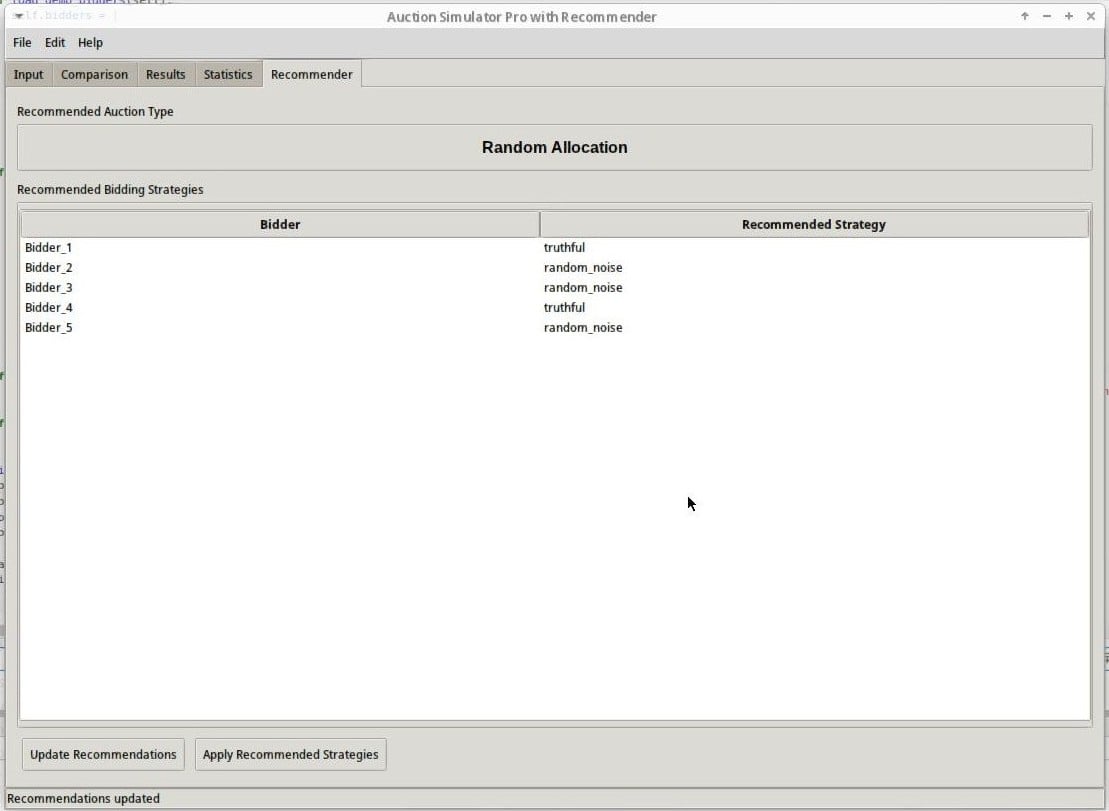
Accessible via a new "Recommender" tab. It suggests:
Best auction type for the current set of bidders.
Optimal bidding strategy for each bidder based on historical performance.
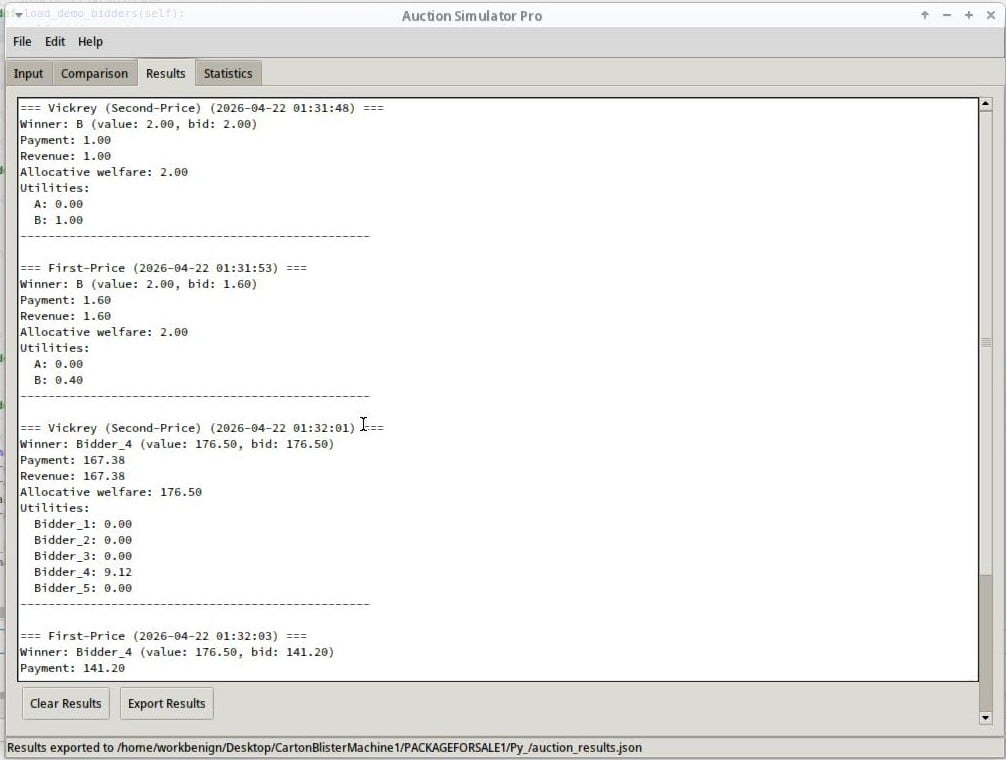
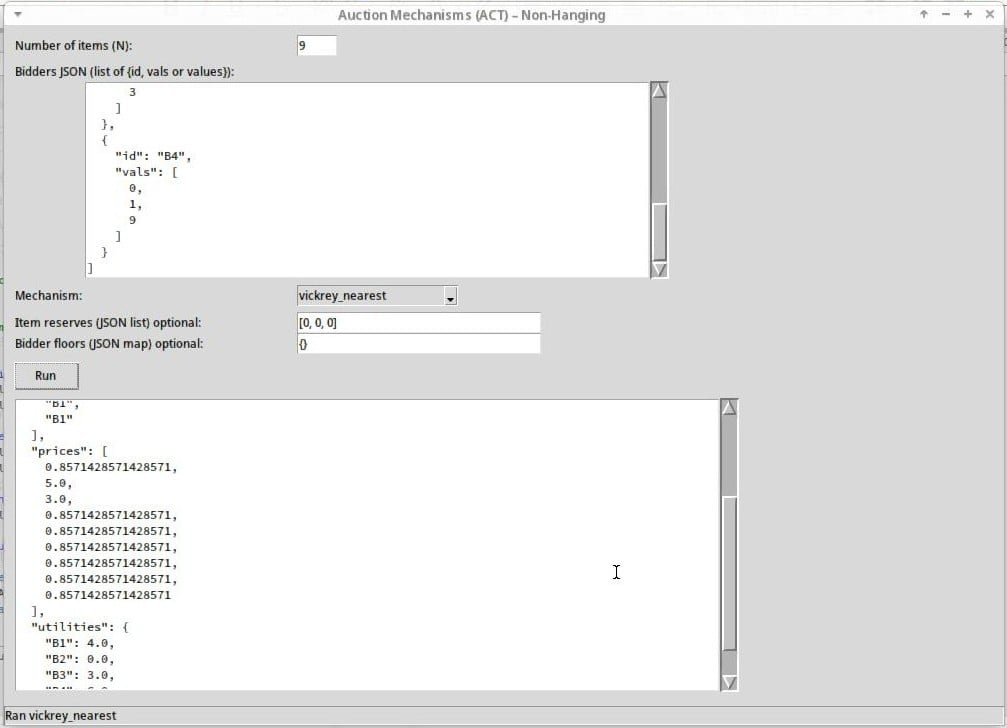
Monolithic Auction Mechanisms GUI (single-file).
Provides a runnable Tkinter app that:
- Accepts bidders with per-item valuations (list length N)
- Accepts number of items N, optional item reserves and bidder floor prices
- Runs multiple mechanisms and shows allocation, prices, utilities.
Note: This implementation favors clarity and correctness over advanced economic
features (ILP, core computations). Mechanisms are implemented with straightforward
algorithms that match expected interfaces for typical classroom / demo use.
Online learning: Update SVD incrementally instead of rebuilding from scratch after each auction.
More features: Add bidder risk‑aversion, time of day, number of items, etc.
Cold‑start handling: Use a pre‑trained model or more sophisticated heuristics when little history exists.
Neural collaborative filtering: Replace SVD with a small neural network (using PyTorch or TensorFlow) for better non‑linear interactions.
Contextual bandits: Treat recommendation as a bandit problem to explore/exploit auction types.
Explainability: Provide a textual explanation of why a certain auction type or strategy was chosen (e.g., “Because bidder values are high and spread, Vickrey tends to produce higher revenue”).
The shortcomings identified are: static strategies, a one-dimensional recommendation system, the absence of economic externalities, no dynamic reserve pricing, lack of exploration and exploitation, insufficient equilibrium learning, and a lack of fairness-awareness.
• The advancements made include: neural auctions that consider context and preferences, machine learning-enhanced combinatorial auctions, maximization of consumer surplus, guarantees of liquid welfare, auction welfare that is utilitarian with externalities, groupwise-pivotal referral auctions, non-autoregressive generative auctions, learning policies for ranking, reinforcement learning for bidding strategies, and dynamic reserve price optimization.
• The identified deficits are: static strategies, a one-dimensional recommender, no economic externalities, absence of a dynamic reserve price, lack of exploration/exploitation, insufficient equilibrium learning, and no awareness of fairness.
• The advancements noted include: context- and preference-aware neural auctions, machine learning-powered combinatorial auctions, maximization of consumer surplus, guarantees of liquid welfare, auction utilitarian welfare with externalities, groupwise-pivotal referral auctions, non-autoregressive generative auctions, learning ranking policies, reinforcement learning for bidding strategies, and dynamic reserve price optimization.
The enhanced version now includes:
Adaptive exploration (ε-greedy) to balance exploitation vs. exploration of new auction types.
Multi-objective optimization allowing user‑adjustable trade‑offs between revenue and welfare.
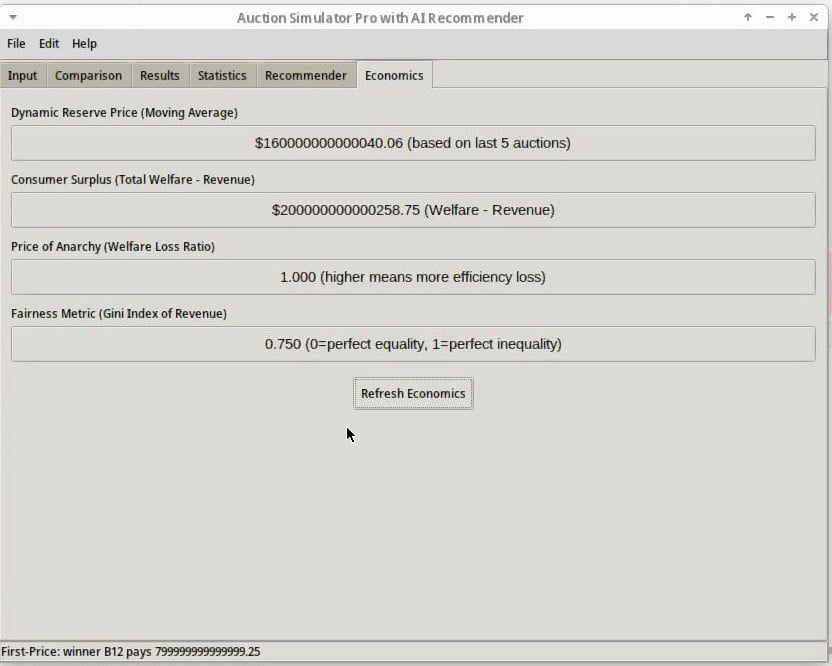
Dynamic reserve price based on moving average of historical prices.
Contextual bandits using bidder features to select optimal auction mechanisms.
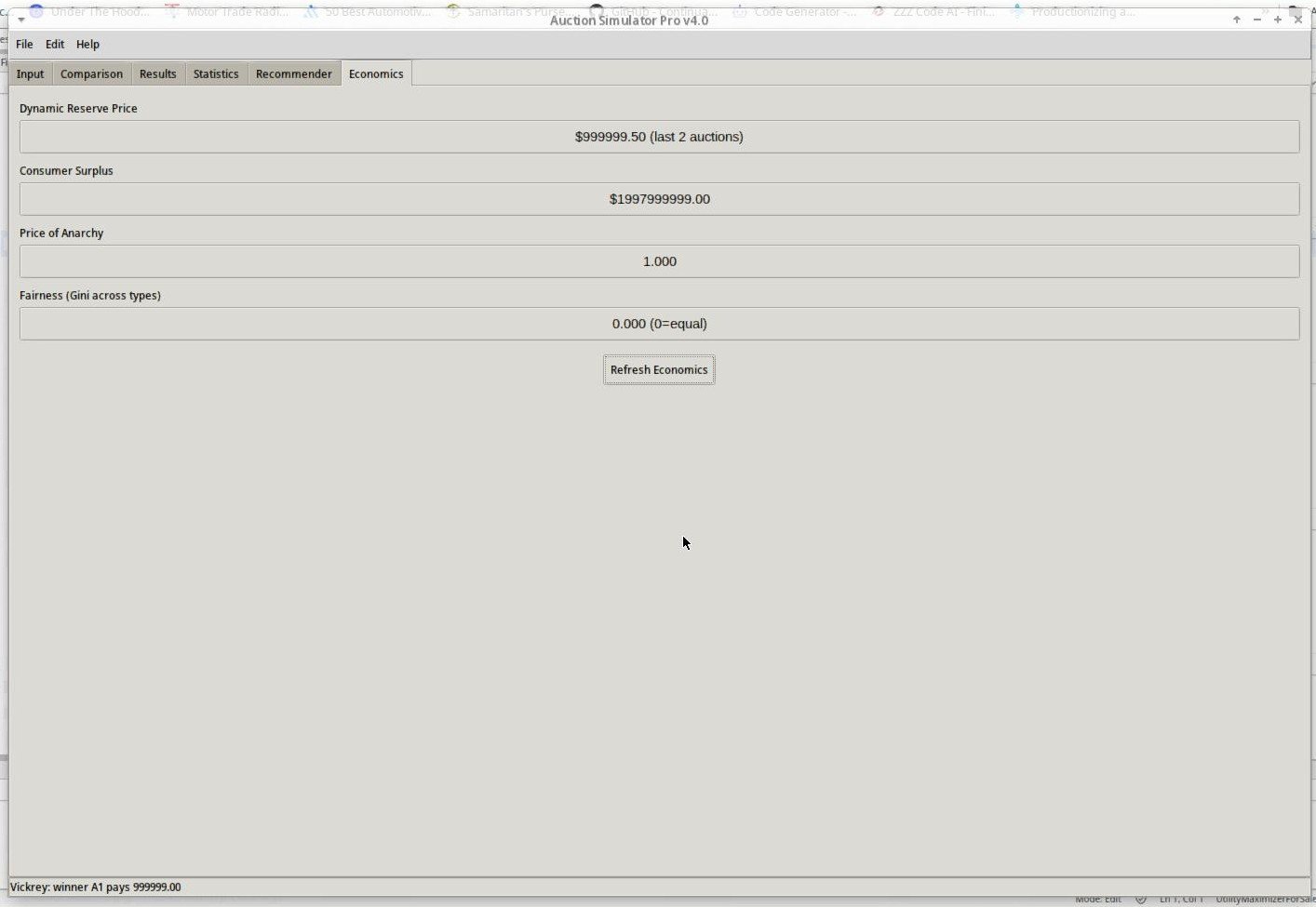
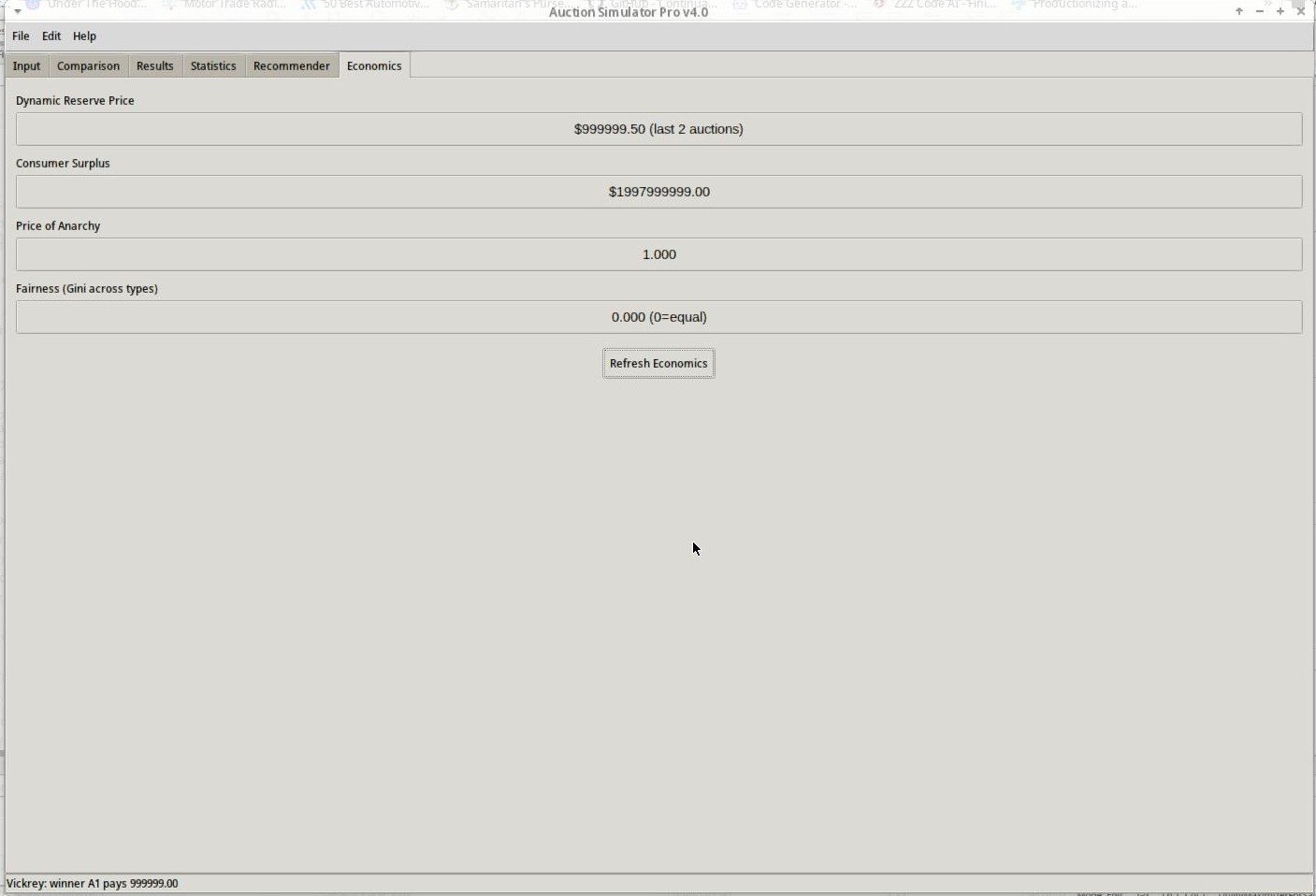
Fairness constraints (max‑min fairness) and economic diagnostics (consumer surplus, price of anarchy).
Enhanced hybrid recommender incorporating:
- Adaptive exploration (ε-greedy)
- Multi-objective optimization (revenue vs welfare trade-off)
- Dynamic reserve price based on historical data
- Contextual bandits for auction selection
- Fairness constraints (max-min fairness)
The advances include: context- and preference-aware neural auctions (CPAD), ML-powered combinatorial auctions (MLHCA), consumer surplus maximization, liquid welfare guarantees, auction utilitarian welfare with externalities (AUWE), groupwise-pivotal referral auctions (GPR), non-autoregressive generative auctions (NGA), ranking policy learning, reinforcement learning for bidding strategies, fairness-efficiency tradeoffs, and dynamic reserve price optimization.
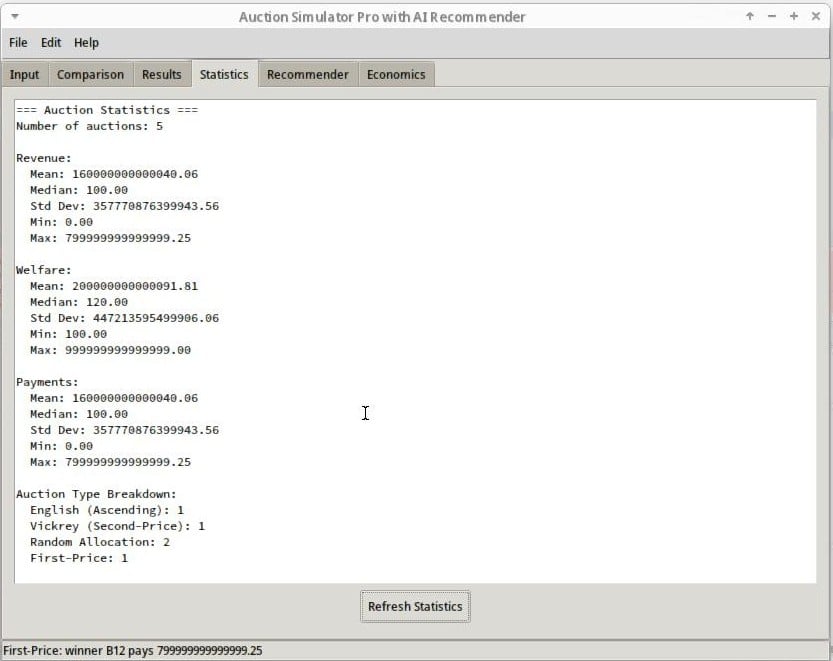
All auction types (First-Price, Vickrey, Random, English, Dutch)
Enhanced recommender with ε‑greedy exploration and fairness adjustments
Economic diagnostics (consumer surplus, price of anarchy, dynamic reserve, Gini fairness)
Multi-objective trade‑off (revenue vs welfare)
Already includes built Full GUI (console‑based for Lua and Go; Tkinter for Python; Tkinter‑like for Kotlin using Swing; browser‑based for JavaScript using HTML/CSS/JS)
Can be trans-coded to Kotlin, Go, Lua and more as per custom service request upon purchase.
Defensible Solute with feasible modular extensions/add-ons as per paid request on ITM Strike Price.
Ask me the builder for pass-codes upon buying.