
Phi Tree Mobius Synth License - Promo
Phi Tree Möbius Synth
Phi Tree Möbius Synth is an experimental MIDI synthesizer that transforms mathematical relationships into rich, evolving sound.
Built around a seven-oscillator sound engine, the instrument explores the golden ratio — Phi (φ), branching frequency structures and recursive FM modulation. It moves beyond traditional harmonic synthesis, producing everything from delicate tonal textures and organic drones to metallic movement, unstable harmonics and complex cinematic soundscapes.
Two Distinct Synthesis Modes
Spectral Tree
Spectral Tree creates a branching oscillator structure based on golden-ratio frequency relationships. Use the Morph control to move continuously between a conventional harmonic spectrum and the more unusual Phi-derived frequency tree.
The result can range from clear, musical tones to organic, suspended and subtly inharmonic textures.
Möbius Twist
Möbius Twist uses a recursive frequency-modulation chain in which the oscillators influence one another like a continuous sonic loop.
The FM Amount control takes the sound from gentle harmonic movement to aggressive metallic tones, unstable textures and abstract digital sound design.
Expressive Modulation
Phi Tree Möbius Synth includes several modulation systems that can be routed directly to important synthesis and effects parameters.
The built-in LFO offers:
- Sine
- Triangle
- Saw
- Square
- Sample and Hold
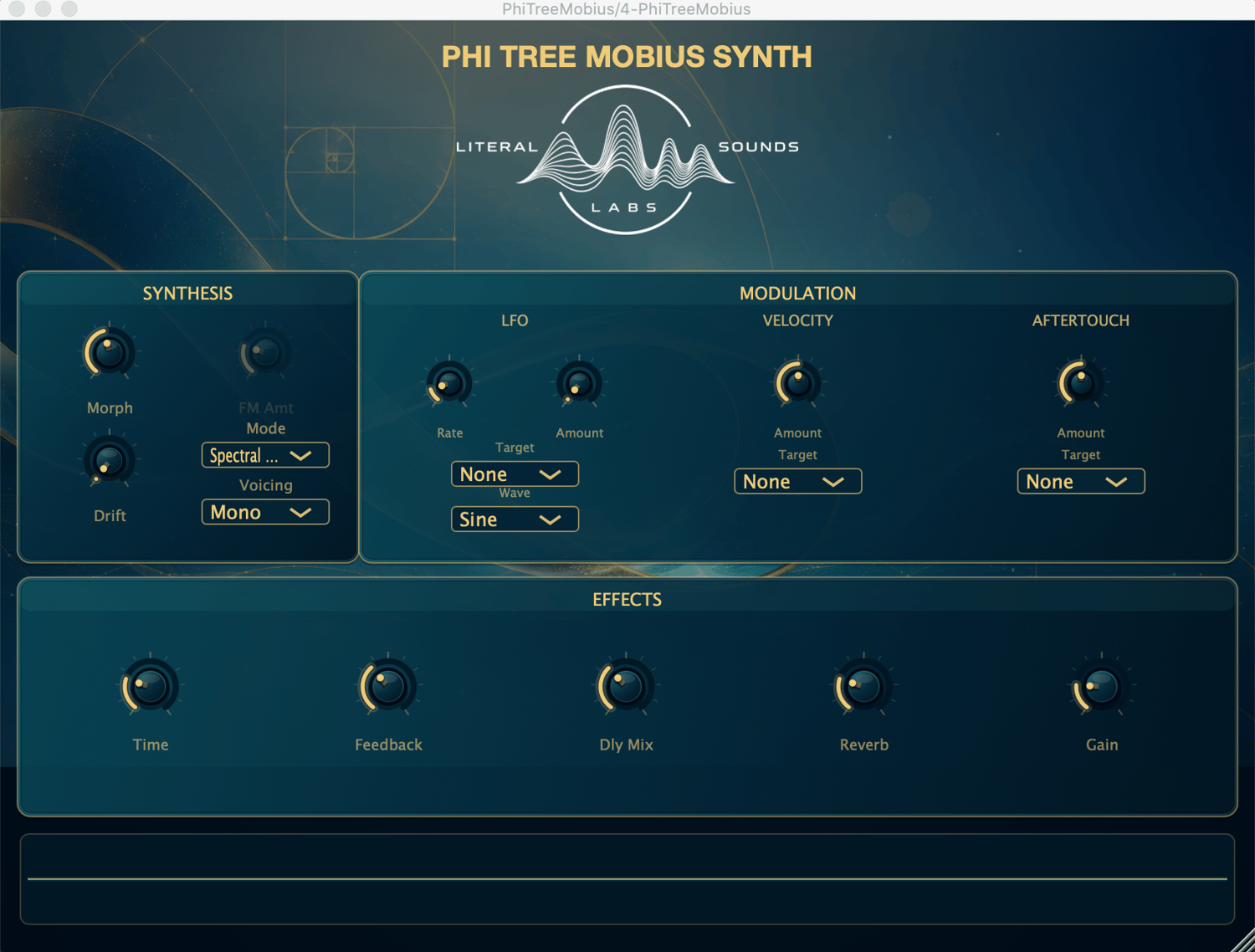
The LFO can control Morph, FM Amount, Drift, delay time or delay feedback.
MIDI velocity and aftertouch can also be assigned to these destinations, allowing the character and movement of the sound to respond directly to your performance.
Organic Movement
The Drift control introduces slow variations across the oscillator network. Instead of remaining completely static, each oscillator moves at a slightly different rate, producing natural fluctuations, beating patterns and evolving textures.
Combined with the Phi-based tuning system, Drift is especially effective for creating ambient layers, drones and sounds that continue to change while a note is held.
Built-In Effects
Shape and expand the sound using the integrated effects section:
- Adjustable delay time
- Delay feedback
- Delay wet/dry mix
- Stereo reverb
- Master output gain
- Smooth parameter transitions
- Soft saturation for controlled harmonic intensity
The delay parameters can also be modulated by the LFO, velocity or aftertouch to create animated echoes and unpredictable rhythmic movement.
Visual and Resizable Interface
The resizable interface combines a dark, golden visual style with clearly organised synthesis, modulation and effects sections.
A real-time waveform display provides immediate visual feedback while you design and perform your sounds.
Key Features
- Seven-oscillator synthesis engine
- Golden-ratio frequency architecture
- Harmonic-to-Phi Morph control
- Spectral Tree synthesis mode
- Recursive Möbius FM synthesis mode
- Oscillator Drift for organic pitch movement
- Five LFO waveforms
- Assignable LFO modulation
- Assignable MIDI velocity modulation
- MIDI aftertouch and channel-pressure support
- Integrated delay and stereo reverb
- Smooth parameter changes
- Real-time waveform display
- Resizable user interface
- Full parameter and project-state recall
Ideal For
Phi Tree Möbius Synth is designed for:
- Experimental electronic music
- Ambient and drone composition
- Cinematic sound design
- Generative and electroacoustic music
- Metallic and inharmonic textures
- Evolving pads and sustained tones
- Unusual leads and bass sounds
- Abstract effects and transitions
Phi Tree Möbius Synth is not intended to recreate a conventional analogue synthesizer. It is an instrument for musicians and sound designers who want to explore the space between mathematics, harmony, instability and motion.
Created by Literal Sounds Labs — Michel Figueiredo.