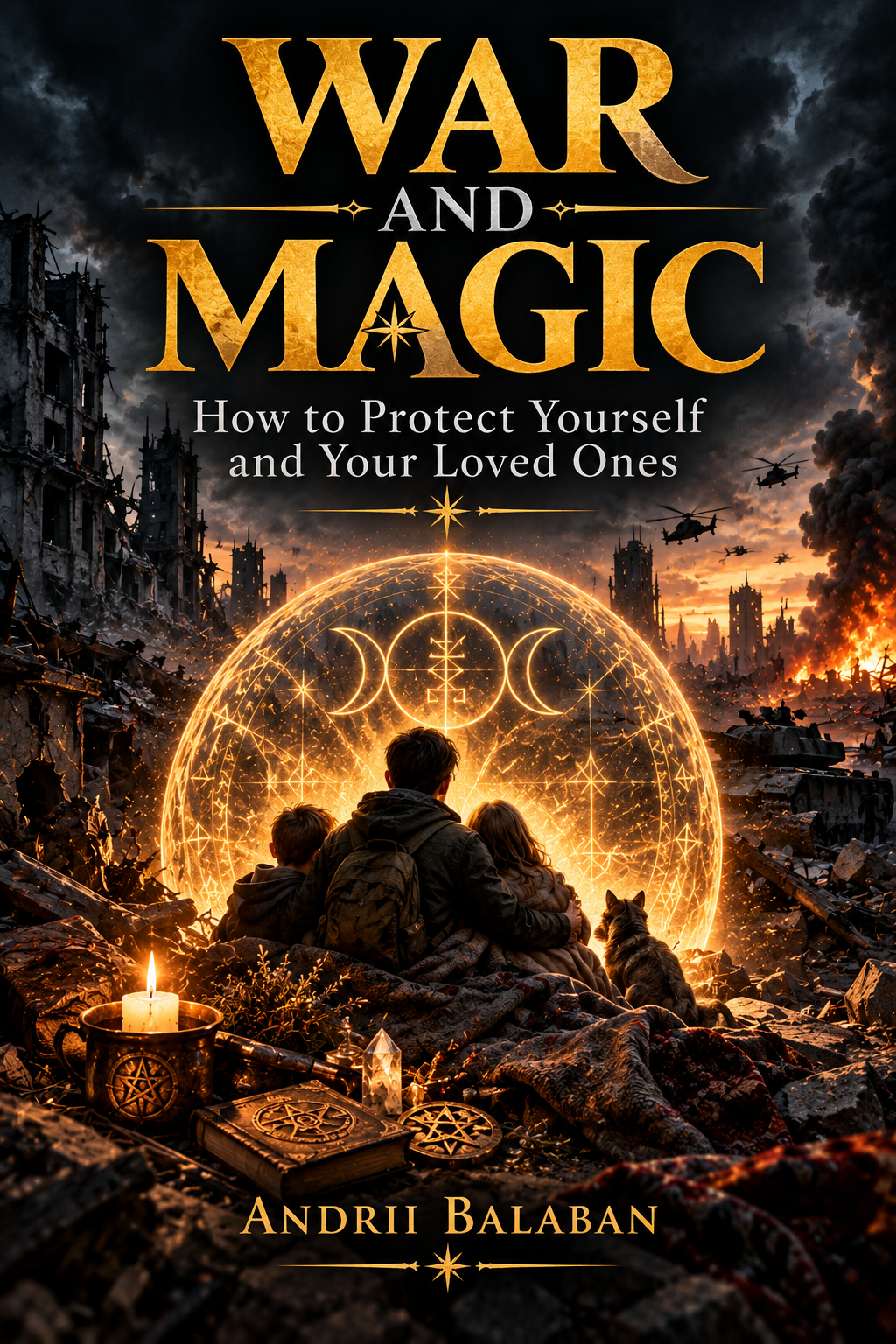
War and magic. How to protect yourself and your loved ones.
Contents
Chapter 1. The hidden structure of protective magic in wartime
This chapter establishes the fundamental principles of magical work during modern war. It examines the difference between real danger, anticipated danger, and fear; the relationship between physical, psychological, and magical protection; and the correct formulation of a protective intention. Particular attention is given to the central rule of the entire book: magical practice must accompany responsible safety measures rather than compete with them. The chapter introduces the basic symbols of wartime protection — the circle, shield, wall, gate, key, flame, stone, water, protective seal, and guardian figure — and explains how they can be organized into a coherent system.
Chapter 2. Protection of the home during missile and drone attacks
This chapter focuses on the home as both a physical place and a symbolic center of family life. It explores protective rituals for apartments and houses, magical boundaries around doors and windows, household talismans, protective seals, candles, stones, water, and formulas intended to establish calm and order. At the same time, the realities of modern aerial warfare remain central: air-raid warnings, shelters, blast waves, shattered glass, fires, loss of electricity and communications, and the possibility that a familiar home may suddenly become unsafe. The magical protection of a home is therefore presented not as a promise that the building cannot be damaged, but as a disciplined practice accompanying real preparation and responsible behavior.
Chapter 3. The protective circle: shielding yourself and your loved ones
This chapter develops the central magical operation of the book: the creation of a protective field around oneself, one’s children, partner, parents, relatives, and other loved ones. It explains individual and family protective circles, protection at a distance, personal talismans, names and photographs in ritual work, guardian symbols, and formulas of preservation. Special attention is given to situations in which family members are separated by hundreds or thousands of kilometers and the practitioner cannot physically protect them. The chapter also establishes limits intended to prevent protective ritual from becoming compulsive checking or endless repetition driven by fear.
Chapter 4. Children and magic during war
Children experience war differently from adults, yet they absorb the emotional atmosphere surrounding them with extraordinary sensitivity. This chapter examines protective rituals that can be adapted for children without frightening them or convincing them that invisible dangers surround them constantly. It explores simple symbols of safety, bedtime rituals, family protective objects, practices for entering and leaving shelters, and ways of giving frightening experiences a clear symbolic ending. The purpose is not to teach children to interpret explosions, dreams, or coincidences magically, but to use carefully structured symbolic actions to strengthen a sense of protection, family unity, predictability, and emotional stability.
Chapter 5. Magic of the shelter, evacuation, and the road to safety
War can force a person to leave home with little warning. This chapter is devoted to the magic of transition: moving to a shelter, evacuating from a dangerous area, crossing borders, traveling under uncertain conditions, and temporarily living far from home. The key, road, gate, protective stone, water, travel talisman, and boundary symbols become the principal elements of these operations. Ritual preparation is connected with practical preparation so that documents, medicines, emergency supplies, communication plans, and routes remain part of the same disciplined intention to preserve life. Special attention is given to the emotional difficulty of leaving a home without knowing when or whether one will return.
Chapter 6. Fear, panic, sleepless nights, and the magic of inner stability
Modern warfare attacks not only buildings but also the human capacity to feel safe. Repeated sirens, explosions, disturbing news, interrupted sleep, uncertainty about relatives, and prolonged expectation of danger can keep the mind in a state of constant vigilance. This chapter develops magical practices intended to give fear boundaries rather than deny its existence. Rituals involving Saturn, the Moon, the Sun, water, stones, candles, written formulas, and deliberate ritual closure are used to distinguish what is actually known from what is merely feared. The chapter also examines the danger of obsessive news monitoring, endless divination, catastrophic interpretation of silence, and the belief that remaining frightened is itself a form of protection.
Chapter 7. Protection at a distance and magic for those who are far away
One of the most painful realities of war is separation. This chapter is devoted to magical work for loved ones who live in another city or country, remain near areas of danger, serve away from home, travel frequently, or cannot be contacted immediately. Photographs, names, maps, candles, cords, circles, protective seals, and symbolic guardian figures are incorporated into carefully bounded rituals of distant protection. The practitioner learns to express love and concern without turning every period of silence into a prediction of disaster. The chapter emphasizes the difference between maintaining a symbolic connection with another person and imagining that one possesses absolute control over that person’s fate.
Chapter 8. Destruction, loss, displacement, and the magic of restoration
Protection cannot always prevent loss, and a serious magical system must have a language for what happens when protection is no longer the appropriate objective. This chapter addresses damaged or lost homes, displacement, separation, bereavement, the destruction of meaningful objects, and the painful experience of returning to places transformed by war. Rituals of mourning, purification, release, remembrance, recovery, and the establishment of a new protective space are presented as ways of marking transitions that reality has already imposed. The chapter rejects the idea that tragedy proves insufficient faith, weak magic, incorrect ritual, or personal guilt.
Chapter 9. The ethics and discipline of wartime magic
War creates conditions in which fear, anger, hatred, grief, hope, rumor, propaganda, intuition, and genuine information can become dangerously entangled. This chapter examines the ethical and psychological discipline required of the practitioner. It addresses divination during crises, rumors presented as magical knowledge, false promises of invulnerability, people who exploit fear for money, the temptation to interpret every coincidence as supernatural information, and the responsibility never to persuade another person to ignore real danger because of an occult claim. The practitioner learns that serious protective magic requires humility before reality and that uncertainty must sometimes remain uncertainty.
Chapter 10. The complete art of war and protective magic
The final chapter brings the entire system together into a complete practice of wartime protection. It integrates the protection of the individual, family, children, home, travel, shelter, distant relatives, emotional stability, and recovery after danger into a single coherent magical framework. A complete protective rite is developed in which the circle, shield, gate, key, candle, water, stone, talisman, names of loved ones, and carefully formulated protective words each receive a specific function. The chapter also explains when protection should be renewed, when a ritual should be closed, how the system changes after evacuation or the end of an immediate threat, and how eventually to release the habits of wartime vigilance when circumstances permit. The final principle is simple: magic should help a person remain human within circumstances that continually threaten to reduce life to fear.