
Airwave Radio Procedure Trainer | Interactive Police Radio Simulator — BTEC Uniformed Public/Protective Services Unit 5
Hand your students a working police radio — and make them get the procedure right.
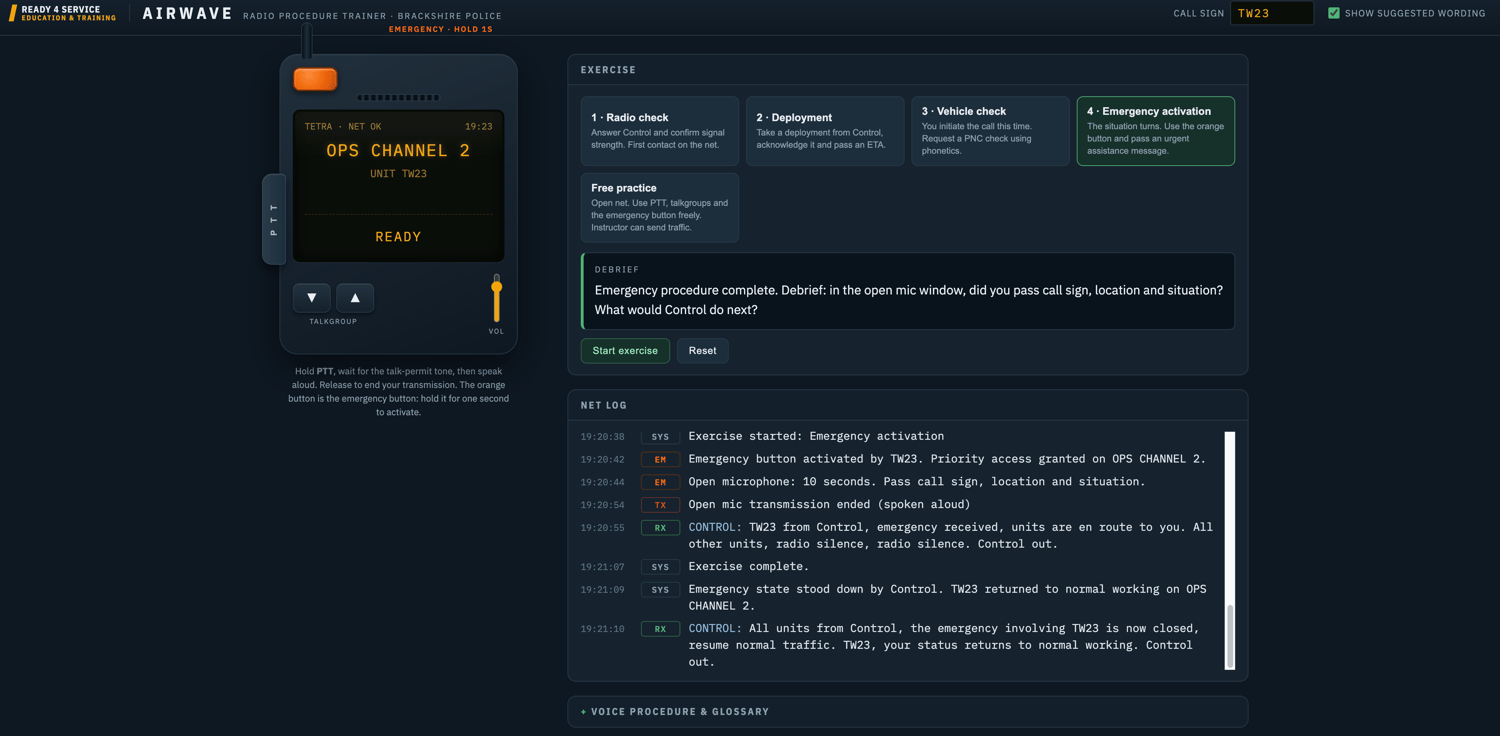
The Airwave Radio Procedure Trainer is a realistic TETRA handset your students operate on the fictional Brackshire Police net in the (fictional) town of Calderwick. They hold push-to-talk, wait for the tone, and speak aloud to the room. Control answers in a UK voice. They learn the calling sequence, the phonetic alphabet, prowords, and the emergency button — the way it's actually done.
Four guided exercises take them from a routine radio check, through a deployment and a vehicle check using phonetics, to a full emergency activation with a live open-mic window. A free-practice mode lets you inject traffic at will. A "show suggested wording" toggle scaffolds early attempts, then switches off so they construct transmissions unaided.
Why it's different:
- It runs itself. One file, any browser, no install, no login. Control's voice, talk-permit tones and net static are all generated in-browser.
- Genuinely hands-on. Real push-to-talk (mouse, touch, or spacebar for the projector), talkgroup switching, volume, and an emergency button modelled on a real handset — hold it for one second to activate.
- Built for the room. Run it on the board and bring students up one at a time, or set them off in pairs to operate and assess each other.
- No assumed knowledge. Full voice-procedure reference and glossary built in — phonetic alphabet, prowords, calling sequence and system terms.
What you get:
- The interactive trainer (single HTML file — projector or devices, online or offline)
- A 7-page teacher pack (PDF) with: honest Unit 5 mapping, a one-page lesson plan, a ready-to-print observation record for assessing Learning aim C, reasonable-adjustments guidance, and model report extracts at Pass, Merit and Distinction
- A printable glossary
Curriculum fit: Primary fit is Unit 5, Learning aim C — the unit content names Airwave, the phonetic alphabet and standard voice procedure directly. The evidence for aim C is your witness/observation record of the student using the system (template included), supported by their written report; this is the activity you observe, not a Pearson-set task. Cross-reference the current specification and confirm with your IV/IQA.
Format & requirements: One HTML file. Any modern browser. Speakers needed for Control's voice — it uses the browser's built-in speech, so do a 30-second test on your classroom machine first (Edge and Chrome on Windows have good UK voices).
© Ready 4 Service Education and Training. Single-centre use; not for resale or redistribution. An independent teaching resource, not endorsed by or affiliated with Pearson.
See also my VHF Maritime Radio Simulator