

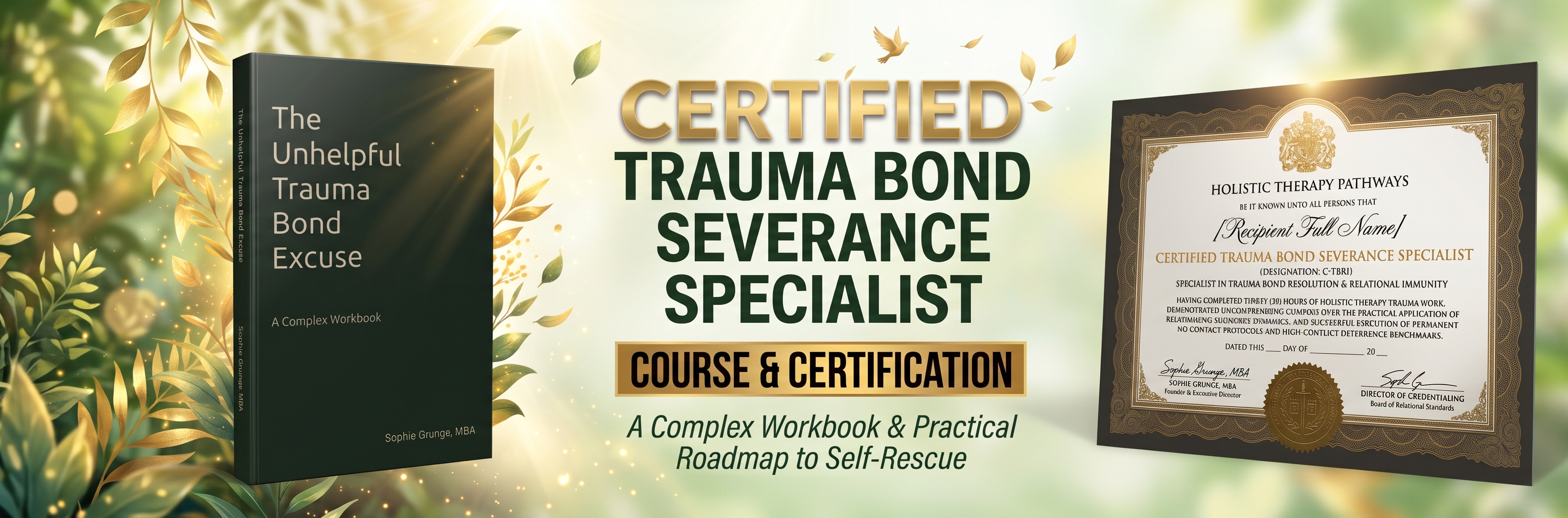
Trauma Bond Severance Specialist
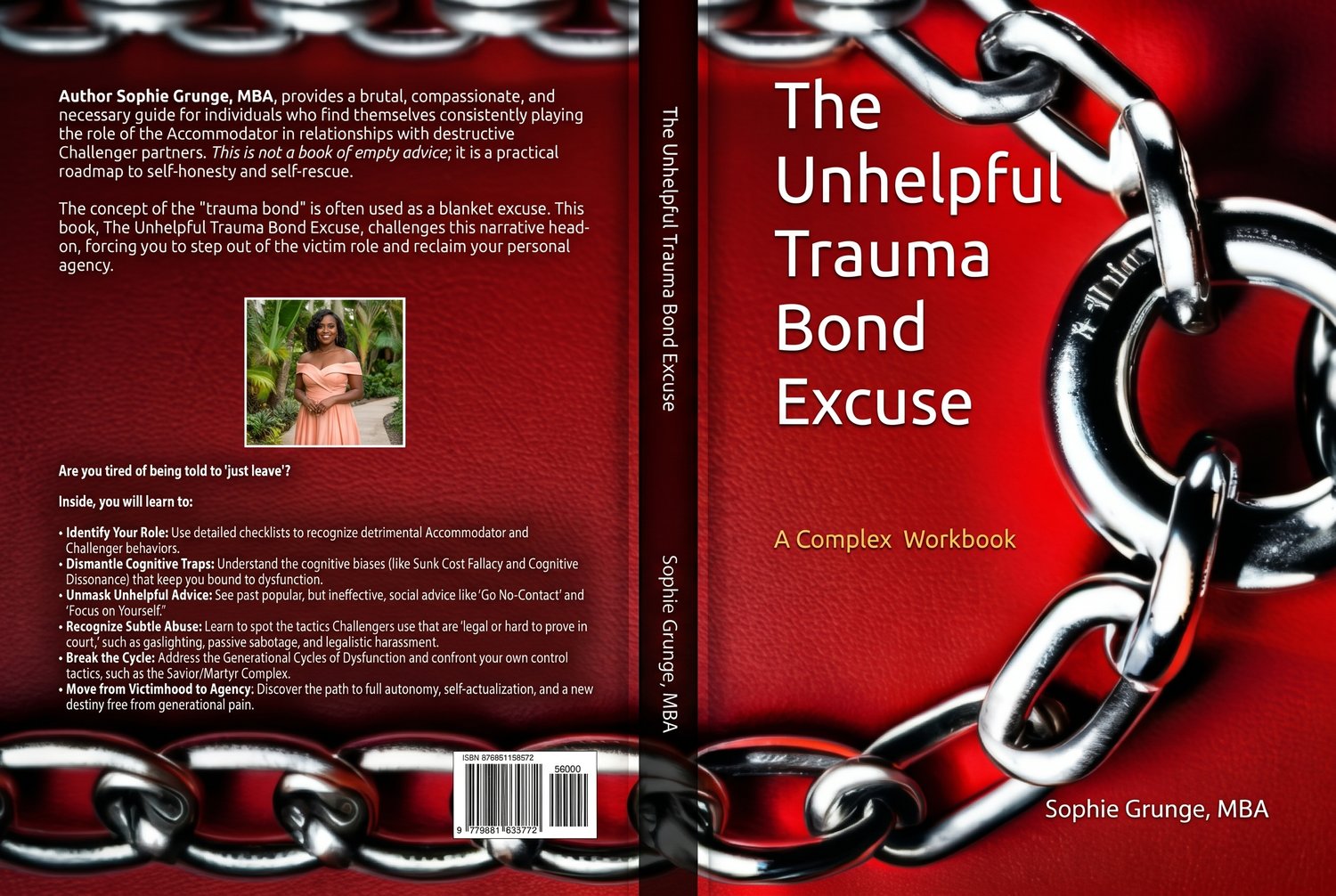
The Trauma Bond Severance Specialist Certification is a course created by the author Sophie Grunge, MBA, after she wrote her first ever published complex workbook The Unhelpful Trauma Bond Excuse in 2026. This course is for those struggling to let go, move on, find autonomy, and accept accountability by learning practical ways to get your needs met, respect your own boundaries, and deal with high-conflict personalities, including relationships with narcissistic individuals or abusers.
This certification program is for those that have not found much help with the typical advices and explanations that never helped the author Sophie Grunge in her years of trying to escape a relationship that nearly ended her life. If you're tired of hearing:
"Just focus on yourself."
"Leave! Run!"
"Respect yourself more."
"You have low self-worth/self-esteem."
"You're in a trauma bond."
"Why do you attract these types of people?"
"You need therapy."
"You don't need their validation."
"Where do you meet this person?"
"Awww, but that's your... [sibling/parent]. They're your family."
"Stay positive. Be grateful."
"Why don't you just leave?"
"It's because of intermittent reinforcement. It's not your fault."
"Go no-contact."
"Not saying it's going to be easy, but I'm also not going to offer you any real help or support, either, just more typical, unhelpful advice. I will judge you and talk behind your back though!"
That's because it is the only advice society, therapists, friends, family, and strangers are capable of giving. They're vague, unhelpful, and if they're not victim-blaming or insulting your worth, they're telling you to leave without guaranteeing any real support during or after you make that big, terrifying decision to finally move on with your life.
This course is going to do the opposite of giving politically safe advice or unhelpful support. It's not going to coddle your feelings. It's not going to be afraid to tell you the truth you don't want to hear. This course has one primary goal in mind: Help you break free from the brainwashing fantasies and beliefs that are holding you back from being your true authentic, unadulterated self. What no one told me and what I have never heard anyone say is that the key to overcoming any dysfunctional relationship is training; it's practice.
Some of us had very little training or maybe only training to be the best person and partner no matter what. Some were trained to be selfish. Each and every one of us are dealt different cards in life, given different types of guidance based of our culture, religion, family, environment, etc. If you receive no training in how to deal with high-conflict personalities, no training in how to cope in certain situations, and no clue how to properly vet individuals, then "leaving" and "focusing on yourself" isn't going to accomplish severance.
Pre-Requisite to the Course
It is highly recommended to do the workbook prior to the course to see if the author's unfiltered, straightforward approach is right for you. Author Sophie Grunge has spent decades in-and-out of therapy finding that those one-hour therapy sessions 1-4x month takes too long and costs too much. 1-4 hours of your life a month while you are literally struggling and needing help or support more than that begins to feel like an ineffective process. One can even assume it's motivate by capitalistic greed. We all have to make a living, and repeat clients keeps the money flowing. If therapy patients got way more rehabilitative, thorough assistance personal to their own unique situations, these therapists would be out of the job. There is a sense of urgency where time is precious and those that really want to get help prefer to skip the validation speeches, the emotional hand-holding, and the annoying advice that comes in the indirect form of questions that's left to be open to misinterpretation. If you choose not to read the book and dive right in with a leap of faith, you will not receive a refund for having buyer's remorse.
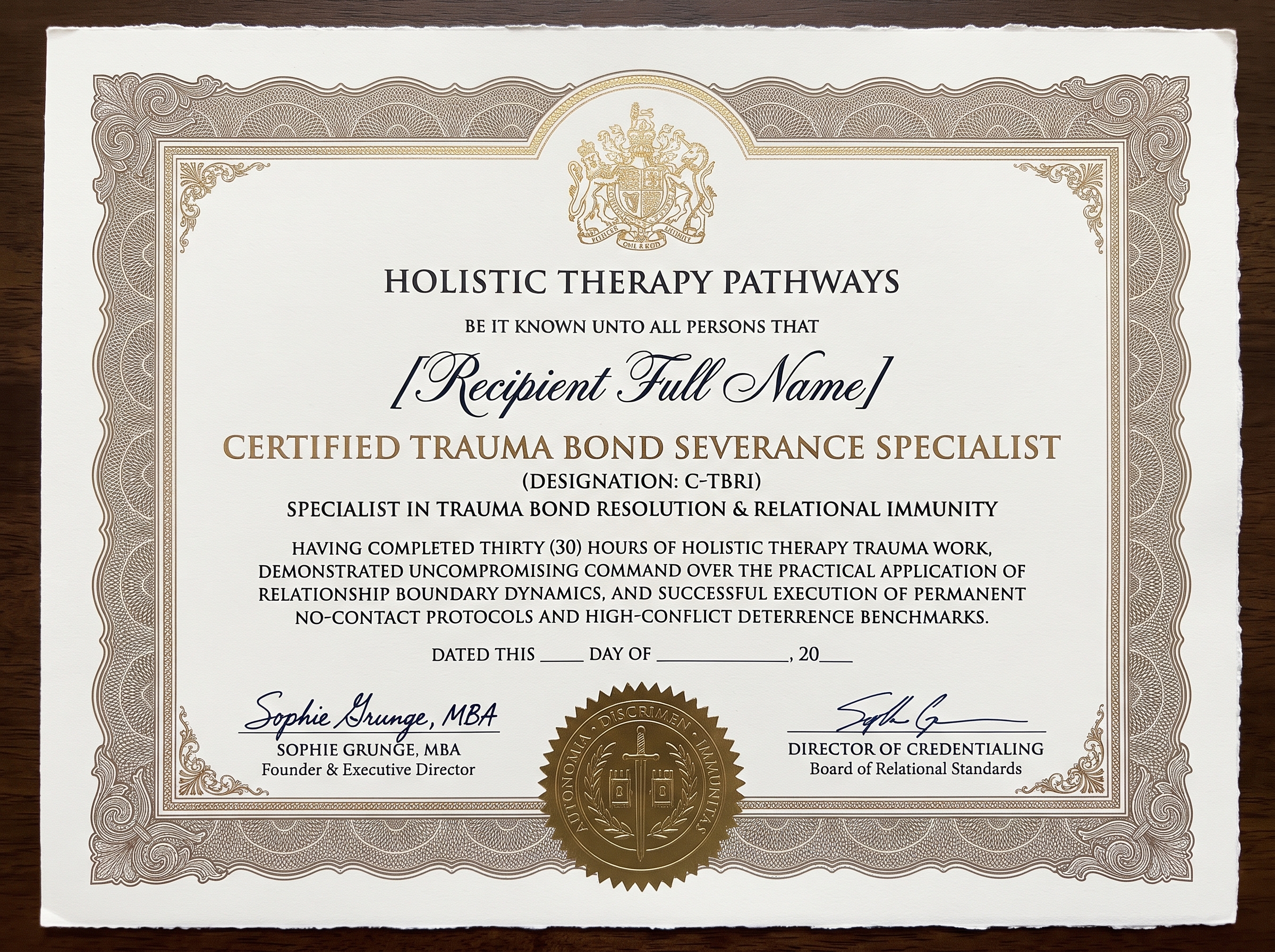
Trauma Bond Severance Specialist Certification course
$99
This certification curriculum is designed to dismantle conventional, ineffective relationship advice and replace it with pragmatic, accountability-driven strategies for severing ties with high-conflict personalities. The program focuses on neutralizing the Generational Cycles of Dysfunction (GCD) through rigorous self-assessment, radical acceptance, and unconventional deterrence tactics.
Course curriculum
Trauma Bond Severance Specialist Certification (TBSSC)
Curriculum Developer: Sophie Grunge, MBA
Prerequisite: Completion of The Unhelpful Trauma Bond Excuse workbook.
This certification curriculum is designed to dismantle conventional, ineffective relationship advice and replace it with pragmatic, accountability-driven strategies for severing ties with high-conflict personalities. The program focuses on neutralizing the Generational Cycles of Dysfunction (GCD) through rigorous self-assessment, radical acceptance, and unconventional deterrence tactics.
Module 1: Deconstructing the "Trauma Bond" and Embracing Accountability
Objective: Eradicate the victim/perpetrator binary and establish the Challenger/Accommodator framework to restore personal agency.
- The Unhelpful Excuse: Why clinical labels like "trauma bond" often paralyze action and excuse mutual participation in dysfunctional cycles.
- The Challenger vs. Accommodator Dynamic:
- The Challenger: Identifying traits of high-conflict personalities, entitlement, and the drive for superiority.
- The Accommodator: Confronting enabling behaviors, hypersensitivity, and the subconscious control exerted through self-sacrifice.
- Victimhood vs. Agency: Differentiating between being an undeniable victim of random harm, adopting a victim mentality (learned helplessness), and engaging in victim-blaming/self-blaming.
- The Healthy Mindset: Mastering Radical Acceptance (acknowledging the uncontrollable) and Response-Ability (maximizing internal control).
Module 2: Cognitive Biases and the Failure of Conventional Support
Objective: Analyze how cognitive shortcuts and standard societal advice trap Accommodators in toxic relational loops.
- The Psychology of Entrapment: Identifying the Sunk Cost Fallacy, Cognitive Dissonance, Confirmation Bias, and Emotional Scarcity in relationship decision-making.
- Decoding Unhelpful Advice: Why platitudes like "Just leave," "Go no-contact," "Love yourself," and "Focus on yourself" fail without practical, logistical scaffolding.
- The "Stay and Complain" Epidemic: Understanding the destructive nature of venting without action, how it models inaction for children, and how it damages the credibility of genuine abuse victims.
- Structuring Real Support: Transitioning from passive advice to the "Show-up-and-extract" method, "Pool and place," and actionable community interventions.
Module 3: Profiling and Countering the Challenger
Objective: Equip specialists with unconventional, evidence-based tactics to neutralize legalistic and psychological manipulation.
- Legally Permissible Sabotage: Recognizing tactics that exploit legal gray areas, including infidelity, passive sabotage, withholding information, and public image management.
- Dismantling Gaslighting and Isolation: Strategies for documenting reality, preserving external networks, and utilizing "Verified Patterns."
- The Unconventional Deterrence Strategy:
- Shifting from "prey" (submissive) to "enforcer" (predator-deterrent) by refusing circular arguments and imposing immediate consequences.
- When and how to use "Mirroring" to expose a Challenger’s double standards (with strict safety caveats).
- Legalistic Harassment Defense: Navigating frivolous filings and custodial manipulation through meticulous documentation and procedural countermeasures.
Module 4: The Accommodator’s Trap and Generational Dysfunction (GCD)
Objective: Force extreme self-reflection on the Accommodator's covert control tactics and their role in perpetuating generational trauma.
- The GCD Blueprint: How cultural reproduction, institutional self-interest, and religious/familial norms condition individuals to tolerate mistreatment.
- Covert Control Tactics:
- The "Fixer" Trap: How chronic caretaking fosters dependency.
- People-Pleasing as Manipulation: Using the "Radical Honesty Filter" to expose the true emotional cost of overcommitting.
- Intimacy Avoidance: Using busyness and external drama to dodge genuine vulnerability.
- The Morality of Procreation: Confronting the cruelty vs. mercy of bringing children into established cycles of severe dysfunction and instability.
Module 5: Dire Situations and Lethality Management
Objective: Provide strategic frameworks for surviving and escaping physically violent or lethal relationships when systemic protections fail.
- Assessing Lethality Risk: Identifying the escalation timeline and the "Final Act of Defiance" trigger.
- The "Death-or-Prison" Dilemma: Navigating the grim reality of self-defense when evidence is scarce and the legal system fails to protect.
- The "Disappear-and-Sacrifice" Strategy: Executing an untrackable, abrupt exit to ensure immediate survival.
- Psychological Disruption: Lawful, indirect strategies to keep a Challenger focused on defense and damage control while the Accommodator fortifies their exit plan.
Module 6: Relational Distinctions and Dismantling Fantasies
Objective: Train individuals to differentiate between authentic connection and self-deception.
- Key Unhelpful Distinctions:
- Verifying vs. Carelessness: Implementing the "Specific Example Technique" to vet partners instead of relying on blind faith.
- Attraction vs. Ideation: Utilizing the Idealization Self-Assessment to separate reality from fantasy.
- Acceptance vs. Tolerating: Distinguishing between embracing a partner's authentic flaws and dangerously enduring destructive behaviors.
- Empath vs. Superiority: Recognizing when "high sensitivity" is weaponized to patronize or judge others.
- Shattering Generational Fantasy Cycles (GFCs): Actionable steps to destroy the "Perfect Partner," "Someday Success," "Family Reunion Healing," and "If I Had X" fantasies.
Module 7: Navigating Extrinsic Value and Radical Independence
Objective: Reconcile modern therapeutic ideals with real-world socio-economic hierarchies to foster genuine autonomy.
- Intrinsic vs. Extrinsic Value: Why diagnosing a victim with "low self-worth" is often a privileged, inaccurate dismissal of their limited extrinsic options (financial, social, cultural).
- The Impracticality of "Never Settle": Understanding the socioeconomic risks of leaving a relationship without an established safety net.
- Overcoming Social Gaslighting: Rejecting societal, religious, and familial guilt designed to keep individuals compliant in toxic roles.
- Achieving Self-Actualization: Applying the SMART framework to build non-negotiable autonomy in decision-making, finances, career, and emotional independence.
Final Practicum and Certification Exam
- Case Study Analysis: Trainees must evaluate complex relationship scenarios, correctly identifying Challenger tactics and Accommodator enabling behaviors without using traditional "victim/abuser" labels.
- Action Plan Formulation: Drafting a complete, logistical "Extraction and Autonomy Plan" for a theoretical client, demonstrating proficiency in the Grunge Method's unconventional solutions and boundary enforcement.