
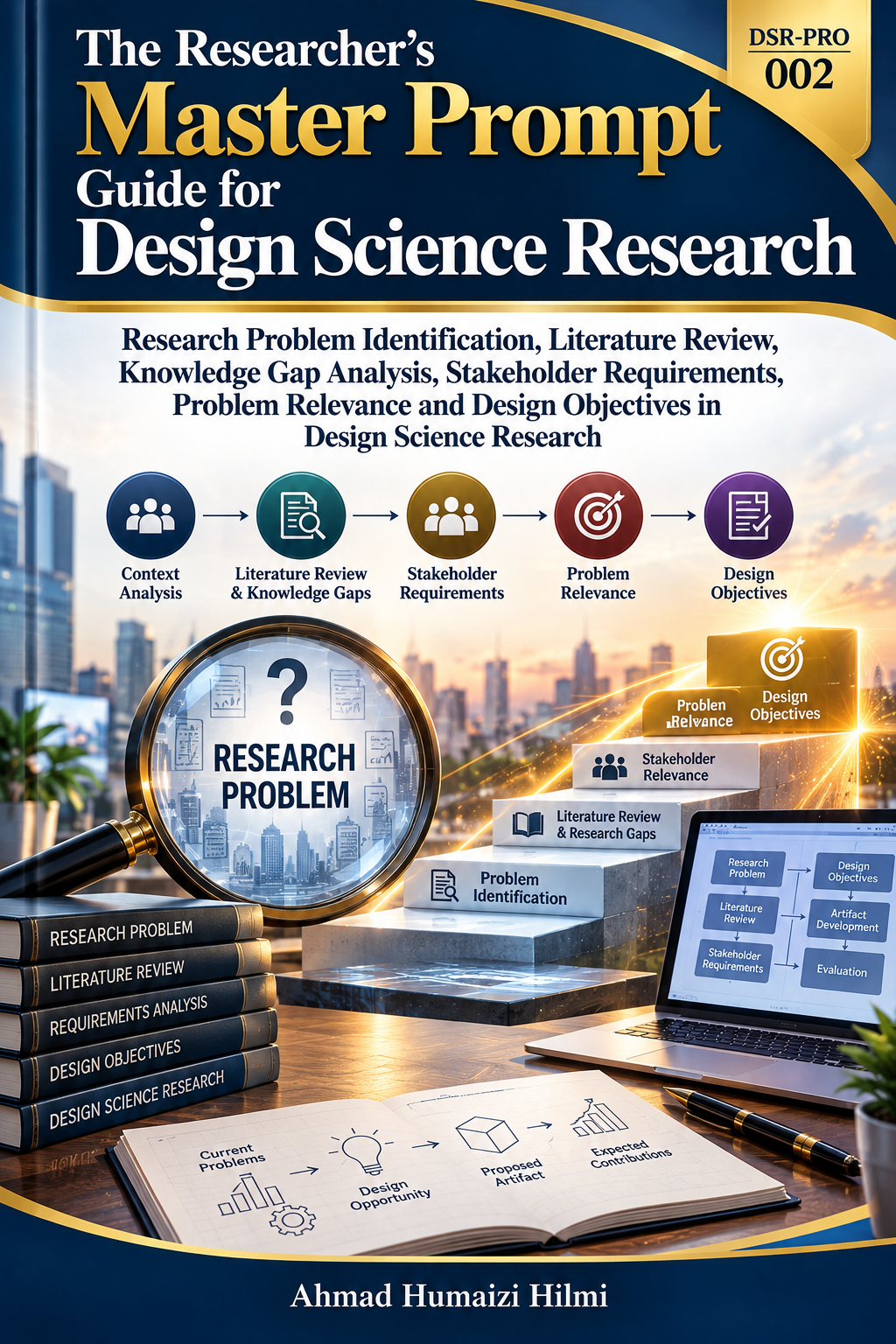
2. DSR-PRO-002 — Research Problem Identification, Literature Review, Knowledge Gap Analysis, Stakeholder Requirements, Problem Relevance and Design Objectives in Design Science Research
Description
This Master Prompt provides a comprehensive methodological framework for identifying, analyzing, conceptualizing and translating real-world problems into scientifically meaningful Design Science Research investigations. It examines the relationships among organizational challenges, technological limitations, operational inefficiencies, stakeholder needs, environmental constraints, existing solution deficiencies, theoretical knowledge gaps and opportunities for artifact-driven innovation. Particular emphasis is placed on distinguishing practical problems from research problems, identifying unresolved limitations in existing artifacts, establishing the relevance and significance of the research context, and developing evidence-based justifications for proposing new design solutions. The framework incorporates systematic literature reviews, scoping reviews, narrative evidence synthesis, bibliometric analysis, problem structuring, stakeholder analysis, requirements elicitation, focus group discussions, expert interviews, observational studies, document analysis, contextual inquiry, process mapping and comparative evaluation of existing solutions. Researchers are guided in developing problem statements, defining research boundaries, identifying stakeholder expectations, establishing functional and non-functional requirements, constructing problem–solution relationships, formulating research questions and objectives, and translating theoretical and practical knowledge into measurable design requirements. The Master Prompt also addresses the identification of design opportunities, assessment of problem complexity, evaluation of contextual constraints, prioritization of requirements, development of problem relevance matrices, and establishment of traceability between identified research gaps, artifact objectives, design specifications and evaluation criteria. Particular attention is given to ensuring that proposed artifacts address authentic research problems rather than merely reproducing existing technological solutions, thereby strengthening the scientific relevance, methodological justification and practical significance of Design Science Research.