
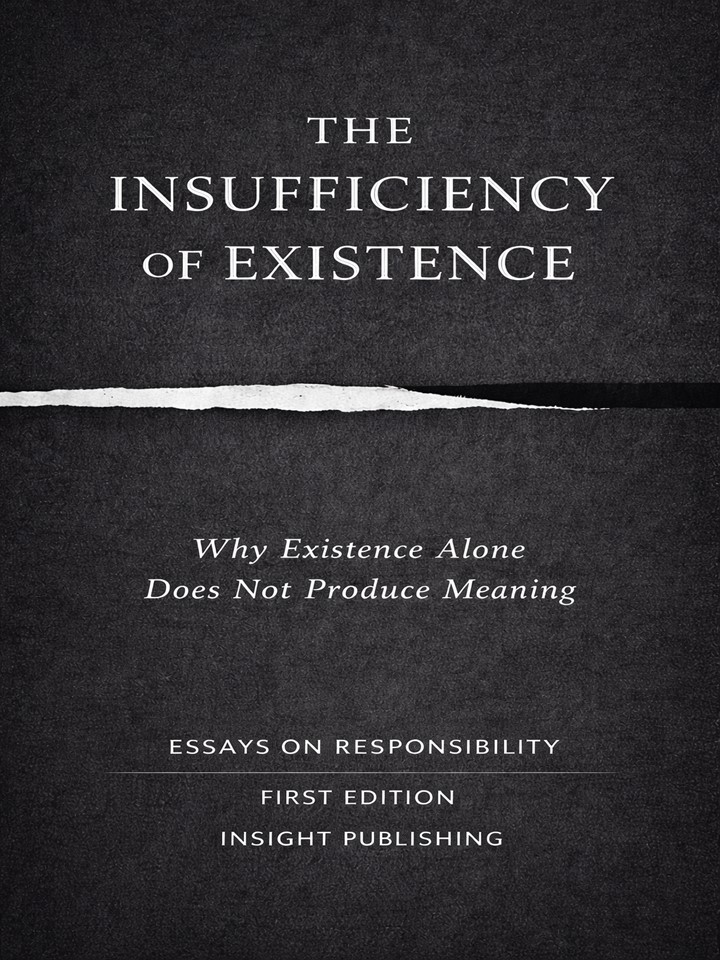
The Insufficiency of Existence Why Existence - Alone Does Not Produce Meaning
This book examines a common but rarely questioned assumption: that existence, by itself, should eventually produce meaning, value, or justification.
The Insufficiency of Existence is not an argument for nihilism or despair. It is an examination of expectation. It challenges the belief that being here, enduring time, accumulating experience, or surviving difficulty carries an inherent claim to meaning.
The book begins by treating existence as a given condition rather than an achievement. Continuity is shown as neutral, not directional, and persistence as insufficient to justify purpose. Experience, effort, success, and suffering are examined as quantities that promise meaning through accumulation, yet repeatedly fail to deliver it.
As the argument deepens, the focus shifts to the expectations placed on being itself. The book explores the unspoken demand that existence should explain itself, reward endurance, or provide reassurance. It shows how meaning is often misused as comfort rather than orientation, and how reality’s neutrality is frequently misread as failure or absence.
Rather than resolving this tension, the book locates responsibility precisely where guarantees disappear. Meaning is not inherited from existence. It emerges from judgment exercised without assurance. Action is examined in a world that does not complete itself, where choices do not promise closure, payoff, or coherence.
The final section addresses life after the assumption is removed. Orientation replaces expectation. Deliberate action replaces waiting. Meaning is treated not as something produced by time or survival, but as something constructed under conditions that offer no confirmation.
There is no consolation and no final synthesis. Only disciplined reasoning applied to a condition that remains incomplete by design.
The Insufficiency of Existence is part of Essays on Indifference, a series examining neutrality, continuity, and non-response as fundamental conditions of existence.
Existence continues. Meaning does not follow automatically.
TABLE OF CONTENTS
Preface - Why Existence Is Not Enough - 9
A short framing of the problem this book addresses.
Not nihilism, not despair, but the widespread assumption that existence, by itself, should eventually produce meaning, value, or justification.
Part I — Existence Without Credit
1. The Given Condition - 13
Existence as a starting point, not an achievement. Why being here carries no inherent claim to value or purpose.
2. Neutral Continuity - 17
Why time, persistence, and survival continue without direction, and why continuity is often mistaken for justification.
3. The Accumulation Illusion - 21
Experience, effort, success, and suffering as quantities that promise meaning but fail to deliver it.
Part II — The Expectations We Place on Being
4. The Unspoken Demand - 25
What humans silently expect existence to provide, and how those expectations distort judgment.
5. Comfort Disguised as Meaning - 31
How meaning is often used as reassurance rather than orientation, weakening clarity instead of strengthening it.
6. The Misreading of Reality - 35
Reality as neither instructive nor hostile. Why neutrality is frequently misinterpreted as failure.
Part III — Responsibility Without Assurance
7. The Absence That Creates Obligation - 41
Why responsibility emerges precisely because meaning is not given, and why that responsibility carries no guarantees.
8. Choice Without Completion - 445
Action in a world that does not resolve itself. Acting without the expectation of closure, payoff, or final coherence.
Part IV — Living After the Assumption Is Removed
9. Orientation Without Promise - 51
What remains once existence is stripped of automatic meaning, and how orientation replaces expectation.
10. Acting Under Insufficiency - 55
Living deliberately when existence is understood as necessary but incomplete.
Final Executive Summary — Meaning Is Not Inherited - 59
A disciplined consolidation of the book’s position. Meaning is not produced by existence, time, or endurance. It is constructed through orientation, judgment, and responsibility, without assurance of completion.