
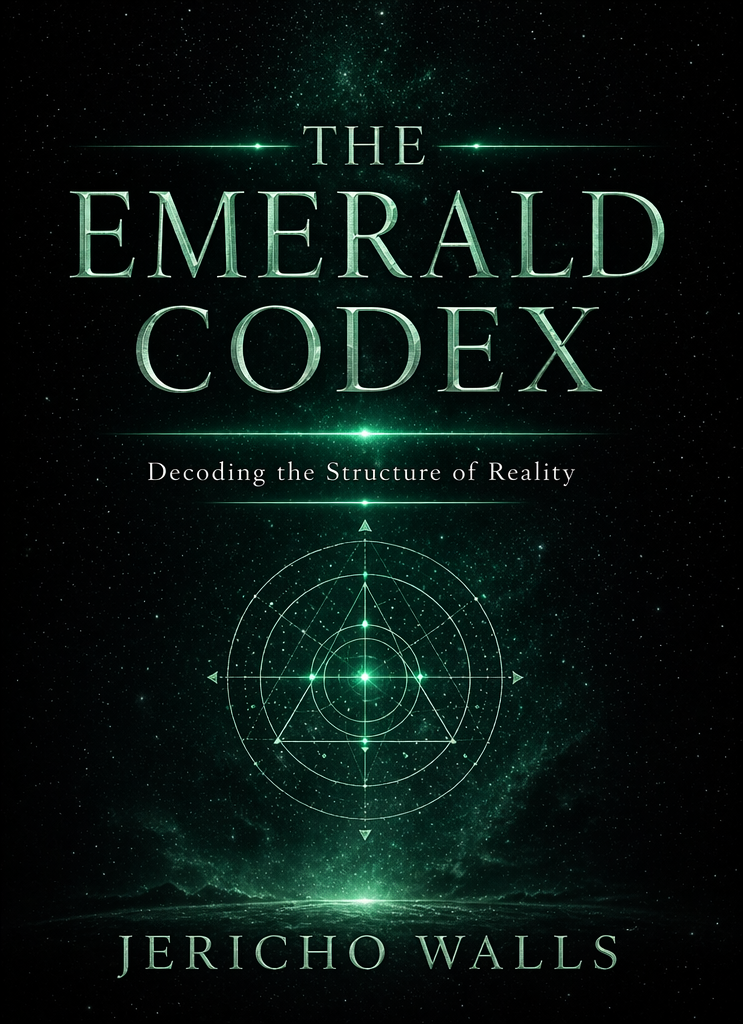
The Emerald Codex: Decoding the Structure of Reality
What if the ancient texts were never meant to be read as stories…
…but as systems?
For centuries, writings like the Emerald Tablet, the Corpus Hermeticum, and the Gospel of Thomas have been treated as myth, philosophy, or belief.
In the process, something was missed.
Not the meaning—
but the structure.
Hidden within these texts is a consistent framework—one that has been buried beneath symbolism, distorted through narrative, and reduced to interpretation.
The Emerald Codex approaches them differently.
This book does not reinterpret ancient teachings.
It decodes them.
By translating symbolic language into functional structure, a unified system begins to emerge—one that mirrors the way reality organizes itself.
Concepts such as correspondence, transformation, and perception are not presented as abstract philosophy, but as interacting components within a working model.
Across traditions and disciplines, the same patterns appear:
Structure precedes form
Signal defines pattern
Perception influences outcome
These are not ideas.
They are mechanics.
Rather than separating science and mysticism, The Emerald Codex places them side by side—examining their parallels without forcing conclusions, and allowing the structure to reveal itself.
Modern physics is not used as proof, but as comparison.
Different language. Same pattern.
This is not a book of belief.
It is a book of recognition.
It does not ask you to accept what is written.
Only to observe it.
Because if the patterns described here are seen directly, the material shifts—
from concept
to function.
And once seen,
it cannot be unseen.
Inside The Emerald Codex, you’ll uncover:
• A structural decoding of the Emerald Tablet beyond metaphor or mythology
• A system-level breakdown of consciousness, perception, and reality interaction
• The underlying mechanics behind principles like correspondence and transformation
• A framework for understanding how patterns form and influence outcomes
• Clear distinctions between symbolic narrative and functional structure
• Parallels between ancient systems and modern physics—without forced conclusions
• A model for recognizing recurring patterns across disciplines and traditions
This is not a collection of interpretations.
It is a framework for recognition.