
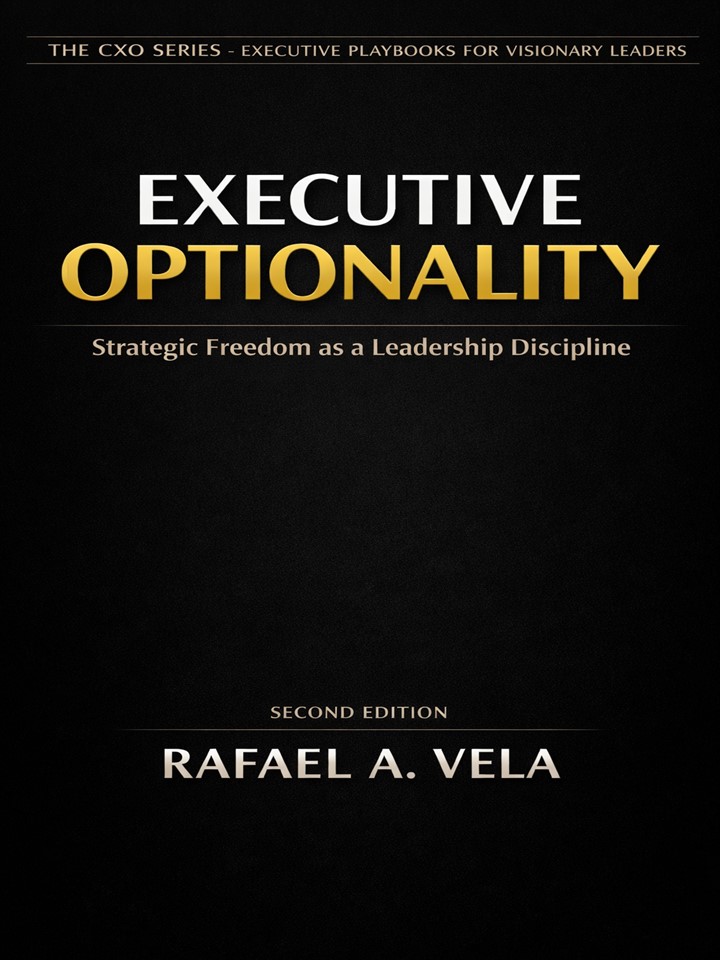
Executive Optionality – Strategic Freedom as a Leadership Discipline
In volatile, high-pressure environments, a leader’s real advantage is not speed. It is the ability to keep options open.
EXECUTIVE OPTIONALITY reframes leadership as the discipline of preserving strategic freedom over time. This Second Edition shows how optionality is built through decision design, governance, and resource choices—before pressure forces irreversible moves.
You will learn how to:
- Make decisions without closing future paths
- Build organizations that adapt under stress
- Maintain room to maneuver when constraints tighten
This is not about reacting faster. It is about retaining control when choices narrow.
A concise playbook for leaders who want freedom of action, not forced decisions.
TABLE OF CONTENTS
Introduction — Defining Executive Optionality - 14
PART I — THE EROSION OF STRATEGIC CHOICE
Chapter 1 — How Executives Lose Optionality - 19
• Strategic commitments that silently narrow future decisions - 19
• Organizational inertia and path dependency - 22
• When success becomes a structural constraint - 24
• Seeing Optionality Loss as a Leadership Pattern - 27
Chapter 2 — Optionality as a Leadership Discipline - 29
• Why optionality must be governed, not improvised - 29
• Asymmetry, reversibility, and timing in executive decisions - 31
• Decision quality versus decision speed - 34
• Optionality as an executive accountability - 36
PART II — DESIGNING OPTIONALITY INTO STRATEGY AND RESOURCES
Chapter 3 — Strategy Without Lock-In - 41
• Directional clarity without premature commitment - 41
• Staged decisions and controlled narrowing of options - 44
• Knowing when commitment is necessary and when it is destructive - 47
Chapter 4 — Capital, Investment, and Financial Freedom - 51
• Liquidity and balance sheet strength as strategic enablers - 51
• The hidden cost of over-optimization - 54
• Capital allocation decisions that preserve future leverage - 57
• Financial freedom as a leadership responsibility - 61
PART III — ORGANIZATIONAL AND STRUCTURAL OPTIONALITY
Chapter 5 — Organizational and Talent Optionality - 63
• Designing structures that can evolve without disruption - 63
• Decision rights as a mechanism for preserving choice - 67
• Leadership depth, succession, and capability portability - 70
Chapter 6 — Value Chain and Partner Optionality - 75
• Dependency risks across suppliers and ecosystems - 75
• Optionality beyond cost and efficiency - 79
• Preserving choice across procurement, sourcing, and partnerships - 82
PART IV — EXECUTION, TECHNOLOGY, AND GOVERNANCE
Chapter 7 — Operating Models and Technology Lock-In - 85
• Process design that adapts without breaking - 85
• Technology decisions that restrict future choice - 89
• Avoiding operational and digital path dependency - 92
Chapter 8 — Risk, Governance, and Executive Judgment - 95
• Risk management as option creation, not only protection - 95
• Reversibility as a governance criterion - 99
• Elevating optionality to board-level dialogue - 102
PART V — LEADERSHIP UNDER CONSTRAINT
Chapter 9 — When Pressure Collapses Choice - 107
• Why crises expose poor decision architecture - 107
• How some executives retain freedom under stress - 110
• Learning from constraint-driven failures - 111
Chapter 10 — The Optionality-Driven Executive - 115
• How leaders think when preserving choice matters - 115
• Discipline, patience, and long-term judgment - 116
• Optionality as a leadership legacy - 117
Conclusion — Designing Freedom Before You Need It - 120
• Appendix A: Executive Optionality Diagnostic - 125
• Appendix B: Decision Filters for Preserving Strategic Choice - 131
• Appendix C: Board Discussion Framework on Optionality - 138
• Appendix D: Strategy Lock-In Diagnostic - 144
• Appendix E: Executive Optionality Accountability Checklist - 150
• Appendix F: Procurement and Partner Optionality Diagnostic - 155