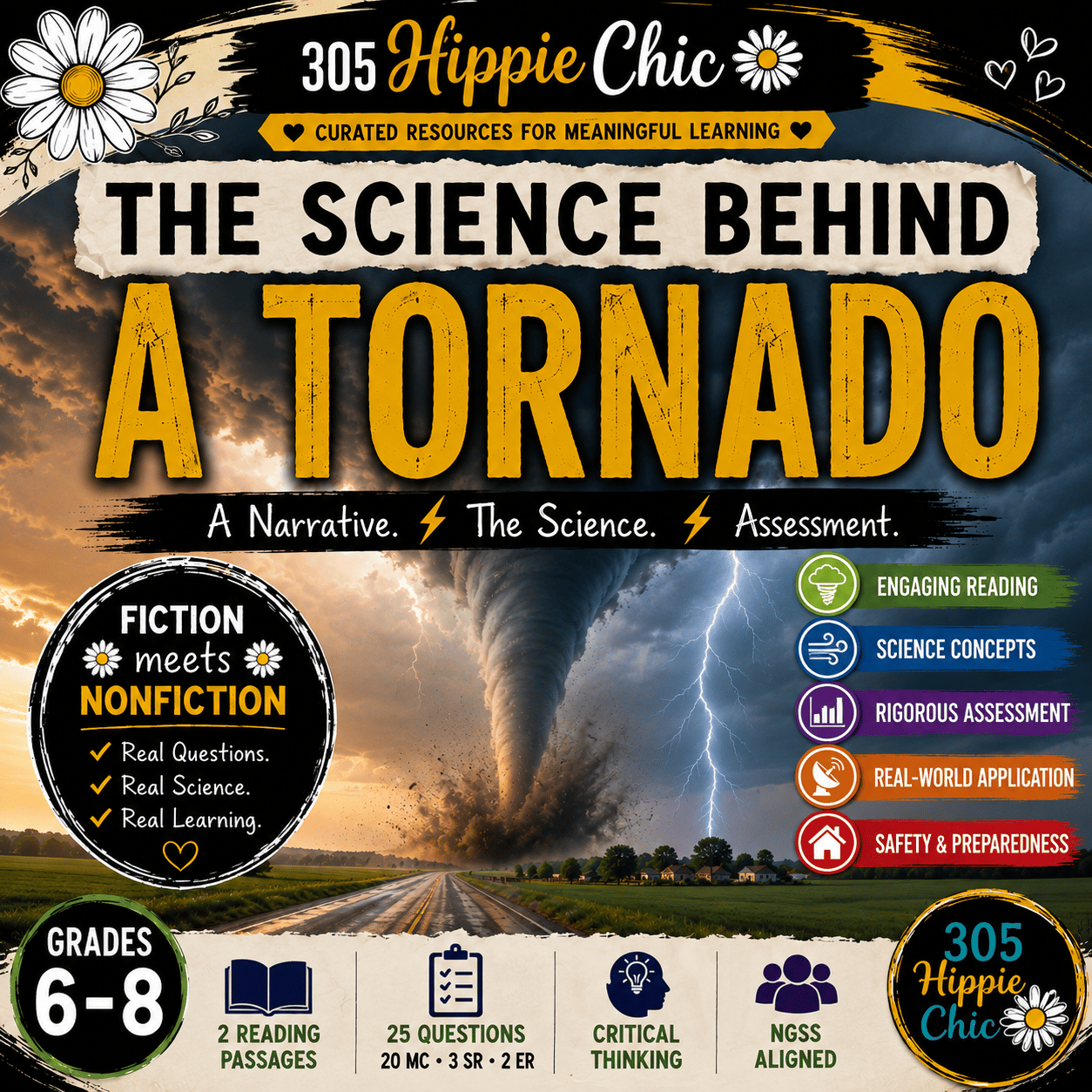
Tornado Reading Comprehension & Science Assessment | Severe Weather & Natural Disasters | Grades 6–8
🌪️ The Science Behind a Tornado | Reading Comprehension & Earth Science Assessment
How does an ordinary thunderstorm transform into one of nature’s most destructive forces? Discover the fascinating science behind tornadoes through engaging storytelling, informational reading, and critical thinking!
The Science Behind a Tornado is a comprehensive, standards-aligned Earth science and reading comprehension resource designed for middle school students in grades 6–8.
This engaging science reading assessment pack combines an original fictional narrative with a detailed nonfiction informational passage to help students understand tornado formation, supercell thunderstorms, wind shear, atmospheric instability, tornado intensity, and the scientific technology used to monitor severe weather.
Students begin with a suspenseful tornado survival story before investigating the atmospheric processes responsible for these powerful storms and the importance of emergency preparedness.
Perfect for middle school Earth science, weather and climate units, natural disasters lessons, ELA reading comprehension, and cross-curricular science instruction!
📚 WHAT’S INCLUDED
19-Page Printable PDF Resource
✔ Part I: When the Sky Turned Green
An engaging fictional narrative following seventh-grader Maya as an ordinary spring afternoon transforms into a dangerous weather emergency.
After noticing unusual atmospheric changes, towering storm clouds, and approaching thunderstorms, Maya receives an emergency tornado warning.
As powerful winds and hail threaten her neighborhood, Maya and her family take shelter in an interior bathroom.
Through Maya’s experience, students explore the importance of recognizing severe weather conditions, understanding tornado warnings, and following emergency safety procedures.
✔ Part II: The Science Behind a Tornado
A comprehensive nonfiction informational passage explaining the scientific processes responsible for tornado formation, including atmospheric instability, supercell thunderstorms, wind shear, mesocyclones, and funnel clouds.
Students also investigate tornado intensity, the Enhanced Fujita Scale, modern forecasting technology, and tornado safety.
✔ 25 Reading Comprehension & Science Assessment Questions
- 20 Multiple-Choice Questions
- 3 Short-Response Questions
- 2 Extended-Response Questions
✔ Complete Answer Key
Includes correct multiple-choice answers and sample constructed responses.
✔ Common Core ELA & NGSS Standards Alignment
✔ Teacher Implementation Guide
✔ Flexible Instructional Suggestions
🌎 SCIENCE CONCEPTS COVERED
Students investigate:
- What tornadoes are and how they form
- Warm, moist air and cool, dry air masses
- Atmospheric instability and rising air
- Cumulonimbus clouds and severe thunderstorms
- Supercell thunderstorms and rotating updrafts
- Wind shear and changing wind patterns
- Mesocyclones and atmospheric rotation
- Funnel cloud formation
- Tornado development and ground contact
- Tornado Alley and severe weather patterns
- The Enhanced Fujita Scale (EF0–EF5)
- Tornado intensity and damage assessment
- Doppler radar and storm detection
- Weather satellites and weather balloons
- Storm spotters and computer forecasting models
- Tornado Watches versus Tornado Warnings
- Emergency preparedness and tornado safety procedures
🎯 READING & CRITICAL-THINKING SKILLS
Students strengthen essential literacy skills while developing scientific understanding.
✔ Identifying central ideas and supporting details
✔ Comparing fictional and informational texts
✔ Analyzing cause-and-effect relationships
✔ Making inferences and drawing conclusions
✔ Using textual evidence to support written responses
✔ Understanding scientific vocabulary in context
✔ Explaining complex atmospheric processes
✔ Evaluating scientific evidence and forecasting technology
✔ Developing evidence-based explanations
✔ Connecting scientific concepts to real-world situations
🏫 PERFECT FOR
✔ Middle School Science (Grades 6–8)
✔ Earth Science & Meteorology
✔ Weather and Climate Units
✔ Tornadoes & Natural Disasters Lessons
✔ Middle School ELA
✔ Informational Text Reading Comprehension
✔ Fiction and Nonfiction Paired Passages
✔ Cross-Curricular Science & Literacy
✔ Independent Practice & Homework
✔ Small-Group Instruction
✔ Science Centers & Enrichment
✔ Substitute Teacher Plans
✔ Homeschool Science Curriculum
✔ Severe Weather Preparedness Activities
🌼 WHY TEACHERS WILL LOVE THIS RESOURCE
Real Questions. Real Science. Real Learning.
Instead of introducing tornadoes through scientific definitions alone, this resource begins with an engaging fictional story that encourages curiosity and scientific investigation.
Students follow Maya as she experiences the warning signs of an approaching tornado, witnesses the storm’s powerful effects, and discovers why meteorologists issue emergency alerts before dangerous weather arrives.
They then investigate the scientific explanations behind these events through an informative nonfiction passage.
This two-part instructional approach helps students connect storytelling with scientific concepts, making complex atmospheric processes more accessible and meaningful.
The accompanying assessment evaluates both reading comprehension and scientific understanding while encouraging students to analyze evidence, explain weather processes, and apply their knowledge to real-world situations.
No complicated preparation. No additional materials required. Just meaningful, ready-to-use instruction.
📋 PRODUCT DETAILS
Grade Levels: 6–8
Subjects: Earth Science, General Science, English Language Arts
Resource Type: Fiction & Nonfiction Reading Comprehension with Assessment
Format: Printable PDF Digital Download
Length: 19 Pages
Assessment: 25 Questions + Complete Answer Key
Standards: Common Core ELA & NGSS
Preparation: Print and Go
🌼 EXPLORE THE SCIENCE BEHIND SERIES
Looking for additional engaging science reading comprehension resources?
Explore more titles from The Science Behind Series, where fictional storytelling meets informational science to encourage curiosity, strengthen literacy, and build scientific understanding.
Created by 305HippieChic 🌼
Print. Write. Think. Learn.