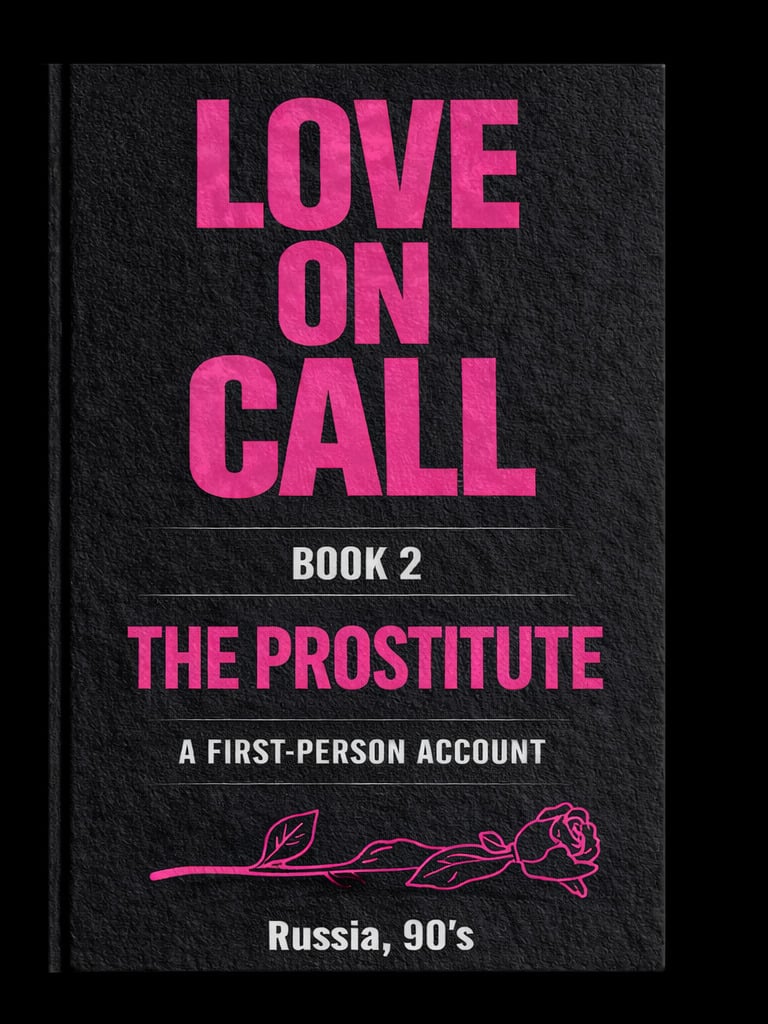
Dmitry Gardin. Love on Call. Volume Two. A Prostitute's Story
From the Publisher
Love on Call: A Prostitute's Story is the second book in the Love on Call series — a collection of accounts by people drawn into prostitution in a large provincial Russian city in the late 1990s. With the qualification that across Russia as a whole, the picture was much the same.
The books in this series have two principal merits. The first is absolute authenticity in every detail. These are accounts by people who were fully immersed in events as their principal participants.
Both the publisher and the author openly acknowledge that in certain cases the accounts of several individuals have been combined into one — but all sources are one hundred per cent genuine. Everything has been preserved: from the most brutal and absurd details to the real language of the dialogue.
The second merit is this: it is impossible to come away from these books without a perfectly clear and stunning impression of the profound wrongness of this occupation — at least in the form in which it emerged and existed during those years. The books are entirely free of any romanticisation of any role in this spectacle, despite the fact that the accounts — the prostitute's account in particular — clearly contain something, shall we say, embellished.
Fiction and film have portrayed prostitution and prostitutes in many different lights — but as a rule, such portrayals bear the evident mark of professionals: either professionals in the craft of books and screenplays, or professionals in the craft of prostitution itself. And all of them professionals from countries where prostitution is, in one form or another, an age-old institution — one sufficiently clearly separated from the rest of life. In Russia in the 1990s, by contrast, all of this suddenly became a temptation and a magnet for people who understood that it was not meant for them. Yet who found themselves forced to ask the question, or even to try — simply because other paths were difficult to see, or not visible at all.
It is hard to extract a moral from these books — as it is from life as it actually is. And if any conclusions can be drawn, they are exactly the kind each person draws from days actually lived: not so much words as the residue of experience. These books provoke that experience — and the experience is unquestionably worthwhile.