
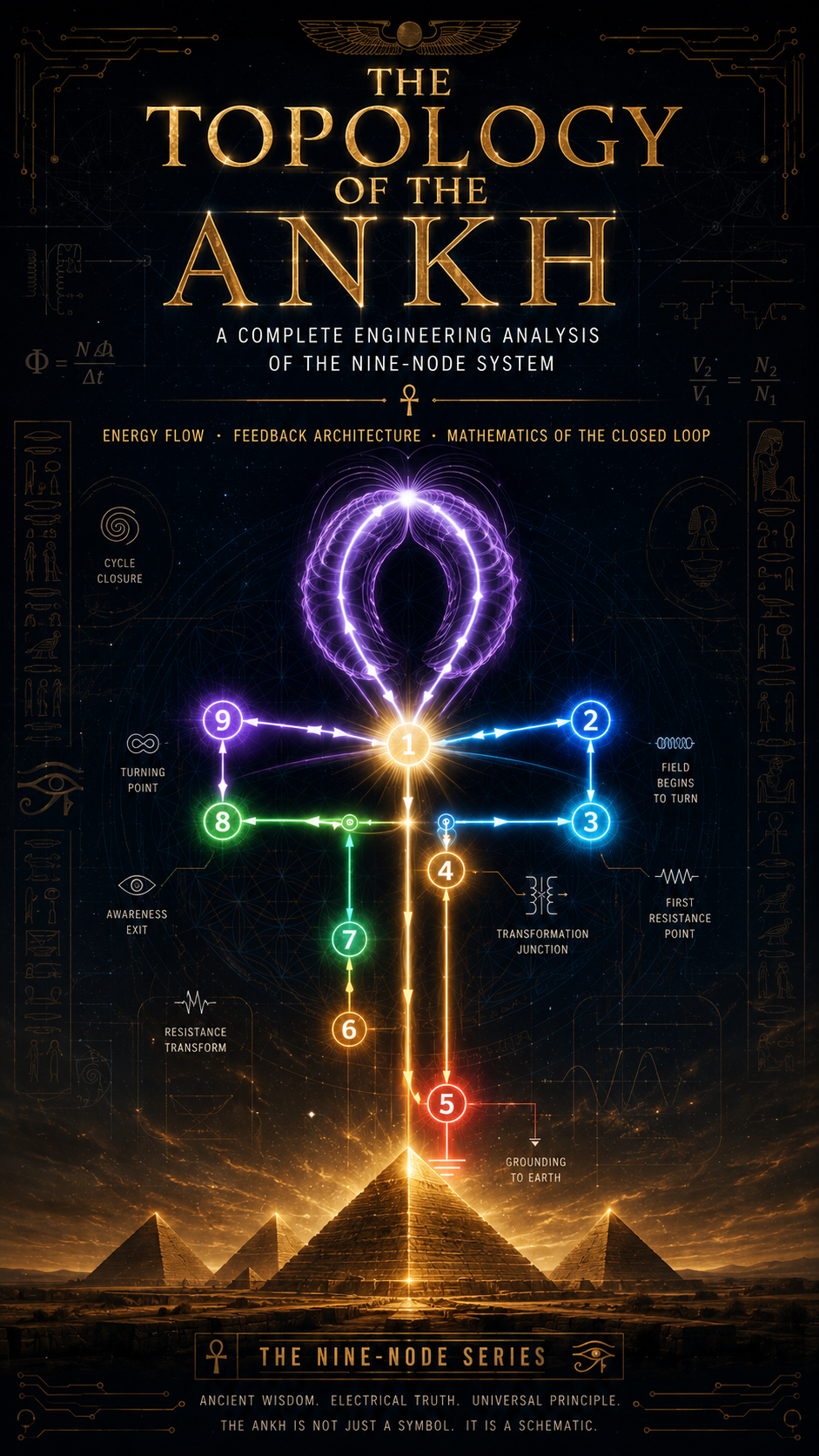
The Topology of the Ankh: A Complete Engineering Analysis Nine Nodes, Ohm's Law, and the Mathematics Hidden in the World's Oldest Symbol
What if the Ankh is a circuit diagram?
This companion volume to The Ankh Code takes the central question further - into mathematics, electrical engineering, and field data.
An electrician with two decades of circuit analysis experience applies the tools of his trade to the most iconic symbol of ancient Egypt. The result is a rigorous, 40-page speculative engineering essay that maps the Ankh onto a nine-node topology with documented mathematical properties, accurate circuit analogues, and six falsifiable research proposals.
What this book contains:
The complete modulo 9 mathematical analysis - why the doubling algorithm documented in the Rhind Mathematical Papyrus produces the exact sequence that maps onto the Ankh's nine nodes.
A symmetry table of mirror pairs showing why every node has an electrical analogue - from summing node to ground reference to feedback path.
The control architecture of nodes 3, 6, and 9 - and why they correspond structurally to a PID controller.
Field measurements from KV9 in the Valley of the Kings - 215 V/m at the sarcophagus in a sealed rock chamber.
Material properties of Aswan granite, Nile ionic conductivity data, and iconographic evidence from Abu Simbel.
Six falsifiable studies - real experiments that could confirm or disprove the framework.
What this book is not:
A claim that ancient Egyptians had modern technology. A pseudoscience text. A book that asks you to believe anything on faith.
Every claim is labelled throughout: fact, hypothesis, or interpretation. The electrical engineering is accurate. The applications to ancient Egypt are a framework - precisely stated and open to testing.
Companion to: The Ankh Code - An Electrician's Guide to Ancient Egypt