
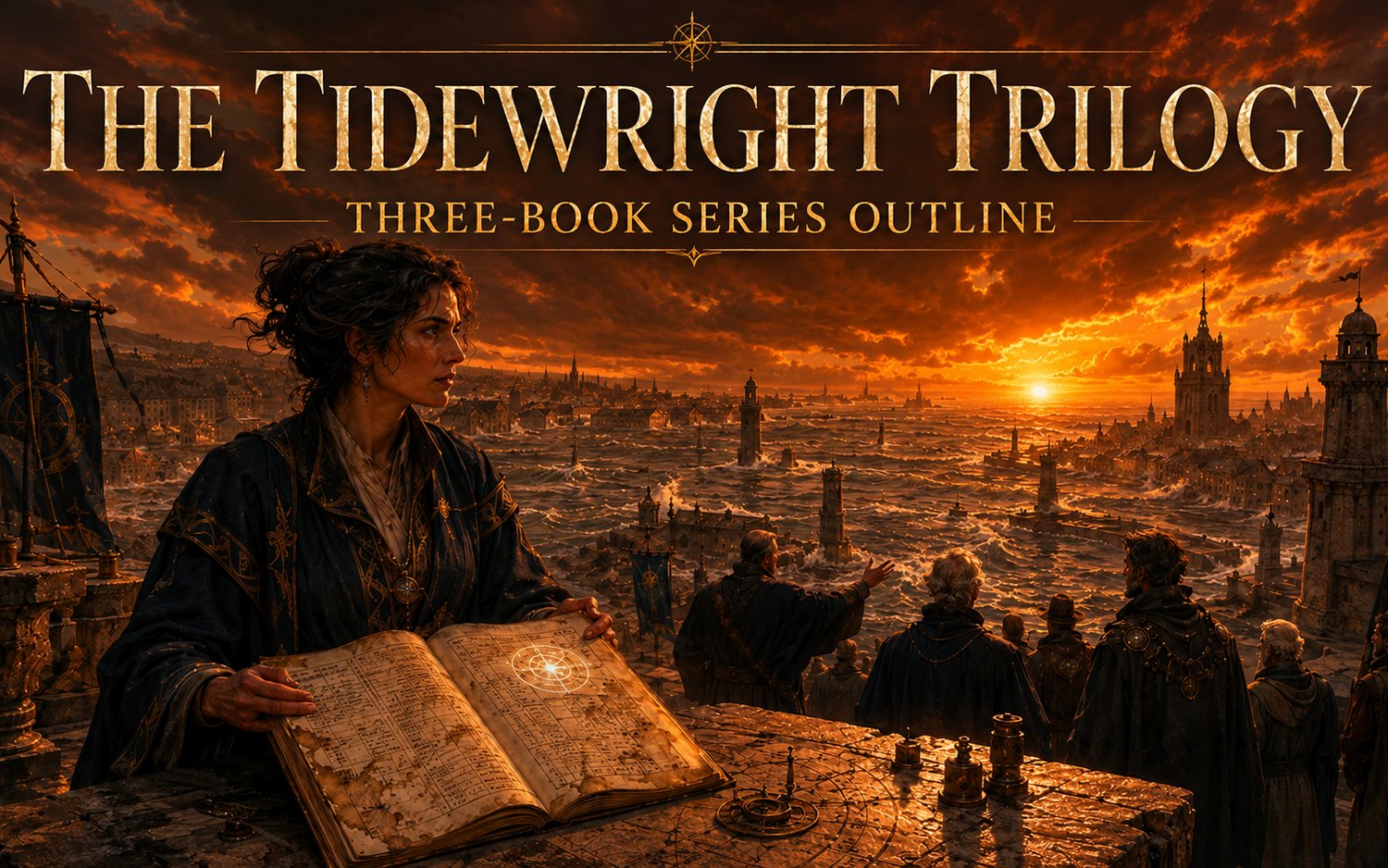
The Tidewright Trilogy
A woman whose profession is certainty must teach a drowning country to act on a maybe.
Across three books, a tide-reader finds a reading that cannot be true, loses the ledger her country lives by, and must teach it to act on a maybe: if she is wrong, they hang her; if she stays silent, they drown.
1. High-Concept & Unique Selling Proposition (USP)
- The Central Logline: "A woman whose profession is certainty must teach a drowning country to act on a maybe."
- Commercial Evaluation: Exceptional. It is magnetic, creates an immediate paradox, and defines both internal and external conflicts with crystal clarity.
- The "Non-Magic" System (Arithmetic & Institution): In a market saturated with complex magic systems based on rigid hard-fantasy rules or flashy battles, The Tidewright Trilogy bets on something far more visceral and original: the bureaucracy of survival and the mathematics of the tides.
- The "No-Coin" Rule: This is a brilliant worldbuilding choice both commercially and conceptually. It isolates the story from generic medieval capitalist tropes, focusing the world’s economy entirely on scarce resources, grain, labor, and institutional trust. This gives the work a uniquely tactile, material texture.
2. Trilogy Architecture: Escalation Without Repetition
The Achilles' heel of many fantasy trilogies is the "middle-book slump." This outline resolves that masterfully, as detailed in Escalation Without Repetition:
- Book 1 (The Private Moral Problem): Vess faces an ethical dilemma within a rigid institution (The Ledger House). It ends with the institution's destruction.
- Book 2 (Systemic Collapse & War): Without the institution, the power vacuum breeds fragmentation and civil war. The failure is no longer Vess's error, but the realization that the sea itself has changed.
- Book 3 (Cultural & Generational Shift): War paralyzes the country, shifting the core problem from mathematical precision to the cultural habit of demanding absolute certainties. Vess becomes the obstacle and must render herself obsolete, passing the torch to the next generation.
- Commercial Verdict: This progression ensures each book possesses its own distinct genre/sub-tone (Book 1: Moral/Institutional Thriller; Book 2: Political Drama/Civil War; Book 3: Social Rescue/Philosophical Climax). This keeps readers deeply engaged as the scale of conflict shifts organically.
3. Target Audience & Market Positioning
- Comps & Tone: The project sits in the exact same critical and commercial space as The Traitor Baru Cormorant by Seth Dickinson (for its political and financial/bureaucratic rigor), the atmospheric and reflective tone of Ursula K. Le Guin's The Dispossessed, and the worldbuilding density of Piranesi (Susanna Clarke) or The Fifth Season (N.K. Jemisin).
- Reader Profile:
- Literary fiction readers who cross over into fantasy.
- Mature audiences (New Adult / Adult).
- Fans of stories centered on ethics, moral dilemmas, relentless bureaucracy, and complex, deeply flawed characters (Vess, Sorn, Ott).
WHAT YOU GET
· outline.pdf — 3 books, 71 chapters. Each with a synopsis of what
happens, what the chapter does for the novel that no other chapter does,
and how the situation is different at its end than at its start.
· codex-worldbuilding.pdf — the reference you keep open while drafting:
4 characters with wound, want and verbal habit; places with sensory
anchors; factions; the rules of the world and what they cost; a
4-term glossary; the timeline; and 6 continuity rules.
· The same two documents as plain Markdown, with no branding on them at
all — the editable source.
· license.pdf — your licence: what you may do with what you write.
THE LICENCE
Write, publish and sell any number of novels set in this material, in any language and any medium, in print, ebook or audio — and keep 100% of what you earn. No royalty, no revenue share, ever. Modify it however you like. Credit is welcome and never required.
The material itself stays with you: it cannot be resold, shared or republished. The restriction is on the outline, never on the book you write from it.
ONE OF ONE
This outline is sold to a single buyer. On the day it sells it is withdrawn and it will not be listed, reissued or sold again. No one else is writing from this material.
novelstarter.com