
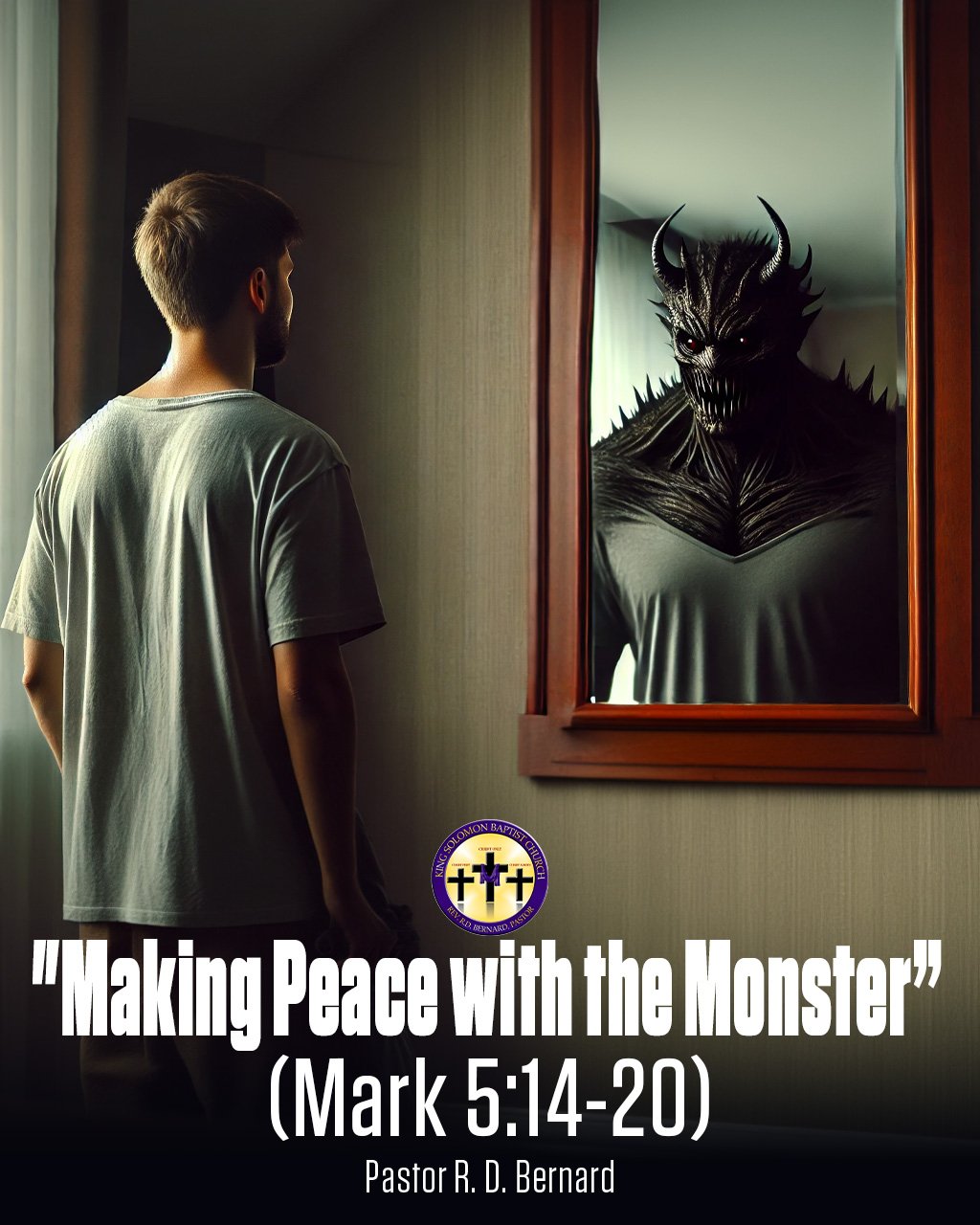

"Making Peace with the Monster"
"Making Peace with the Monster" (Mark 5:14-20)
In the verses under our consideration, the people were amazed at the demoniac’s recovery. They witnessed or they heard of the property damage done to the great herd of pigs that were destroyed. The record reads in Mark 5:13 that “the herd ran violently down a steep place into the sea.”
Now of course, the people of that place knew firsthand, or by reputation, of the demoniac’s violence toward himself. Again, the record reads in Mark 5:5 that “always, day and night, he was in the mountains, and in the tombs, crying, and cutting himself with stones.”
Yet here he is with Jesus, at peace with himself and at peace with those around him. Mark 5:15 describes him as “him that was possessed with the devil, and had the legion, sitting, clothed, and in his right mind.”
The observers were those who had witnessed his handiwork with their own eyes. Rarely, even in church, do we get to see what a person was before Christ delivered them. We can all see what they are at present, either good people who warrant our love and affection in Christ; or perhaps shady characters, who warrant our caution because they may be wolves in sheep’s clothing.
Rarely do we know people long enough, or rarely do they stay in one place long enough, so that the same set of observers can see the before and the after. This man had made peace with his monster.
There are some situations in life that don’t get solved with prayer or fasting or even prayer and fasting. There are certain adverse life conditions that may be ameliorated with church attendance and worship, but certainly these adverse life conditions don’t go away with a few hymns and words of praise or even years of singing and years of praise.
The condition of the demoniac is a stark reminder to the modern church, that parishioners can be mentally, spiritually, and or emotionally sick in ways that seem beyond the reach of ordinary and practical spiritual remedies. Consider the following three points.
- Pain, caused by social and emotional dysfunction in the early home life, creates monsters. a. Extreme physical, emotional, or psychological abuse that causes us, in the words of Mark 5:15 not to be in our “right mind.” b. We are not given the demoniac’s background. When he bursts forth from the tombs to meet Jesus, we are told that he has an unclean spirit (Mark 5:2). i. The person has one physical body, but there are at least two personalities in that body. In this man’s case, there were many personalities (for the demon identified himself in Mark 5:9, as “Legion,” which means “many”). ii. The unclean spirit works to destroy healthy relationships. The unclean spirit kept this man isolated. He would dwell in the tombs and the mountains (Mark 5:5). iii. The unclean spirit was the dominant spirit in this man’s body. They were too strong for him, and when they raged, he could not control them (Mark 5:4).
- The monster is made known in our closest relationships. a. You don’t know people until you have met their monsters. You only know their public personas. This is precisely why the people still feared the man in Mark 5:15, though he had been delivered. b. This is also the reason why so many people run when their monster is discovered. Their social acceptability was based on one personality, but when the monster is triggered, they believe that they will be asked to leave, just as the man, who even though he had been delivered, was asked to leave in Mark 5:17.
- Peace should be the goal of those with monsters. a. Note how the man who was formerly possessed is encouraged to tell his story in Mark 5:19. He was encouraged by Christ to “tell them what great things the Lord hath done for you.” b. Jesus says for him to tell how the Lord “had compassion on him.”
“Christ First, Christ Only, Christ Always”