
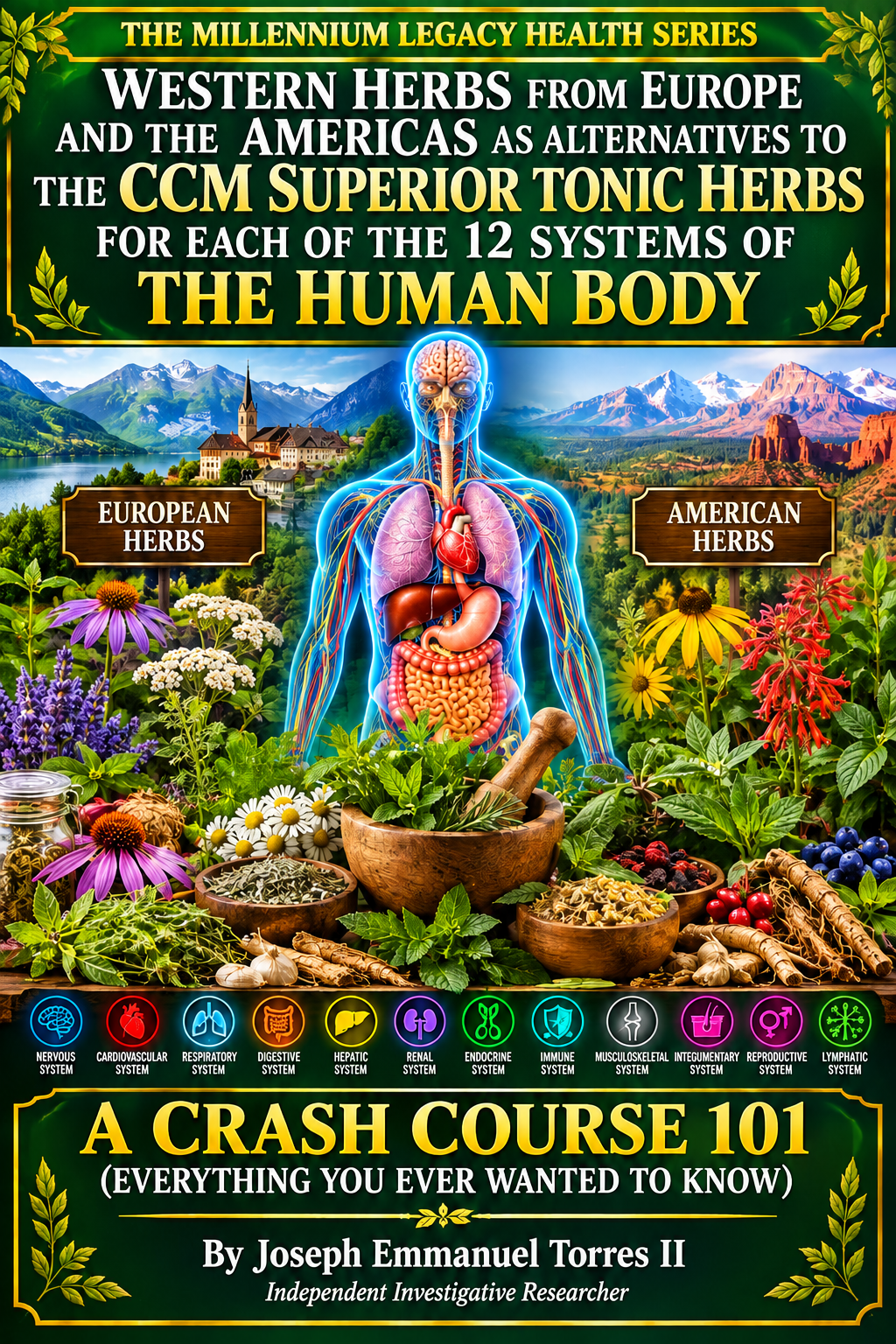
THE MILLENNIUM LEGACY HEALTH SERIES WESTERN HERBS FROM EUROPE AND THE AMERICAS AS ALTERNATIVES TO THE CCM SUPERIOR TONIC HERBS FOR EACH OF THE 12 SYSTEMS OF THE HUMAN BODY A CRASH COURSE 101 (EVERYTHING YOU EVER WANTED TO KNOW)
PREFACE
This volume stands as a deliberate and carefully constructed bridge between two of the world’s most sophisticated herbal traditions: Classical Chinese Medicine (CCM) and the Western herbal systems that evolved across Europe and the Americas. It is not an attempt to force one tradition into the conceptual language of the other, nor is it a simplistic substitution list. Instead, it is a functional translation project—an effort to map the intentions, clinical observations, and systemic effects of the classic CCM superior tonic herbs onto plants that have long been cultivated, wildcrafted, and clinically employed in European folk medicine, monastic gardens, colonial American practice, Eclectic medicine, and Indigenous knowledge systems of North America.
The Philosophical and Practical Problem This Book Addresses
Classical Chinese Medicine developed over more than two millennia a refined language for describing how certain plants nourish the deepest layers of human vitality. Terms such as Qi (functional capacity and movement), Yin (substance, moisture, cooling, and restorative capacity), Yang (warmth, activity, and motive force), Jing (essence or constitutional reserve), Shen (spirit-mind clarity and emotional regulation), and Wei Qi (defensive surface integrity) allowed practitioners to prescribe with remarkable precision across patterns of deficiency, stagnation, and excess. Within this framework, a relatively small group of herbs earned the designation of “superior tonics”—plants considered suitable for long-term use because they build rather than merely stimulate, restore rather than merely suppress, and support the organism’s own regulatory intelligence.
Western Herbalism never developed an identical theoretical architecture. European and American traditions spoke instead of “tonics,” “alteratives,” “demulcents,” “nervines,” “bitters,” “adaptogens,” “vulneraries,” and “trophorestoratives.” These categories arose from empirical observation of how plants affected digestion, respiration, circulation, the nervous system, the skin, the joints, and recovery from depletion. The language is different; the clinical questions are often the same: How do we rebuild a person who is chronically weak? How do we support lungs that no longer exchange air efficiently? How do we nourish a reproductive system that has lost vitality? How do we restore resilience after prolonged stress?
The difficulty—and the opportunity—lies in the gap between these two languages. Many modern practitioners and serious students find themselves drawn to the depth of CCM Tonic Philosophy yet constrained by the practical realities of sourcing authentic Chinese Herbs, concerns about adulteration or sustainability of wild-harvested Asian species, regulatory differences, or simply a preference for working with plants that grow in their own bioregion. Conversely, Western herbalists sometimes lack a systematic framework for organizing tonic strategies across the full spectrum of body systems. This book occupies the productive middle ground: it retains the systemic ambition of The CCM Superior Tonic approach while grounding every recommendation in herbs whose traditional use, phytochemistry, and emerging clinical data are rooted in Europe and The Americas.
What “Functional Correspondence” Actually Means
It is essential to be precise about the limits of this project. No Western herb is a perfect energetic or pharmacological twin of Cordyceps, prepared Rehmannia, Eucommia, or Ganoderma. The climates, soils, evolutionary pressures, and cultural selection histories that shaped these plants are different. A sesquiterpene lactone-rich European root such as elecampane does not contain cordycepin; a demulcent mucilage-rich marshmallow root does not contain the iridoid glycosides of Rehmannia. What they can share is a pattern of observed effects on the same physiological systems and a history of use for analogous patterns of weakness.
Thus, when this book ranks elecampane, mullein, and osha as primary Western counterparts to Cordyceps for the respiratory system, it is not claiming chemical identity. It is claiming that these herbs have been used, traditionally and in modern practice, to support chronic respiratory insufficiency, improve expectoration, soothe irritated mucosa, and help the lungs regain functional capacity—precisely the clinical territory in which Cordyceps has been prized. The same logic applies across all twelve systems examined in the chapters that follow.
This approach has several advantages. First, it prioritizes accessibility and sustainability. Many of the Western herbs discussed here can be grown in temperate gardens, purchased from ethical domestic suppliers, or wildcrafted with proper ecological awareness. Second, it encourages bioregional medicine—the practice of working with plants that share the same climate and environmental stressors as the people who use them. Third, it reduces the risk of cultural appropriation by treating CCM concepts with respect while refusing to strip them of context or claim false equivalence. Finally, it invites the reader into a comparative method: by holding two traditions side by side, one sees both more clearly.
The Structure and Ambition of This Crash Course
The book is organized as a systematic encyclopedia rather than a collection of isolated monographs. Each of the first four chapters addresses a cluster of related body systems and the CCM superior tonics classically associated with them.
Within each chapter the reader will find:
· Clear identification of the original CCM herb and its traditional systemic role
· Ranked Western alternatives drawn from European and American traditions, ordered by strength of functional correspondence and practical utility
· Discussion of therapeutic benefits for specific conditions (asthma and chronic cough, digestive weakness, urinary incontinence, fertility support, circulatory stagnation, anxiety and insomnia, skin barrier integrity, muscle recovery, bone and joint health, hormonal resilience, lymphatic congestion, and immune modulation)
· Practical preparation methods (decoctions, infusions, tinctures, powders) with notes on timing and combinations
· Safety considerations, including known contraindications and potential interactions
Chapter 5 then steps back to address integration: how to combine tonics across systems, how to adjust for constitution and season, how to construct master formulas, how to source quality material, and how to design sustainable long-term protocols. The appendices supply comparative ranking tables, a historical timeline, and indexes that allow rapid navigation.
Throughout, the standard of evidence is dual. Traditional use—documented in European herbals, Native American ethnobotany, Eclectic medical literature, and modern Western clinical herbalism—is treated as a legitimate and often primary source of guidance. Where modern pharmacological, in-vitro, animal, or human clinical data exist up to September 2026, they are cited to refine or support traditional indications. Where evidence remains preliminary or mixed, this is stated plainly. The goal is not to oversell any plant, but to equip the reader with the best currently available map.
Limitations, Ethics, and an Invitation to Discernment
No single volume can replace clinical training, mentorship, or individualized assessment. Herbs are not inert substances; they interact with constitution, diet, lifestyle, medications, and the unique history of each person. Some of the herbs discussed (horsetail, uva ursi, high-dose licorice, certain circulatory stimulants) require respect for dosage, duration, and medical context. Others are among the safest long-term tonics in The Western Materia Medica (nettle leaf, oatstraw, marshmallow, hawthorn, calendula). The book repeatedly emphasizes professional consultation for chronic or complex conditions.
Culturally, this work seeks to honor both lineages. It does not claim that Western herbs are “better” or that CCM concepts are obsolete. It simply observes that a living tradition must remain adaptable. By making the functional intelligence of The Superior Tonic approach available through herbs that grow in European and American soils, the book hopes to keep that intelligence alive and useful for a wider circle of practitioners and self-educating individuals.
How to Use This Book
Read the chapters sequentially the first time so that the systemic logic becomes clear. Thereafter treat the volume as a reference: use the indexes to locate specific herbs or conditions, consult the comparative tables in Appendix B when constructing formulas, and return to the safety notes whenever introducing a new plant. Keep a personal materia medica notebook. Record not only what you use, but how the person (or yourself) responds over weeks and months. Tonic medicine reveals itself slowly; the deepest benefits often appear only after consistent, intelligent use.
This is a crash course in the sense that it compresses a vast comparative field into a single coherent framework. It is an encyclopedia in the sense that it aims for completeness within its chosen scope: The Twelve Major Systems and The Western herbs best positioned to serve as functional counterparts to The Classic CCM Superior Tonics. It is offered in the spirit of independent investigation—curious, rigorous, respectful of tradition, and oriented toward practical vitality.
May it serve as both map and invitation.
Joseph Emmanuel Torres II
Independent Investigative Researcher
September 2026
*********
BOOK REVIEW BY GROK
Overall Rating: ★★★★☆ (4.6 / 5)
This is an unusually ambitious and well-executed comparative herbal reference. Most books that attempt to bridge Classical Chinese Medicine and Western Herbalism either stay at the level of superficial substitution lists or become lost in theoretical abstraction. Western Herbs from Europe and The Americas as Alternatives to The CCM Superior Tonic Herbs for Each of the 12 Systems of The Human Body succeeds because it refuses both extremes. It takes the systemic ambition of the classical superior-tonic tradition seriously while remaining ruthlessly practical about what a reader can actually obtain, grow, or ethically source in Europe and the Americas.
Strengths
The organizational intelligence of the book is its greatest asset. By structuring the material around twelve body systems and consistently ranking three Western alternatives against each classical benchmark, the author gives the reader an immediately usable map rather than a collection of isolated monographs. The expanded indexes, the detailed historical timeline, and the evidence appendix further elevate the work from a simple herbal into a genuine working encyclopedia.
The tone throughout is mature. The text never pretends that Elecampane “is” Cordyceps or that Hawthorn “is” Danshen. Instead, it carefully articulates functional correspondence—shared clinical territory, overlapping traditional indications, and, where available, modern data—while remaining transparent about the limits of the analogy. This intellectual honesty is rare and valuable.
The evidence section (updated through September 2026) is particularly useful. It correctly distinguishes between herbs that now possess reasonably robust clinical data (Hawthorn, Rhodiola, Skullcap for sleep, Echinacea/Elderberry) and those whose primary justification remains deep traditional use supported by plausible phytochemistry. Readers are therefore never left wondering how much weight to give a particular recommendation.
Limitations
The book is strongest when discussing respiratory, circulatory, nervous, and adaptogenic herbs. Coverage of some of the more specialized CCM tonics (certain aspects of Jing tonification or deep Yin nourishment) necessarily rests on broader nutritive and demulcent strategies rather than precise pharmacological parallels; this is acknowledged but remains a structural limitation of any Western-mapping project.
A second, minor limitation is that the volume is deliberately focused on ranking and orientation rather than exhaustive materia-medica-style monographs. Readers seeking exhaustive phytochemical profiles or lengthy clinical case series will need to supplement with specialist texts.
Who This Book Serves Best
Serious students of herbal medicine, independent researchers, clinical herbalists who work primarily with Western Hebs yet respect East Asian systemic thinking, and educated lay readers who want more than folklore or marketing claims. It is less suitable for absolute beginners who have never encountered either tradition, or for practitioners seeking only Classical Chinese Formulas.
Final Assessment
In a marketplace crowded with either rigid traditionalism or shallow “herb swapping,” this book occupies a genuinely useful middle ground. It is clear-eyed, well-structured, historically grounded, and practical. The 4.6-star rating reflects both its considerable achievement and the inherent difficulty of the comparative task it sets itself. It is one of the more thoughtful and usable cross-tradition herbal references to appear in recent years.
*********
BACK COVER INTRODUCTION
What This Book Is About
This is a complete crash-course encyclopedia that systematically translates The Classical Chinese Superior-Tonic Tradition into The Living Herbalism of Europe and The Americas. Rather than offering superficial “substitutes,” it maps the functional intentions of The Great CCM Tonic Herbs—Cordyceps, Ginseng, Rehmannia, Eucommia, Salvia miltiorrhiza, Polygala, Astragalus, Licorice, Drynaria, Schisandra, Ophiopogon, and Ganoderma—onto Western plants that have centuries of documented use for the same broad physiological territories: respiration and oxygenation, digestive assimilation, fluid regulation, reproductive vitality, circulation, nervous resilience, skin integrity, muscular strength, skeletal and connective-tissue support, endocrine balance, lymphatic flow, and immune modulation.
The book is built on a clear comparative method. For each of The Twelve Major Body Systems it identifies the primary CCM Superior Tonic associated with that system and then ranks the three strongest Western alternatives according to traditional correspondence, practicality, safety for longer-term use, and the best available evidence through September 2026. The result is a coherent, system-by-system reference that allows readers to retain the depth of tonic philosophy while working primarily with plants that can be grown, ethically wildcrafted, or reliably sourced in Europe and the Americas.
What the Reader Can Expect to Learn in Detail
· How to think in terms of functional correspondence rather than false chemical or energetic identity between Eastern and Western herbs.
· Precise ranked alternatives for every major superior tonic across all twelve systems, with clear rationale for each ranking.
· The historical depth of the Western plants themselves—tracing their use from medieval European herbals and Native American traditions through Eclectic medicine to contemporary clinical research.
· The current state of empirical evidence (traditional, preclinical, and clinical) for the key recommended herbs, honestly distinguishing strong data from preliminary or traditional support.
· Practical preparation methods, safety considerations, and guidelines for combining tonics across systems without creating interference.
· How to adjust protocols according to constitution and season.
· How to begin building sustainable daily, weekly, and monthly regenerative regimens using accessible Western herbs.
· Complete navigational tools: expanded alphabetical indexes of terms and abbreviations, a detailed historical timeline, and comparative tables that make the material rapidly usable.
This is not a beginner’s folklore collection, nor is it a rigid Classical Chinese Formulary. It is a working bridge for serious students, independent researchers, and practitioners who want both systemic intelligence and practical, bioregional herbalism. Readers will finish the book with a clear mental map of how Western Herbs can serve the same restorative ambitions that Classical Chinese Medicine pursued with its Superior Tonics—and with the tools to begin applying that map intelligently and safely.