

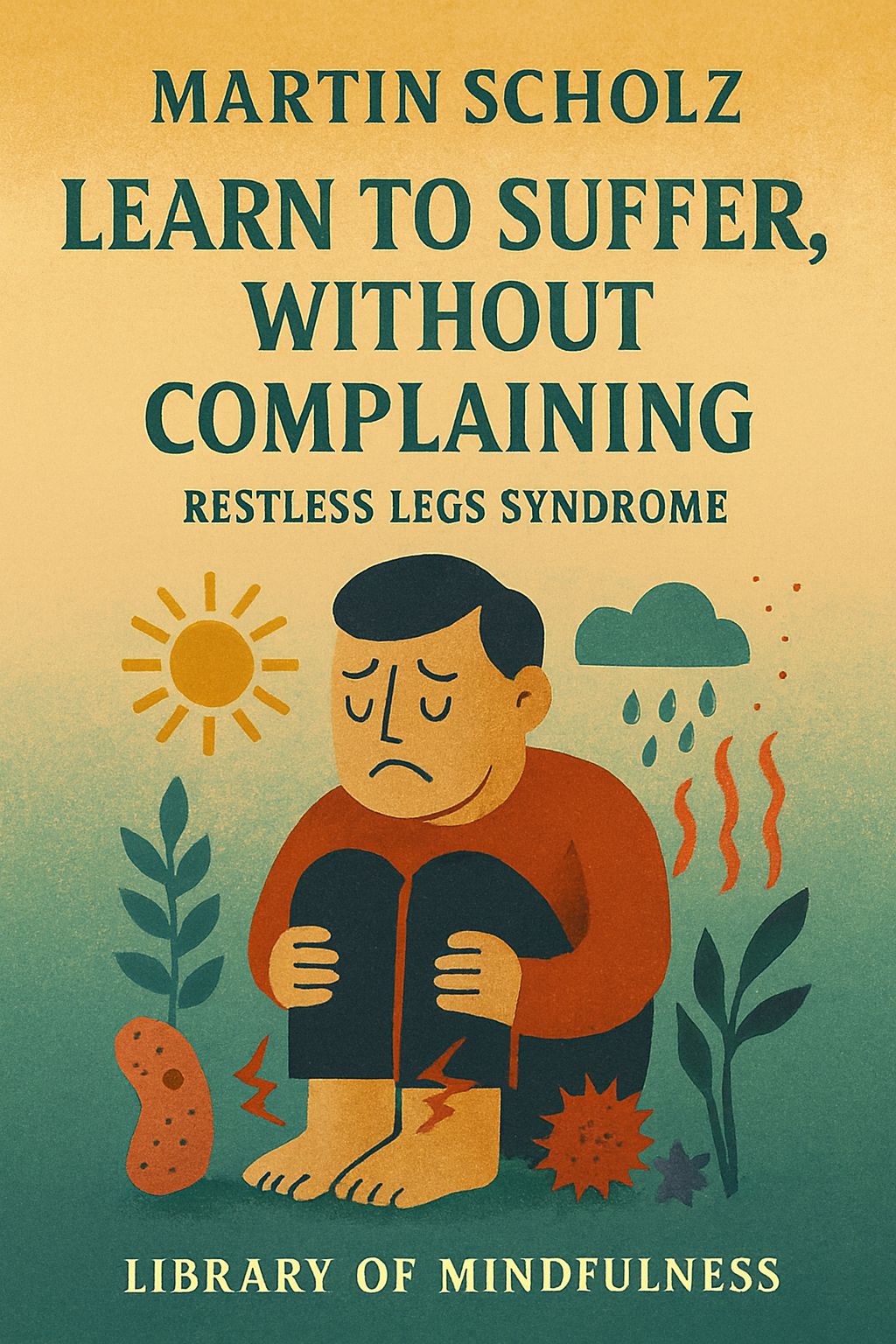
Learn to suffer without complaining - RLS
🌙 Learn to suffer without complaining
Mindfully accepting Restless Legs Syndrome (RLS) – Finding inner peace through warmth, movement, and compassion Scientifically proven. Suitable for everyday use. Immediately effective.
Why this book?
Restless legs syndrome (RLS) is more than a neurological phenomenon—it is a nightly invitation to self-awareness. But while most guidebooks focus on medication, dopamine agonists, or iron supplements, this book shows you a holistic, evidence-based way to regain your inner peace through mindfulness, warmth, movement, and compassion – without fighting your body.
“Learn to suffer without complaining” translates the latest findings in neurobiology, sleep medicine, and somatic psychology (including Stephen Porges' polyvagal theory, dopamine research, circadian rhythms) into practical, everyday micro-rituals that work without radical lifestyle changes. You will learn how heat, breathing techniques, micro-movements, and social connection regulate your nervous system, reduce stress, and transform your relationship with your body – measurable through biomarkers such as HRV, cortisol, and dopamine levels.
What to expect: Science meets practice
🔹 The physiology of RLS: Why dopamine deficiency, iron metabolism, and circadian rhythms trigger nighttime restlessness—and how gentle exercise, warmth, and nutrition recalibrate them (Nature Reviews Disease Primers, 2021).
🔹 Mindfulness in pain: How body scanning, breathing techniques (4-6-8 breathing), and somatic presence change the perception of discomfort – without suppressing it (Mindfulness Practice, Hölzel et al., 2011). 🔹 Warmth & movement: Why foot baths, hot water bottles, and micro-movements (e.g., circling your toes while lying down) promote blood circulation and activate the vagus nerve—without having to get up (Journal of Bodywork and Movement Therapies, 2013).
🔹 Nutrition & iron: How ferritin levels (>75 µg/l), magnesium, and B vitamins stabilize dopamine production—and which food combinations (e.g., lentils + vitamin C) optimize absorption (Sleep Medicine Reviews, 2012).
🔹 The vagus nerve as the key: How slow exhalation, abdominal warmth, and co-regulation (e.g., synchronized breathing with a partner) strengthen the parasympathetic nervous system and reduce stress hormones by up to 30% (Frontiers in Psychology, 2017).
🔹 Social warmth & compassion: Why touch, humor, and community break the loneliness of RLS—and how simple rituals (e.g., drinking tea together) release oxytocin (Psychological Science, 2009). 🔹 For those interested in STEM: Deep insights into the biophysics behind the strategies—e.g.:
- How C-tactile fibers (skin nerves) convert touch into oxytocin (Science, 2008).
- Why fascia functions as “liquid crystals” – biophysics of biotensegrity (Fascia Research Congress, 2015).
- How somatic markers (Damásio) control decisions and emotions (Self Comes to Mind, 2012).
Who is this book for?
✔ Those interested in science and STEM who want to understand neuroscientific and biophysical mechanisms (e.g., dopamine, vagus nerve, circadian rhythms) and apply them in everyday life.
✔ People affected by RLS, fibromyalgia, or chronic pain who are looking for gentle alternatives to medication – without sacrificing evidence.
✔ Shift workers, professionals with sleep disorders or stress who want to strengthen resilience and body awareness through evidence-based rituals.
✔ Doctors, physical therapists, and coaches who want to teach patient-friendly, scientifically sound approaches to pain management and sleep optimization.
✔ People with a digital lifestyle who want to compensate for body dissociation (e.g., due to working from home, screen work) with micro-rituals.
✔ Relatives of RLS sufferers who want to develop empathy and support through concrete courses of action (e.g., joint evening rituals).
Your advantages at a glance
✅ No radical changes – instead, 12 scientifically based micro-strategies that fit into any everyday life (e.g., breathing techniques, hot water bottles, 1-minute interventions).
✅ Evidence-based & transparent – Studies from neurobiology, sleep medicine, and psychophysiology (including Harvard and the Max Planck Institute) are explained in an understandable way – perfect for those interested in STEM who want to understand the biophysics and physiology behind the methods.
✅ Suitable for everyday use & time-saving – practices for the office, home office, and on the go that don't take any extra time (e.g., feeling the floor while waiting, 3-breath reset before meetings).
✅ Focus on measurable effects – HRV, cortisol, dopamine levels as biomarkers that show: The rituals work – not just subjectively, but physiologically verifiable.
✅ Lasting effects – Reduction of stress, improvement of sleep quality, and strengthening of resilience – without expensive therapies or radical lifestyle changes.
✅ Social integration – Rituals for couples and families that promote compassion and connection – without RLS becoming a burden.
Start now – with your first conscious impulse!
You don't have to meditate for hours or completely change your habits to gain more peace, less stress, and deeper acceptance. Sometimes a single mindful moment is enough – a conscious breath while waiting in line, a gentle hand on your stomach before falling asleep, a 3-minute stretch while brushing your teeth.