

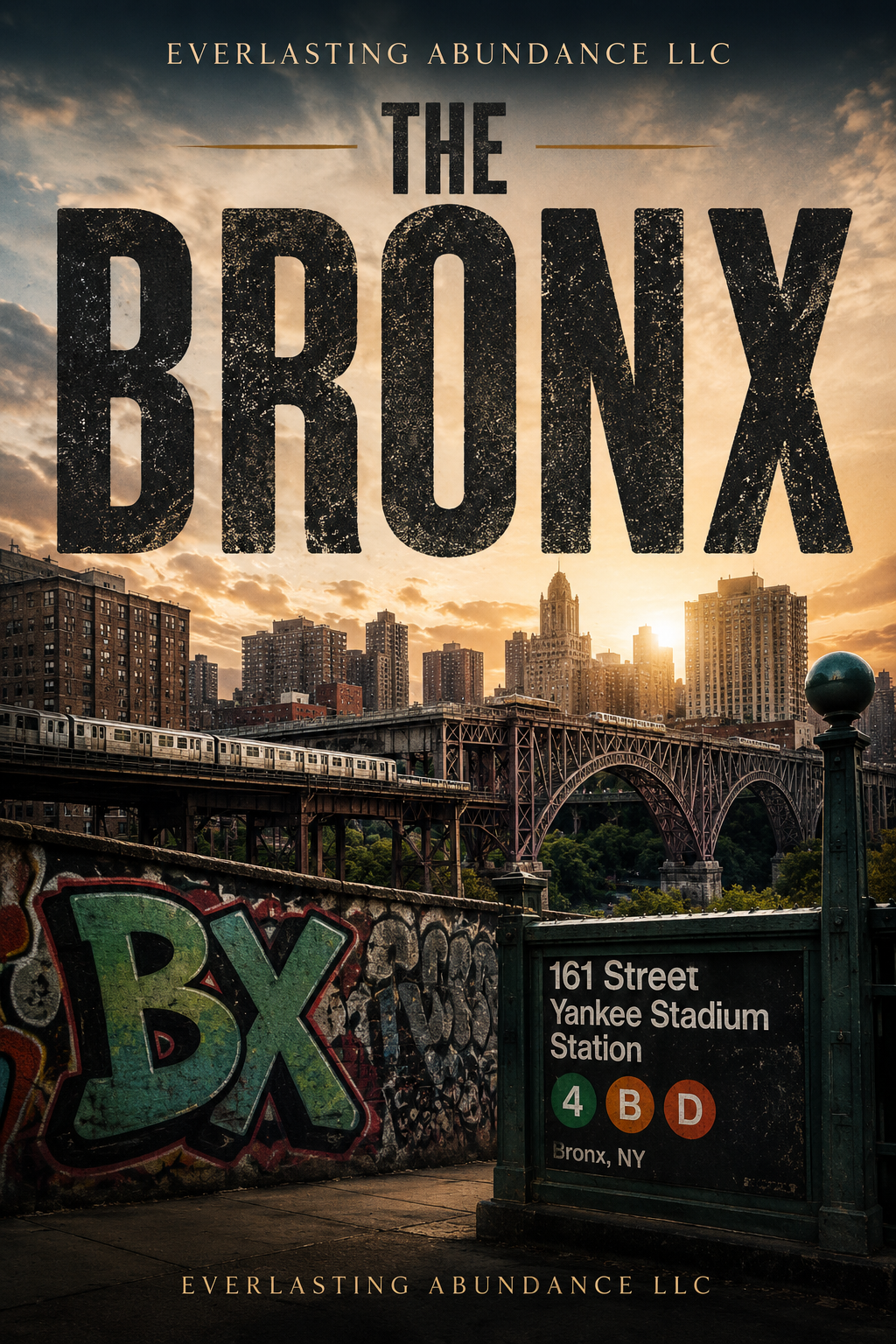
The Bronx
Why This Book is a Must-Read:
- The Untold History: Dive deep into the scorching summers where arson, systemic neglect, and survival forged an unbreakable community bond (pp. 3-4).
- The Pioneers of Sound: Relive the legendary block parties where icons like Kool Herc and Grandmaster Flash engineered the very first breakbeats (pp. 9, 11).
- A Visual and Sonic Tapestry: Explore the explosion of raw creativity—from the poetic street narratives of early MCs to the gravity-defying battles of B-boys and the vivid canvases of graffiti artists (pp. 10, 12).
The Defiant Spirit: Learn how a generation with limited resources repurposed everyday items to turn concrete labyrinths into empires of pure genius (pp. 2, 22). The air in the Bronx, during those searing summers of the 1970s, was a character in itself. It wasn’t just the heat, though that was a constant, oppressive blanket, making the asphalt shimmer and the sweat prickle under even the lightest shirt. It was a thicker, more complex miasma, woven from the exhaust fumes of sputtering buses, the acrid smoke that sometimes still drifted from the gutted husks of buildings, and the faint, metallic tang of something perpetually on the verge of collapse. To walk these streets was to feel the grit not just on your shoes, but under your fingernails, a gritty reminder of the decay that had settled in like a stubborn, unwanted guest. Each cracked sidewalk, each crumbling brick facade, was a testament to neglect, a visible scar in a borough that was rapidly becoming synonymous with urban blight. Yet, beneath this tableau of devastation, a different kind of energy pulsed, a defiant thrum that refused to be extinguished.
The buildings stood like skeletal remains, many of them hollowed out by arson, their windows gaping blackly, like vacant eyes staring out at a world that had largely forgotten them. Fires, a symbol of destruction that had ravaged block after block, had left behind a landscape of skeletal frames and mountains of rubble. But even in the aftermath, life persisted. Stoops, once just a few steps leading to a doorway, had transformed into impromptu community centers. Here, in the sweltering heat, neighbors would gather, seeking solace in shared conversation, the rhythmic sway of rocking chairs, and the collective watchfulness over the block. These were the front porches of a new era, spaces where news was exchanged, grievances aired, and the simple act of existing together became an act of resistance. The sky above, often a bruised and indifferent canvas of twilight grays and purples, seemed to bear witness to this ongoing drama, the darkening hues mirroring the anxieties that clung to the borough. Yet, even as shadows lengthened, these stoops held a light, a fragile but persistent glow of human connection.
You could almost taste the desperation, a lingering residue of hardship that clung to everything. The scent of stale urine in forgotten alleyways, the distant wail of sirens that had become the soundtrack to daily life, the hushed, fearful conversations that stopped abruptly when a stranger passed – these were the sensory markers of a community living on the edge. It was a landscape where dreams were often deferred, or worse, abandoned, replaced by the grim necessity of survival. The grandeur of Manhattan, just across the river, seemed a world away, a gleaming, unattainable utopia. Here, in the Bronx, reality was etched in the peeling paint, the overflowing trash cans, and the weary faces of those who walked these streets. It was a place
3.
where hope had to be actively cultivated, like a stubborn wildflower pushing through cracked concrete, a testament to the sheer tenacity of the human spirit.
The children, however, seemed to possess a different kind of awareness, a resilience forged in the crucible of their environment. They played amidst the decay, their laughter a bright counterpoint to the somber backdrop. Their games were improvisations, their toys often scavenged, their playgrounds the cracked pavement and the skeletal remains of abandoned cars. They navigated this complex urban terrain with an instinct born of necessity, their senses sharpened by the constant hum of the city's underbelly. They were the inheritors of this scarred landscape, and they would, in their own way, begin to reimagine it, to infuse it with a new kind of energy, a new rhythm that would eventually reverberate far beyond the confines of their borough. They were the unacknowledged architects of a future that would rise from the ashes, a future born not of privilege, but of pure, unadulterated creativity.
The sense of abandonment by the city’s authorities was palpable. The fires, often left to burn for days, seemed to symbolize a broader indifference, a systemic neglect that left entire neighborhoods vulnerable. Buildings that could have been saved were allowed to fester, becoming havens for crime and further reinforcing the narrative of the Bronx as a lost cause. This abandonment wasn't just about infrastructure; it was about a perceived abandonment of people, of the very human lives that unfolded within these crumbling walls. The stoops, then, became more than just gathering places; they were observation posts, places where residents kept watch over their streets, their vigilance a silent protest against the encroaching decay and the perceived unresponsiveness of the powers that be. Every boarded-up window, every vacant lot overgrown with weeds, was a story of a dream put on hold, a potential unfulfilled, a silent testament to the systemic challenges that defined the era.
And yet, within this pervasive atmosphere of struggle, a different kind of narrative was beginning to take shape, one not solely defined by ruin, but by creation. The very conditions that threatened to crush the spirit of the Bronx also sowed the seeds of an unprecedented cultural explosion. The absence of traditional outlets for expression, the sheer lack of resources, forced an ingenuity, a raw creativity that would soon redefine not just a borough, but the world. The fires had cleared space, not just physically, but metaphorically, making room for something entirely new to take root and flourish in the scorched earth. The echoes of those fires were not just of destruction, but of a phoenix-like rising, a testament to the indomitable spirit that would soon make the Bronx the birthplace of a global phenomenon. The stage was set, not in a gleaming concert hall, but on the very streets that bore the scars of urban
4.
decay, where a new sound, a new culture, was about to be born.
The cracked pavement beneath my feet felt rough, a familiar texture that spoke of countless footsteps, of lives lived and stories unfolding. The air itself seemed to hum with a low frequency, a resonance born from the constant interplay of struggle and resilience. Sirens, a mournful yet persistent wail, were an almost constant companion, their distant cries weaving through the thick, humid air, a reminder of the ever-present tension. But beyond the immediate sense of urban decay, there was an undeniable pulse, a vibrant, defiant energy that seemed to emanate from the very core of the borough. This wasn't a place that had given up; it was a place that was fighting back, albeit in its own unique, unpolished way.
The buildings, many of them gutted shells, stood as stark monuments to a time of intense urban upheaval. Their broken windows, like vacant eyes, stared out at a world that often seemed to look away. Yet, even in their desolation, they formed the backdrop against which a new kind of life was taking root. The stoops, these humble extensions of front doors, had become the de facto community centers. Here, under the indifferent gaze of a darkening sky, neighbors congregated, their conversations a lifeline, their shared presence a bulwark against the encroaching sense of isolation. These were the stages for everyday dramas, the meeting points where the pulse of the community could be felt most acutely. The worn concrete, the chipped paint, the occasional weed pushing defiantly through a crack – all spoke of a borough under siege, yet undeniably alive.
The scent of exhaust fumes mingled with the fainter, more insidious aroma of neglect, a pervasive perfume that clung to everything. It was the smell of a city struggling, a borough bearing the weight of economic disparity and systemic neglect. The sidewalks, themselves cracked and uneven, bore the imprint of generations, each scuff mark and fissure a silent narrative of lives lived, of journeys taken. The sirens, a constant siren song of emergency, punctuated the otherwise muffled sounds of city life, a persistent reminder of the challenges that lurked around every corner. Yet, in the midst of this urban weariness, there was an unshakeable spirit, a defiance that shimmered like heat haze rising from the asphalt.
The stoops, those few steps leading up to the entrance of apartment buildings, were more than just architectural features; they were the heartbeats of the blocks. On any given summer evening, they would be alive with the murmur of conversation, the laughter of children, the rhythmic creak of rocking chairs. They served as informal gathering spots, places where neighbors could share news, watch over each other’s
5.
children, and simply exist in each other’s company. These were the communal living rooms of the Bronx, extending the private sanctuary of the home into the shared public space of the street. The worn concrete, the chipped paint, the lingering scent of yesterday’s cooking – all contributed to a sense of lived history, of a community deeply rooted, even amidst the surrounding decay.
The visual landscape was a stark testament to the fires that had ravaged the borough. Skeletal remains of buildings, their windows like empty sockets, punctuated the skyline. Piles of rubble, slowly being reclaimed by weeds and hardy urban flora, marked the sites of former homes and businesses. Yet, life found a way. Amidst the destruction, resilience bloomed. Children played in the shadows of derelict structures, their games improvisations born from necessity and imagination. The stoops, as mentioned, became vibrant hubs of social activity, a defiant assertion of community in the face of widespread abandonment. The encroaching darkness of the sky seemed to mirror the anxieties of the residents, yet the lights that flickered on in the occupied buildings, the sounds of music and conversation that drifted from open windows, spoke of an unyielding spirit.
Walking these streets, one couldn't escape the palpable sense of a community teetering on the edge. The weight of urban decay, the constant threat of crime, the economic hardships – all cast long shadows. Yet, it was precisely in this fertile ground of adversity that the seeds of something extraordinary were being sown. The very conditions that threatened to crush the spirit of the Bronx also fueled an unparalleled surge of creativity and innovation. The narrative of ruin was being rewritten, not by erasing the scars, but by building something vibrant and powerful on top of them. The atmosphere was thick with more than just the summer heat; it was charged with a defiant energy, a primal hum of life that refused to be silenced. The stoops were not just places to sit; they were stages for a new kind of cultural revolution, a revolution born from the streets themselves.
The sheer grit of the place was something that seeped into your bones. It was in the dust that coated every surface, the grime that seemed to defy even the most vigorous scrubbing, the pervasive sense of a city that had seen better days and was struggling to remember them. But this grit wasn't just about dirt; it was about a toughness, a resilience that had been forged in the fires of urban neglect and economic hardship. It was the texture of everyday life, the unvarnished reality that shaped the people who called this borough home. The cracked sidewalks were more than just pathways; they were arteries, carrying the lifeblood of the community, each fissure a testament to the constant pressure, the relentless wear and tear of a city pushed to its limits.
6.
7.
The symphony of the streets was a complex composition. The rumble of aging subway cars beneath the surface, the incessant honking of impatient drivers, the distant wail of sirens that had become an almost mournful background score – these were the dominant notes. But interwoven with these were the subtler sounds: the sharp crackle of a boombox on a corner, the rhythmic cadence of voices engaged in animated conversation, the occasional burst of laughter that cut through the ambient noise like a shard of sunlight. These sounds, raw and unfiltered, were the very essence of the Bronx, a testament to the enduring vitality of a community that refused to be defined solely by its struggles. The air itself seemed to vibrate with this collective energy, a palpable force that drew you in, making you a participant in the unfolding drama.
The contrast was stark. On one hand, the pervasive signs of urban decay – the boarded-up buildings, the graffiti-scarred walls, the overflowing refuse bins – painted a picture of neglect and despair. On the other, there was the undeniable pulse of life, the vibrant energy that emanated from the stoops, the playgrounds, the makeshift gathering spots. It was a landscape of contradictions, where the remnants of destruction served as the backdrop for an explosion of creativity. The fires had indeed left their mark, a deep scar on the borough’s physical and psychological landscape. But they had also, in a strange and powerful way, cleared the ground for something new to grow. The indifferent sky, often a canvas of bruised twilight colors, seemed to watch over this precarious balance, bearing witness to a community perpetually on the edge, yet refusing to fall.
The air itself felt heavy, not just with the oppressive summer heat, but with the weight of history, of stories untold and experiences etched into the very fabric of the borough. Walking these streets was like stepping into a living memoir, where every cracked sidewalk and peeling facade whispered tales of resilience and struggle. The scent of exhaust fumes, a constant reminder of the city's relentless motion, mingled with a fainter, more poignant aroma – perhaps the lingering ghosts of the fires that had ravaged so many blocks. These weren't just abstract symbols of urban decay; they were tangible presences, shaping the environment and the lives of the people who navigated it. The stoops, in particular, had become the nexus of community life, informal stages where neighbors gathered, shared their experiences, and forged bonds that transcended the harsh realities surrounding them.
The landscape was a tapestry woven from threads of decay and defiance. Block after block of neglected buildings stood sentinel, many bearing the blackened scars of arson, their windows like vacant eyes staring out at a world that often seemed to look
away. Yet, within this visual narrative of ruin, a different story was unfolding. The stoops, those few steps leading to the entrance of apartment buildings, had transformed into vibrant communal spaces. They were the front porches of a new era, where the rhythms of daily life played out – conversations, laughter, the watchful gaze of parents over children at play. These spaces were crucial, offering a sense of continuity and belonging in a borough that felt increasingly marginalized. The darkening sky overhead seemed to amplify the sense of a community teetering on the edge, yet pulsing with an undeniable, defiant energy, a testament to the enduring human spirit.
The palpable atmosphere was thick with more than just the summer humidity. It was a dense, almost tangible presence, woven from the exhaust of aging buses, the distant wail of sirens that had become an almost constant soundtrack, and the lingering scent of smoke that sometimes drifted from the skeletal remains of burnt-out buildings. To walk these streets was to feel the grit not just on your shoes, but under your fingernails, a visceral reminder of the decay that had settled in like a stubborn tenant. Each cracked sidewalk, each crumbling brick facade, was a testament to a borough under immense strain, a community scarred but not broken. The stoops, these humble extensions of apartment doorways, had become the de facto community centers, spaces where life continued to unfold amidst the encroaching shadows.
The city’s neglect was a palpable force, a silent witness to the fires that had gutted so many buildings, leaving behind hollowed-out shells. These skeletal structures, their windows gaping blackly, served as stark reminders of the violence that had swept through the borough. Yet, in the face of this destruction, a different kind of energy began to stir. The stoops, once mere architectural features, were transformed into vibrant hubs of social interaction. Here, neighbors gathered, seeking respite from the oppressive heat and the pervasive sense of unease, their conversations weaving a rich tapestry of community life. Under the darkening sky, these stoops became impromptu stages, illuminated by the warm glow of porch lights, where the defiant spirit of the Bronx pulsed with an undeniable, life-affirming rhythm. It was a landscape etched with hardship, yet alive with an indomitable will to persevere.
The air in the Bronx, during those sweltering summers, carried a unique scent – a complex blend of exhaust fumes, the distant promise of rain that rarely seemed to deliver, and a faint, almost metallic tang of decay. But beneath it all, there was a pulse, a palpable energy that belied the outward signs of urban blight. The sidewalks, cracked and uneven, bore the weight of countless footsteps, each scuff mark a silent
8.
- testament to the lives lived and the stories unfolding. Buildings stood like weathered sentinels, some scarred by the fires that had swept through the borough, their empty windows like vacant eyes. Yet, it was on the stoops, those few steps leading up to the entrances of apartment buildings, that the true heart of the community beat. They served as informal gathering places, the front porches of a community under duress, where neighbors shared conversations, watched over their children, and forged connections that became their lifeline. The sky above, often a bruised twilight canvas, seemed to hold its breath, witnessing a borough teetering on the edge, yet brimming with an undeniable, defiant spirit.