
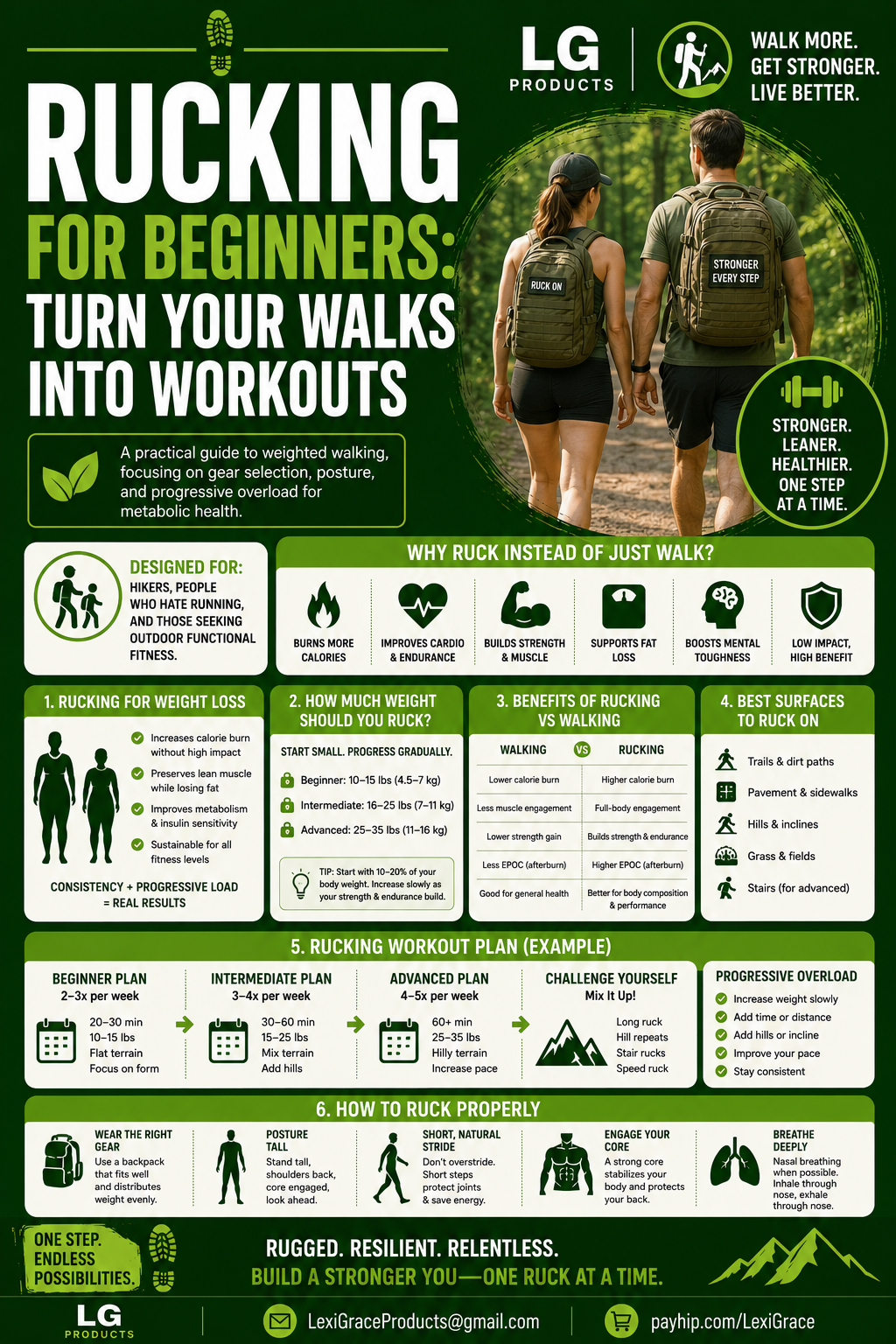
Rucking for Beginners: Turn Your Walks Into Workouts — The Complete Guide to Weighted Walking for Fat Loss, Strength, and Functional Fitness
You do not need to run. You do not need a gym. You do not need to suffer. You just need a backpack, some weight, and the willingness to walk with purpose.
Rucking is the simplest, most accessible, and most underrated workout available to anyone who can walk. Elite military units have used it for centuries to build extraordinary strength, endurance, and mental toughness. Special Operations forces around the world use rucking as a foundational fitness tool precisely because it builds functional strength, cardiovascular endurance, and mental resilience simultaneously — without the joint stress of running or the equipment requirements of the gym.
And now the civilian fitness world has discovered what the military has always known. Rucking burns 30-50 percent more calories than walking. It builds muscle in the posterior chain — the glutes, hamstrings, and back muscles that protect your spine and power your movement. It improves posture, supports fat loss, enhances bone density, and delivers all the cardiovascular benefits of Zone 2 cardio. All in one activity. All outdoors. All at a pace where you can still hold a conversation.
Rucking for Beginners: Turn Your Walks Into Workouts is the complete practical guide to weighted walking for hikers, people who hate running, and anyone seeking outdoor functional fitness — covering weight selection and progressive overload, rucking for fat loss, surface selection, proper form and technique, gear selection, complete training programs, nutrition and recovery, rucking versus other cardio modalities, and the mental toughness dimension that makes rucking unlike any other fitness practice.
Every chapter includes specific how-to guidance, reference tables, and practical examples you can apply on your very next ruck.
What's Inside:
✅ Introduction — Why rucking is the most underrated workout most people are not doing — a complete nine-factor comparison table of rucking versus walking versus running covering calorie burn, muscle engagement, joint impact, equipment needed, mental toughness, injury risk, beginner friendliness, fat loss benefit, and outdoor enjoyment — with rucking's advantages highlighted throughout
✅ Chapter 1 — Rucking for weight loss — five mechanisms that make rucking exceptional for fat loss: higher calorie burn without running's injury risk, EPOC afterburn effect, muscle preservation during fat loss through posterior chain resistance stimulus, the consistency advantage of a low-injury sustainable activity, and insulin sensitivity improvement, plus a complete calorie burn reference table by body weight (130-230 lbs) and ruck weight (15-35 lbs)
✅ Chapter 2 — How much weight to ruck — the starting weight rule (10-15% of body weight), three color-coded level cards with specific weight, frequency, duration, terrain, goal, and how-to guidance for Beginner (10-15 lbs), Intermediate (15-25 lbs), and Advanced (25-35 lbs) levels, plus a complete weight progression table by body weight showing starting, intermediate, advanced, and maximum recommended weights for every size rucker
✅ Chapter 3 — Benefits of rucking vs walking — a head-to-head comparison box with eight specific factors, plus six science-backed benefits explained in depth: bone density improvement through osteoblast activation, posterior chain strength development, cardiovascular efficiency through cardiac remodeling, posture correction through loaded carry mechanics, mental health and stress reduction, and functional fitness for daily life activities
✅ Chapter 4 — Best surfaces to ruck on — five complete surface guides each with description, science, and specific how-to bullets: Trails and Dirt Paths (gold standard — highest recommendation), Pavement and Sidewalks (most accessible for beginners), Hills and Inclines (highest intensity per unit of time), Stairs (advanced only — maximum intensity), and Grass and Fields (recovery sessions and beginners), with guidance for mixing surfaces deliberately across a training week
✅ Chapter 5 — How to ruck properly — five form fundamentals each with a coaching cue and detailed explanation: Stand Tall with upright spine, Shoulders Back and Down to activate rhomboids, Engage Your Core as a natural weight belt, Short Natural Stride to prevent overstriding, and Breathe Through Your Nose as an intensity governor, plus complete pack fit guidance covering pack height, shoulder strap tension, hip belt load distribution, and weight centering
✅ Chapter 6 — Gear selection guide — a four-option pack comparison table covering GORUCK dedicated packs, military surplus, hiking daypacks, and budget starting options, five weighting methods from ruck plates through DIY sandbags to water containers, and footwear guidance covering trail running shoes, hiking boots, running shoes, and minimalist options — with star ratings and specific product recommendations for each category
✅ Chapter 7 — Rucking workout plans — a complete four-week beginner program table (week-by-week sessions, duration, weight, terrain, and focus), an eight-week intermediate program with a deload week, and a full advanced weekly template with seven daily sessions including long rucks, speed rucks, hill repeats, and event simulation — structured for GORUCK Light preparation
✅ Chapter 8 — Rucking vs other cardio — four detailed comparisons each with a six-factor bullet comparison table and a plain-language bottom-line verdict: Rucking vs Running (injury rate, muscle building, sustainability), Rucking vs Cycling (bone density, portability, muscle engagement), Rucking vs HIIT (recovery demand, weekly volume, age-appropriateness), and Rucking as Zone 2 Training — why rucking at conversational pace delivers every mitochondrial and cardiovascular benefit of Zone 2 cycling plus bonus strength training in one session
✅ Chapter 9 — Nutrition and recovery for ruckers — complete pre-ruck nutrition timing (2-3 hours before, 30-60 minutes before, during sessions over 60 minutes, post-ruck within 30 minutes), daily protein targets (0.7-1.0g per pound of body weight), a six-timing hydration guide from the night before through post-ruck replacement, and six specific recovery practices targeting the posterior chain muscles rucking activates: hip flexor stretch, thoracic rotation, figure 4 glute stretch, calf and ankle work, foam rolling, and contrast showering
✅ Chapter 10 — Rucking for mental toughness — five mechanisms through which rucking builds mental resilience: voluntary hardship and the evidence of completion, the 40 Percent Rule from Special Operations culture, presence and meditative focus under load, community and camaraderie through GORUCK events, and the identity-level change that comes from consistently choosing the harder path, plus five specific mental strategies for hard rucks including micro-goals, mantras, embracing the suck, deliberate difficult conditions, and session logging
✅ Bonus — Complete Reference — a three-section pre-ruck gear checklist covering Essentials, Longer Rucks (60+ min), and Seasonal Additions, and a quick-reference starting weight table by body weight showing your start weight, four-week target, and six-month goal weight for every size rucker from under 140 pounds through 220-plus pounds
This guide is perfect for:
- Hikers who want to make their regular walks more challenging and productive without changing the activity they already love
- People who hate running but want meaningful cardiovascular fitness and fat loss without the impact and injury risk
- Anyone who has tried gym memberships and found them unsustainable and wants a fitness practice that requires no facility, no class schedule, and no machine
- Adults over 40 looking for a joint-friendly, sustainable fitness practice that delivers cardiovascular benefit, strength development, and bone density improvement simultaneously
- Fitness enthusiasts who have heard about rucking through GORUCK, military fitness content, or the longevity community and want a complete practical guide
- Anyone who wants their cardio to build something beyond just calorie burn — strength, posture, bone density, and the mental toughness that comes from carrying weight over distance
The weight in your pack is temporary. The strength you build carrying it is permanent.
Most cardio leaves you with a smaller number on a scale. Rucking leaves you with stronger glutes, a more upright spine, better posture, denser bones, a more efficient heart, and the quiet confidence that comes from consistently choosing to carry something heavy instead of putting it down.
Every step counts more. Every walk becomes a workout. Every completed ruck makes you harder to beat.
Walk More. Get Stronger. Live Better.
Instant digital download. Your first ruck starts today.
Note: This guide is for informational and educational purposes only and is not a substitute for professional medical advice. Always consult your physician before beginning a new exercise program, especially if you have injuries, joint issues, or other health concerns.
© 2026 Lexi Grace Products | LexiGraceProducts@gmail.com | payhip.com/LexiGrace