



In Mold Finishing
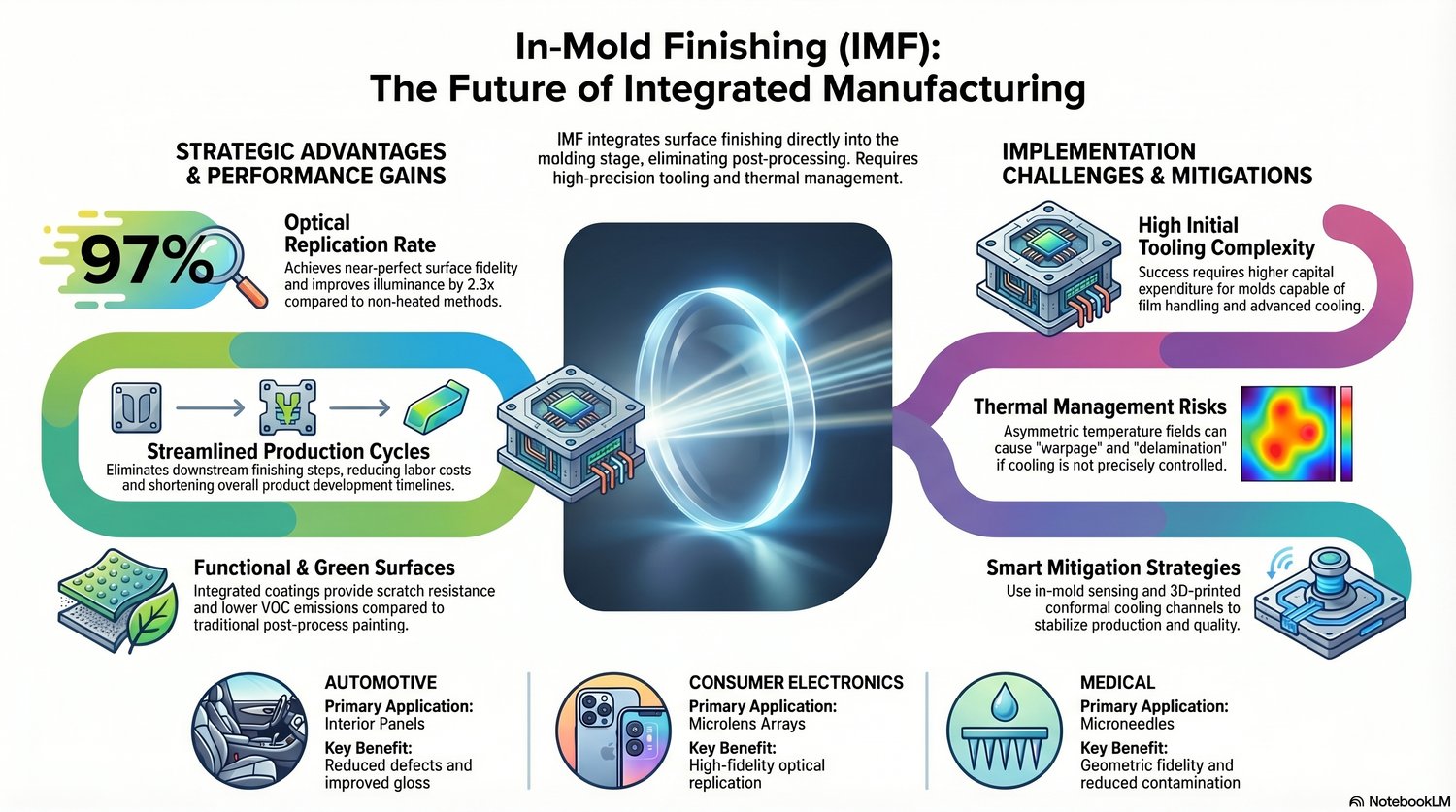
This review synthesises recent research on in-mold finishing (IMF), defined to include in-mold decoration, in-mold coating and in-mold labeling, and evaluates how integrating finishing into the molding cycle alters process design, tooling and product outcomes. The review compares IMF to traditional post-process finishing and shows that IMF can eliminate downstream operations, shorten development cycles and improve surface aesthetics and functional properties when film, coating and substrate compatibility and mold design are aligned. Case evidence from automotive, consumer electronics, packaging and medical sectors demonstrates improved optical replication, reduced floating-fiber defects and enhanced durability for coated surfaces. The literature also identifies recurrent challenges: increased tooling complexity and cost, narrow adhesion windows, asymmetric thermal fields that induce warpage, and specific defect modes such as wrinkles, delamination and gas marks. Studies show these risks can be mitigated by CAE-driven design, conformal cooling, local mold heating, additive tooling for rapid trials and in-mold sensing with closed-loop control. Lifecycle and carbon-accounting work further suggests IMF may reduce emissions associated with finishing when tooling and process choices are optimised.