
Early Reflection Locator
Know exactly where to put your acoustic panels. No mic. No measurement. Just your room dimensions.
Stop guessing where to put your acoustic panels.
If you've ever bought absorption panels and had no idea where to hang them — this tool is for you.
Early Reflection Locator takes your room dimensions and speaker/listening position as input, then gives you a clear picture of where sound bounces off your walls, ceiling, and floor before reaching your ears.
Why this tool exists
The traditional mirror method for finding first reflection points requires a second person and a physical mirror (technically doable solo, but awkward) — and even then it only finds one point at a time. REW is powerful, but it doesn't show reflection points geometrically.
Early Reflection Locator fills that gap: a quick, solo, no-gear-required way to calculate all your reflection points before you buy or place a single panel. Use it to:
- Get a data-driven starting point before measurement
- Avoid placing panels in the wrong position
- Improve stereo imaging and clarity in your listening space
What it does
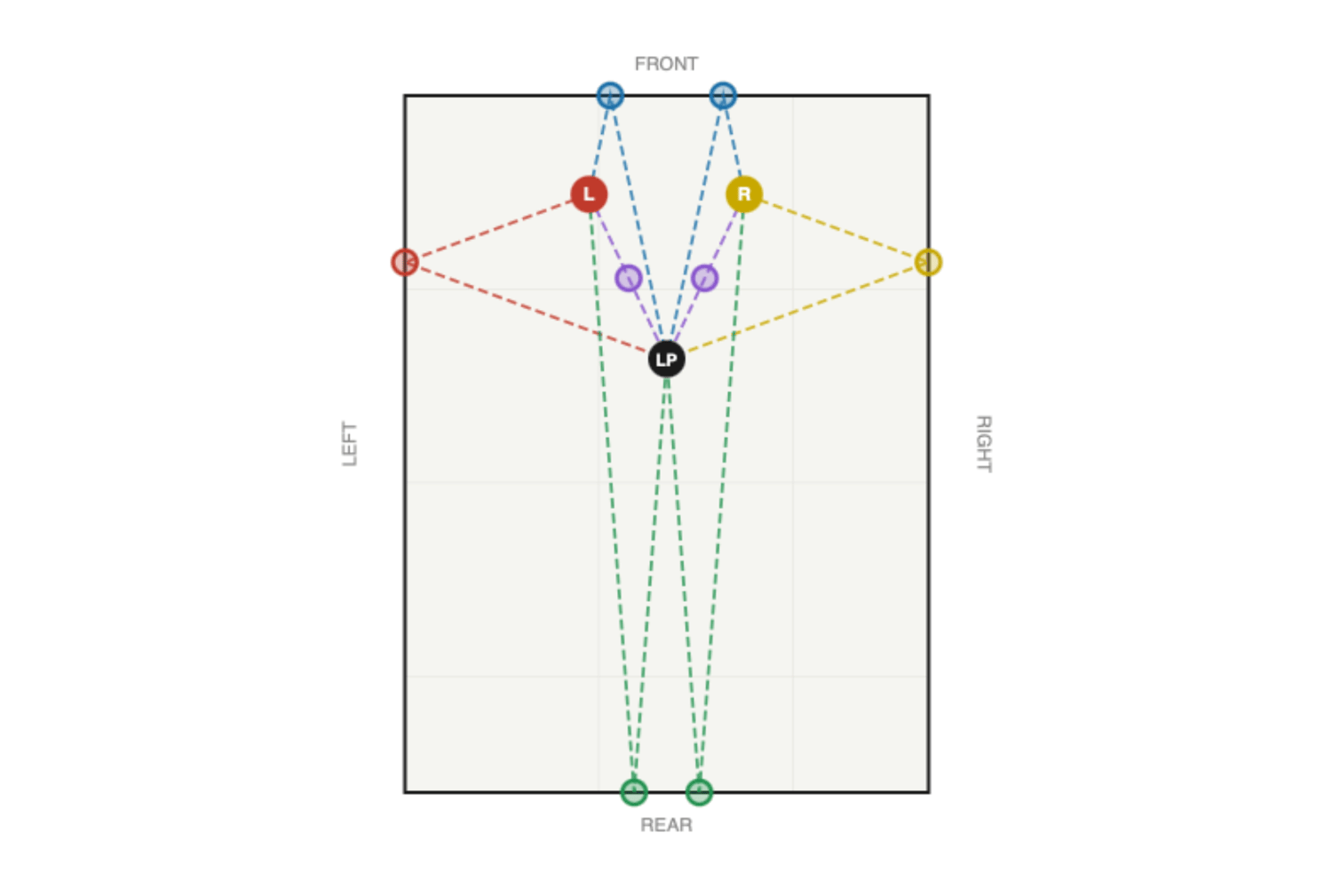
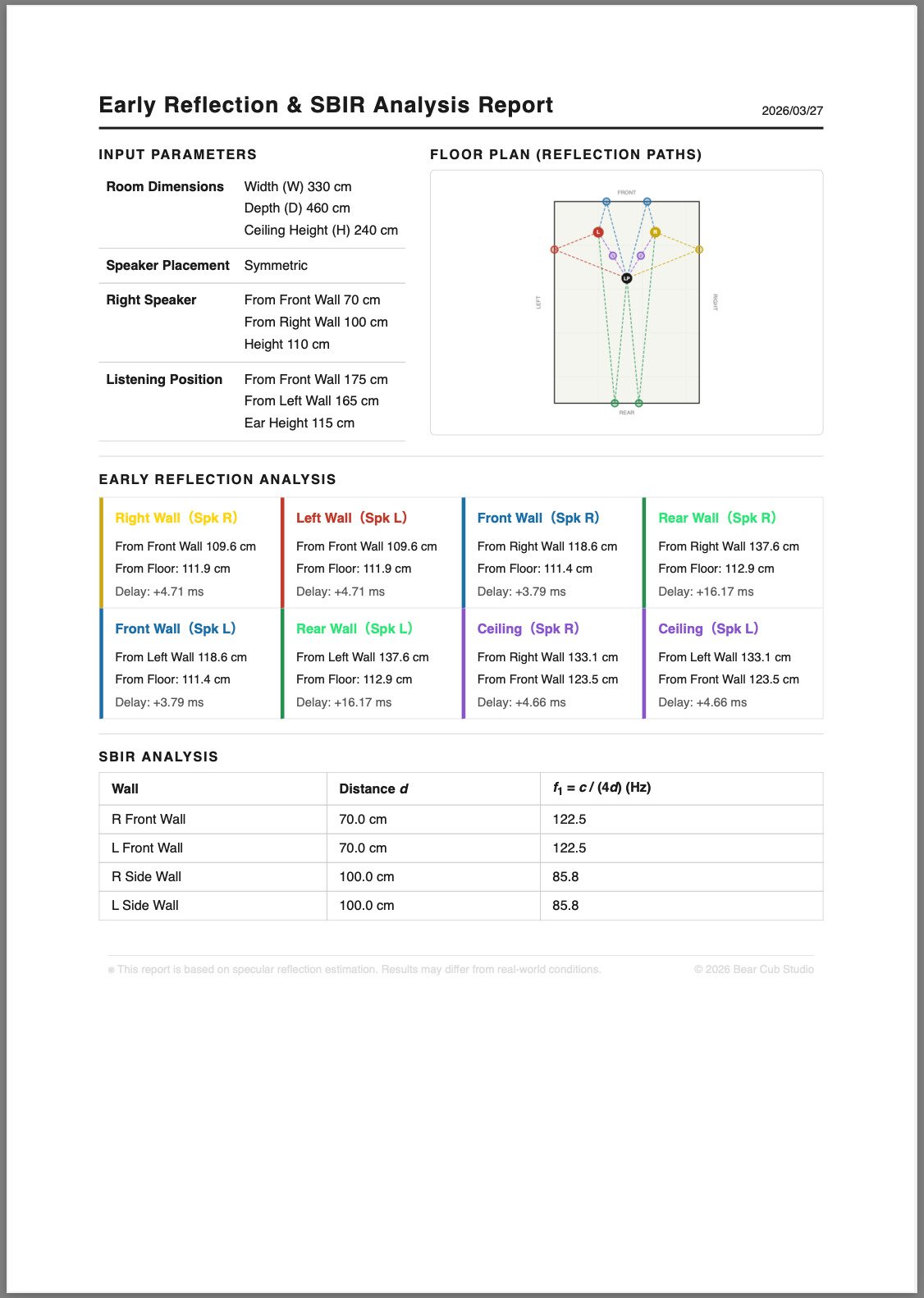
- Plots first reflection paths on a 2D floor plan — left wall, right wall, front wall, rear wall, and ceiling, each color-coded
- Hover over any reflection point on the floor plan to instantly see its coordinates and delay time
- Shows exact coordinates of each reflection point (in cm) measured from two surfaces
- Calculates delay time (ms) between direct sound and each reflection — so you know which ones matter most
- Displays SBIR dip frequencies estimated from speaker-to-wall distances
- Symmetric speaker mode — enter one side, both speakers auto-placed
- Cross-reflection toggle — visualize reflections from the opposite speaker
- Printable analysis report — A4 layout with floor plan, coordinates, and all results
Who it's for
- Home studio owners treating their room for the first time
- Mixing engineers setting up a new listening space
- Anyone who wants a data-driven starting point before buying panels
How it works
- Enter your room width, depth, and ceiling height
- Set speaker positions and listening position
- Hit "Calculate" — reflection paths appear on the floor plan instantly
- Use the coordinate and delay readouts to decide where to place your panels
No microphone required. No room measurement needed. Works entirely offline in your browser.
Technical details
- Single HTML file — no installation, no account, no internet required after download
- Works on Chrome, Safari, and Edge (desktop and mobile, including Edge on mobile)
- Input units: centimeters (cm) and inches — switchable
- Based on the mirror image / specular reflection method
What's included
- EarlyReflectionLocator.html — the full application (single file)
Try before you buy
A free trial version is available here: 👉 https://bearcubstudio.github.io/tools/EarlyReflectionLocator_Trial.html
⚠️ Windows users
If Windows shows a security warning when opening the file, click "Keep" or "Keep anyway" to proceed. This file contains no executable code — it is a plain HTML document that runs entirely in your browser.
FAQ
Q: Does it work on mobile? Yes. Tested on Chrome, Safari, and Edge on both iOS and Android.
Q: Do I need an internet connection? No. The app runs fully offline after download.
Q: Windows shows a security warning — is it safe? Yes. Click "Keep anyway." It's a plain HTML file with no executable code.
Q: What browsers are supported? Chrome, Safari, and Edge — on both desktop and mobile.
Q: Is this based on real acoustic science? It uses the mirror image method (specular reflection), which is standard for estimating first reflection points. Results are a reliable starting point — real rooms have additional variables, so treat this as a planning tool.
This tool estimates first reflection points based on geometric acoustics. Real rooms are more complex — use this as a reliable starting point, not an absolute answer.
Built with Claude AI.