
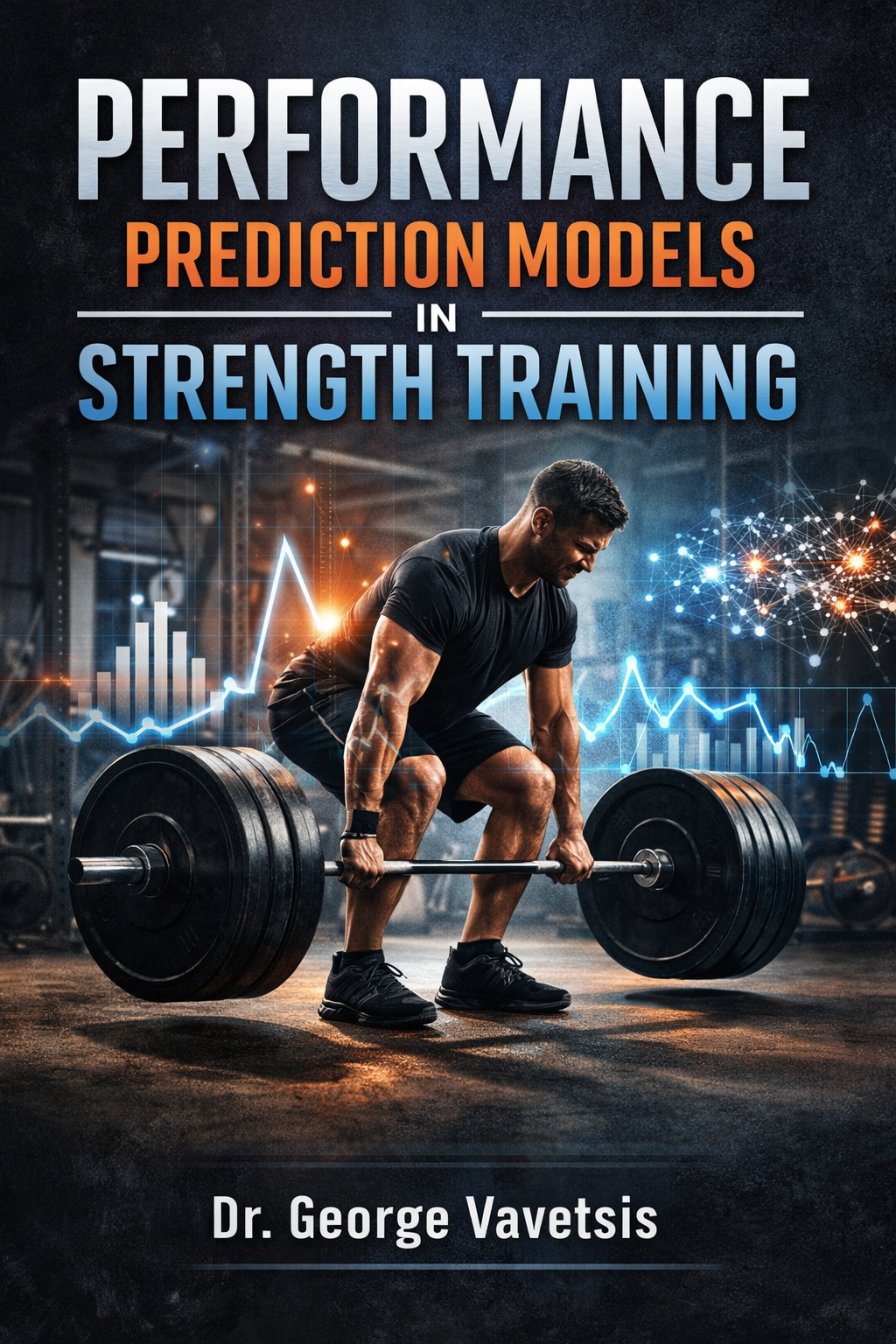
Performance Prediction Models in Strength Training
Pages: 999
Strength training has long been regarded as the most powerful controllable stimulus for enhancing athletic performance. Yet despite decades of empirical practice and scientific investigation, the precise prediction of strength adaptation remains one of the most complex and elusive challenges in performance science. Athletes do not respond to training in linear, predictable patterns; rather, they adapt through dynamic biological systems governed by neural, structural, metabolic, and psychological interactions. The central aim of this book is to bridge the gap between strength training practice and predictive performance science—transforming coaching from reactive decision-making into a structured, data-driven forecasting process.
Performance prediction in strength training is not simply about estimating how strong an athlete may become. It is about understanding when, why, and under what physiological conditions performance improvements occur. Strength adaptation unfolds through a continuous interaction between external training load and the athlete’s internal biological response. This interaction generates adaptive signals that fluctuate across time, often obscured by fatigue, noise, and stochastic biological variability. Without distinguishing true adaptive signal from random variation, prediction becomes unreliable and training decisions risk becoming misguided.
Modern strength coaching increasingly relies on monitoring technologies, neuromuscular diagnostics, and longitudinal performance data. However, raw data alone does not produce meaningful insight. The key lies in constructing predictive frameworks capable of translating biological information into actionable coaching decisions. Such frameworks require the integration of multiple domains: neuromuscular readiness, structural adaptation, fatigue dynamics, load-response relationships, and time-series performance evolution. When these domains are unified within a coherent predictive model, strength training evolves from a static prescription to a responsive and adaptive system.
A fundamental principle underlying this book is that strength performance is governed by multiscale processes. Short-term neural readiness determines the athlete’s capacity to express force in a given session, while long-term structural adaptations—such as muscle hypertrophy and connective tissue remodeling—shape the trajectory of strength development over months and years. Effective prediction must therefore operate across dual time scales, integrating acute readiness indicators with chronic adaptation trends. This dual-timescale perspective enables coaches to adjust daily training loads while maintaining alignment with long-term performance objectives.
Another core challenge in performance prediction is the presence of noise within biological and performance data. Variability arises from numerous sources, including fatigue, psychological stress, sleep quality, nutrition, and measurement error. Distinguishing signal from noise is essential for maintaining prediction accuracy. Overreaction to random fluctuations may lead to unnecessary deloading or inappropriate loading, whereas ignoring meaningful signals can result in maladaptation, overreaching, or stagnation. Consequently, predictive modeling must incorporate statistical filtering, signal detection thresholds, and probabilistic reasoning to ensure robust decision-making.
This book introduces a structured framework for predictive strength training grounded in scientific principles and applied coaching practice. It explores deterministic and probabilistic forecasting, neuromuscular modeling, signal-to-noise analysis, load-response relationships, and time-series strength development. These concepts are translated into practical tools for monitoring athlete readiness, forecasting adaptation trajectories, and optimizing load prescription. Rather than replacing coaching intuition, predictive modeling enhances it—providing objective support for complex training decisions.
Importantly, prediction in strength training does not imply certainty. Biological systems are inherently nonlinear and adaptive, meaning that uncertainty is an intrinsic component of performance forecasting. The objective is not to eliminate uncertainty, but to quantify and manage it. By understanding prediction error, model drift, and response variability, coaches can operate within controlled uncertainty bands—maximizing adaptation while minimizing risk. This probabilistic mindset represents a paradigm shift from traditional percentage-based programming toward dynamic, responsive load management.
The predictive approach presented in this book also recognizes individual variability as a central determinant of performance development. Athletes differ in genetic predisposition, training history, neuromuscular efficiency, and recovery capacity. A training stimulus that enhances performance in one athlete may produce minimal adaptation—or even regression—in another. Therefore, predictive systems must be individualized, continuously updated with new data, and sensitive to evolving athlete states. The future of strength training lies not in universal programming models, but in adaptive, athlete-specific prediction frameworks.
Beyond theoretical exploration, this book is designed as a practical guide for strength and conditioning professionals working in high-performance environments. Each concept is linked to real-world coaching applications, including daily readiness monitoring, load adjustment strategies, fatigue management, and long-term performance forecasting. The intention is to provide coaches with a systematic methodology for transforming performance data into meaningful training decisions—enhancing both effectiveness and safety.
In the evolving landscape of performance science, the integration of predictive modeling represents one of the most significant advances in strength training methodology. As data collection becomes more sophisticated and analytical tools more powerful, the role of the coach is shifting from prescribing fixed training plans to managing adaptive performance systems. This transformation requires not only scientific understanding but also practical wisdom, critical thinking, and continuous observation.
Ultimately, strength training is a process of guided biological adaptation. Prediction serves as the compass within this process, directing training toward optimal performance while navigating uncertainty, variability, and fatigue. By combining scientific rigor with coaching expertise, predictive strength training offers a pathway toward more intelligent, individualized, and effective performance development.
This book invites the reader—coach, scientist, or performance practitioner—to rethink strength training not as a sequence of prescribed exercises, but as a dynamic predictive system. Through this lens, training becomes a process of continuous assessment, informed decision-making, and strategic adaptation, with the ultimate goal of unlocking the athlete’s highest potential.