
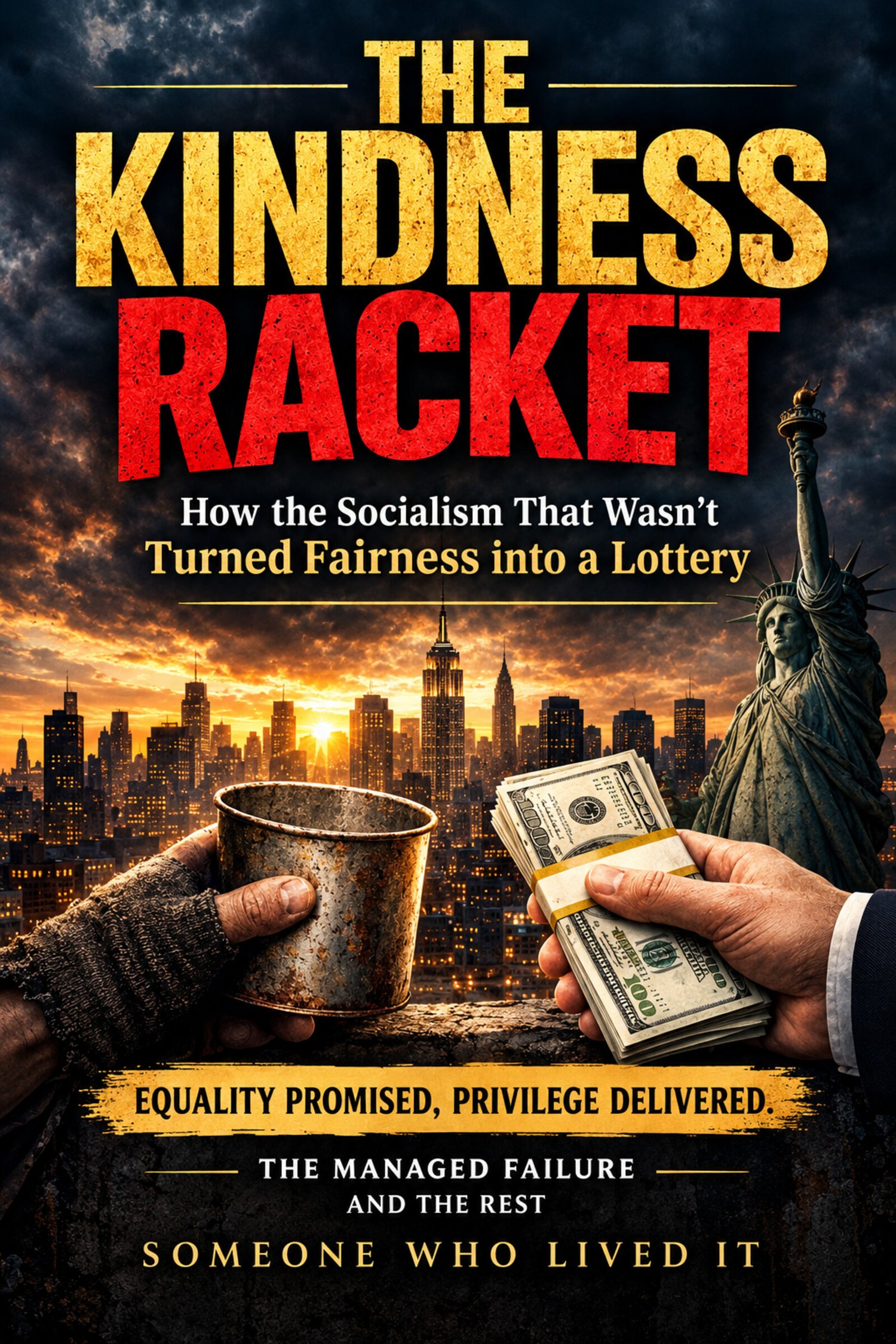
The Kindness Racket. How New York Profits from the Problems It Promises to Solve
What if the problem is not that New York lacks the resources to solve its biggest challenges—but that its systems have learned to survive without solving them?
New York is one of the wealthiest, most influential cities in the world. Yet housing remains unaffordable for many working residents, homelessness persists despite enormous spending, and ordinary people continue to pay the financial and personal costs of problems that successive administrations promise to address.
In The Kindness Racket: How New York Profits from the Problems It Promises to Solve, an author who lived under Eastern European socialism before building a life and businesses in New York examines the incentives, institutions, and political calculations that can keep these problems in place.
The book advances a challenging idea: systems do not always reward the outcomes they publicly claim to pursue. When budgets depend on continuing need, organizations grow around existing problems, and political incentives favor visible activity over measurable results, managing a crisis can become more institutionally rewarding than ending it.
Through the economics of housing, the costs of homelessness services, affordable housing lotteries, rent regulation, public safety, and the pressures facing New York’s middle class, the author asks readers to reconsider familiar explanations and examine who benefits, who pays, and what the numbers actually show.
Inside, the book explores:
- Why housing stability matters beyond the monthly rent and how restrictions on supply can shape affordability.
- How housing lotteries distribute opportunity—and what their outcomes mean for people who work, pay taxes, and still struggle to remain in the city.
- Why spending more money on homelessness does not automatically translate into more permanent housing.
- How incentives can encourage institutions to preserve the programs and structures on which they depend.
- Why the costs of public policies are sometimes difficult to see, especially when they are dispersed across renters, families, and small businesses.
- How concerns about safety affect daily behavior, opportunity, and the freedom to use public spaces.
- Why policies designed to help can produce unintended consequences when their incentives are poorly aligned.
- How words such as compassion, equity, affordability, and investment can obscure the difference between stated intentions and measurable outcomes.
- What a more stable and accountable approach to housing and city governance might require.
This is not an argument that every public program is misguided or that compassion has no place in government. It is a challenge to evaluate public policy by what it achieves, not merely by what it promises.
The book also looks beyond criticism to consider what greater housing supply, transparent costs, clearer incentives, accountability, and long-term stability could mean for the future of the city.
At its heart, The Kindness Racket asks a question that reaches beyond New York: When a system is rewarded for managing a problem, who has the incentive to make that problem disappear?
For readers interested in urban policy, housing economics, government accountability, political incentives, and the future of American cities, this is a provocative examination of the distance between good intentions and real-world results.