
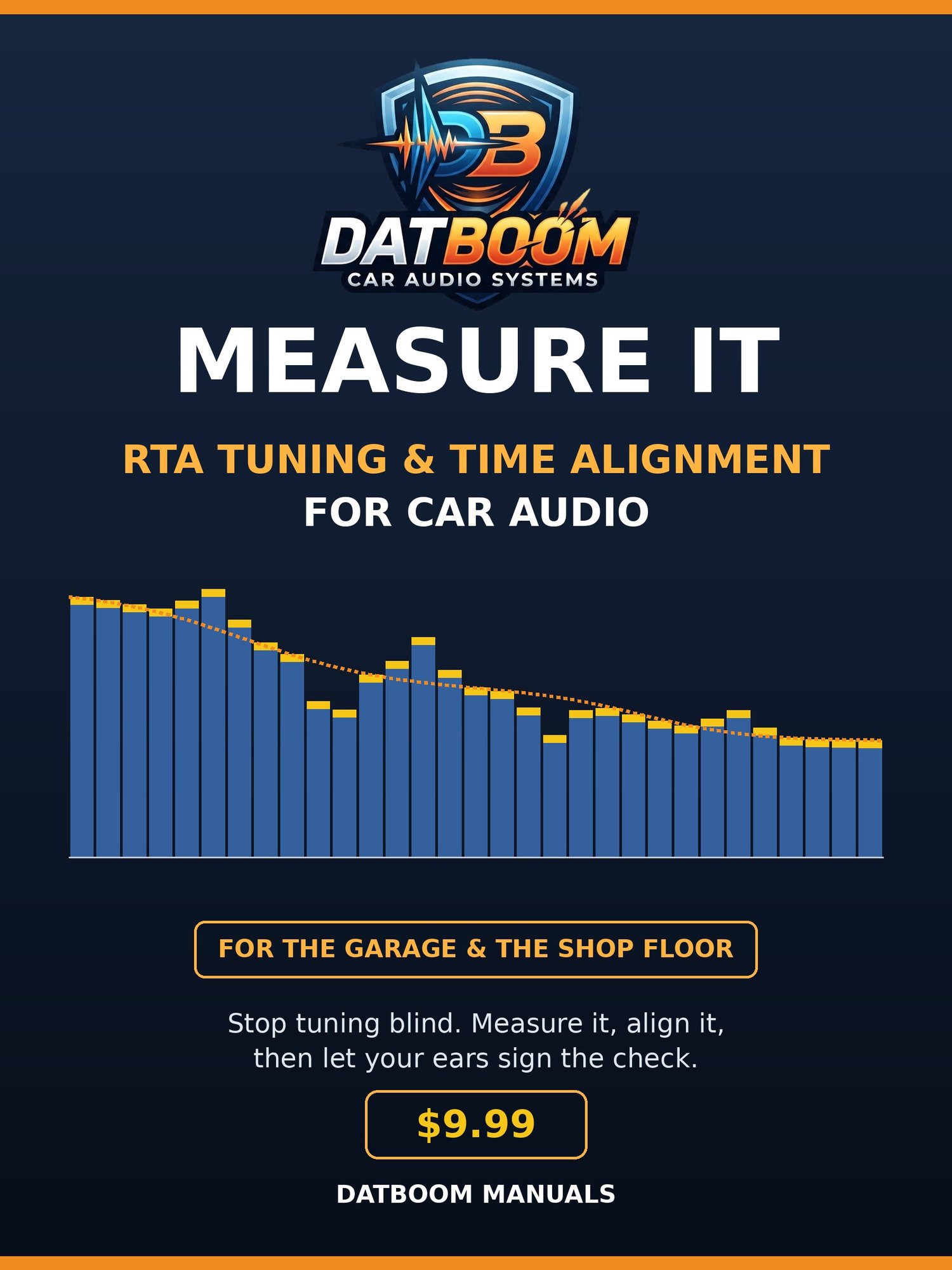
Measure It: RTA Tuning & Time Alignment for Car Audio
Stop tuning blind. Every group, every forum, every shop counter has the same argument: which EQ band, which delay number, whose ears. MEASURE IT ends the argument with an instrument — a real-time analyzer, a calibrated microphone, and free software — and teaches the complete measurement method for car audio, written for BOTH the guy tuning his own car in the driveway AND the tech who gets paid to tune other people's. You'll learn what an RTA actually shows you (and what it can't), why the measurement microphone is the one real purchase and the phone app is a lie, the six-point averaging method that keeps a reflective car cabin from lying to you, pink-noise discipline and hearing-safe measurement levels, and how to build a target curve — because flat measures bad in a car, and this book shows you why, with the curve drawn out. Then the working doctrine: cut peaks, never boost a null. Verify every crossover acoustically and catch the polarity flip that carves a canyon at the crossover point — the fault that hides for years as thin bass. Match left and right until the singer sits in the middle of the dash. Align time twice — tape measure first, impulse measurement as the referee — and put the bass on the dashboard where it belongs, with phase through the crossover region explained in plain terms a working tech can use. Two complete worked sessions walk the whole method end to end — a Saturday garage tune and a billed shop tune on a customer car — and the appendices hand you the shop QC checklists, a symptom-to-trace-to-fix wall chart, a printable session record sheet, and a glossary. The last chapter is the honest one: the RTA gets you 90% of the way. Your ears sign the check. Inside: What an RTA is — and what it isn't (magnitude vs. time, and why it matters); From AudioControl shop boxes to a laptop lab: REW + a calibrated USB mic; The measurement chain and gear tiers — garage starter to shop bench; Why your phone is lying to you (and the two jobs it's honestly good for); Pink noise discipline, sane levels, hearing safety, session rules; Mic placement: the six-point average and the moving-mic method; Reading the screen: a field guide to curve shapes, plus a full worked read; Target curves: cabin gain, the bass shelf, and why flat sounds bright; The doctrine: cut peaks, never boost a null — with the physics drawn; Crossover verification and the polarity canyon (diagram); Left/right matching for a centered stage; Time alignment: tape-measure math, impulse verification, bass on the dash; Phase through the crossover region, incl. the flip-test gauge; Nearfield sub measurement: prove the box's real tuning frequency; Troubleshooting with the mic: buzzes, dying drivers, intermittent channels; Two full worked sessions: the garage tune and the shop tune; Appendices: QC checklists, symptom to trace to fix chart, session record sheet, glossary. 40 pages. 8 diagrams. One honest method. Fair price. Honest value. No gouging. DATBOOM — real car audio knowledge. Books, manuals, and custom plans.