

Alpha Scattering and the Nucleus: AQA GCSE Physics (60-Minute Lesson + Answers)
Lesson 4 of 5: Atoms and Isotopes
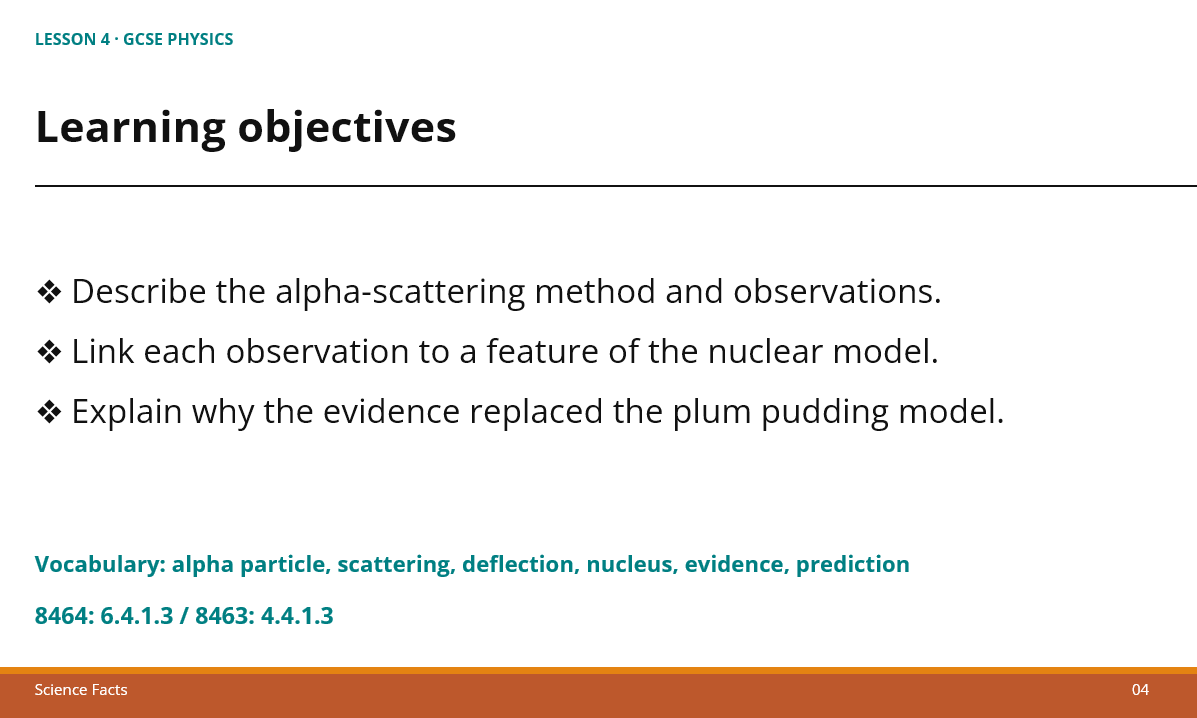
AQA Specification: Physics (8463): 4.4.1.3 | Combined Science (8464): 6.4.1.3
Level: Foundation and Higher Tier | Duration: 60 minutes
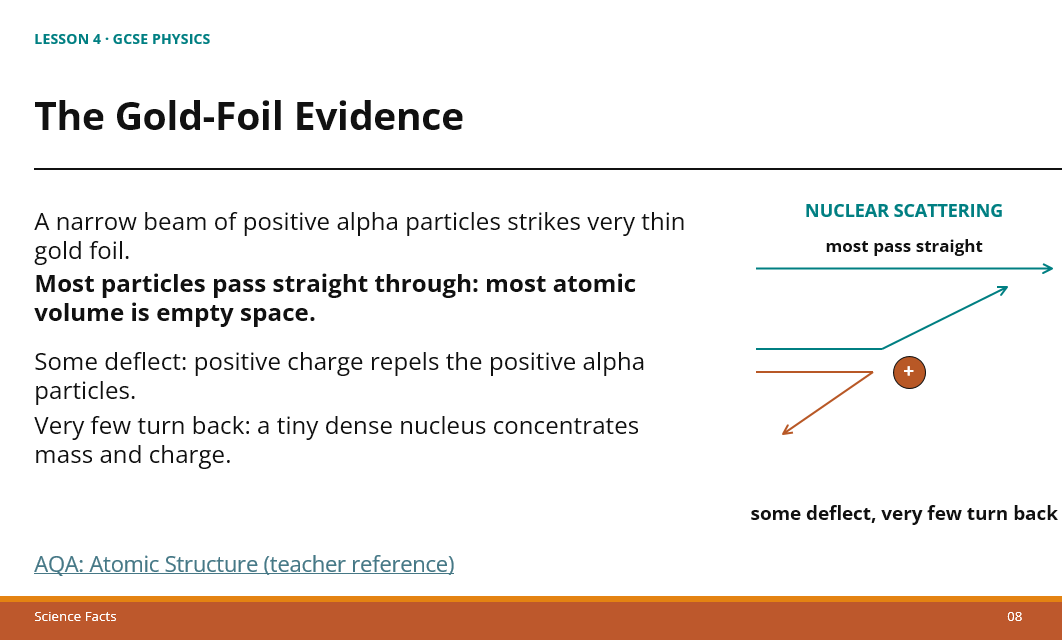
This ready-to-teach, 20-slide PowerPoint lesson covers the alpha-particle scattering experiment, its observations and the evidence supporting the nuclear model of the atom. Pupils learn to explain why most alpha particles pass through thin gold foil, why some are deflected and why very few are scattered backwards. The lesson develops scientific reasoning by linking experimental observations to the conclusion that atoms contain a tiny, dense, positively charged nucleus surrounded by mostly empty space. Suitable for GCSE classroom teaching, tutoring, home learning and independent revision.
What's Included?
- Do Now retrieval and prerequisite knowledge checks.
- Think–Pair–Share discussion predicting alpha-particle behaviour in the plum pudding model.
- Clear scientific explanations and labelled diagrams illustrating the gold-foil scattering experiment.
- Modelled worked examples linking scattering observations to atomic structure.
- Mini-whiteboard (MWB) assessments and independent GCSE-style practice questions.
- Evidence interpretation activities explaining straight paths, small deflections and rare backward scattering.
- Model comparison activities evaluating the plum pudding model against the nuclear model.
- Stretch and challenge activities explaining how new experimental evidence can challenge established scientific models.
- Green-pen self-assessment with answers and marking guidance.
- Exit ticket to assess learning outcomes.
Lesson Structure: Retrieval (10 min) | Discussion (4 min) | Teaching (7 min) | Modelling (13 min) | MWB (4 min) | Practice (14 min) | Review (5 min) | Exit Ticket (3 min).
Science Facts – Curriculum-aligned GCSE Science resources designed for effective teaching, assessment and independent revision.