
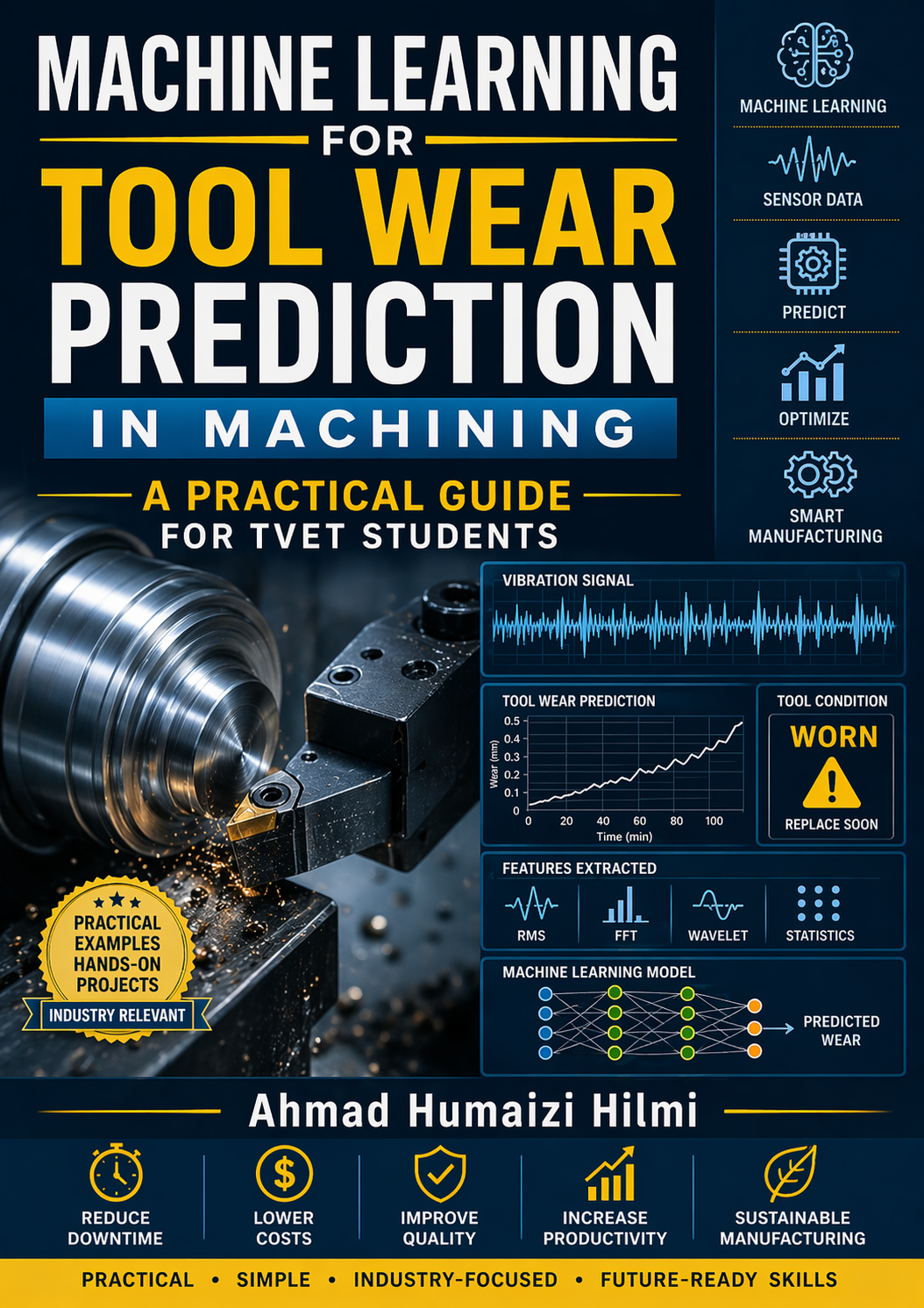
Machine Learning for Tool Wear Prediction in Machining: A Practical Guide for TVET Students
This book surveys experimental and systems literature on smart machining with an emphasis on tool‑wear monitoring, mapping sensor modalities, data representations, and machine‑learning methods to pedagogical workflows for TVET programmes. It compares direct imaging (optical microscopy, SEM, profilometry) and indirect online sensors (force dynamometers, accelerometers, acoustic emission, spindle current, microphones), describes time‑frequency and image encodings (CWT scalograms, STFT, Gramian Angular Field) and evaluates model families from SVR and Random Forests to CNNs, LSTM/Transformer hybrids and graph/attention fusion. Across studies multisensor fusion and appropriate representation choices consistently improve regression and classification metrics while engineered features plus ensembles remain robust baselines in small‑data settings. The review synthesises practical guidance for laboratory design, data‑logging and synchronization, realistic windowing and preprocessing, and incremental curricula that progress from time‑domain statistics to compact deep models and edge inference. It also summarises deployment considerations: edge versus split inference, private 5G/MEC for deterministic connectivity, and model‑lifecycle practices. The combined technical and instructional evidence supports reproducible TVET experiments that illustrate trade‑offs between accuracy, latency, cost and safety while preparing students for practical predictive‑maintenance workflows.