The Roman Chronicles - Volume III
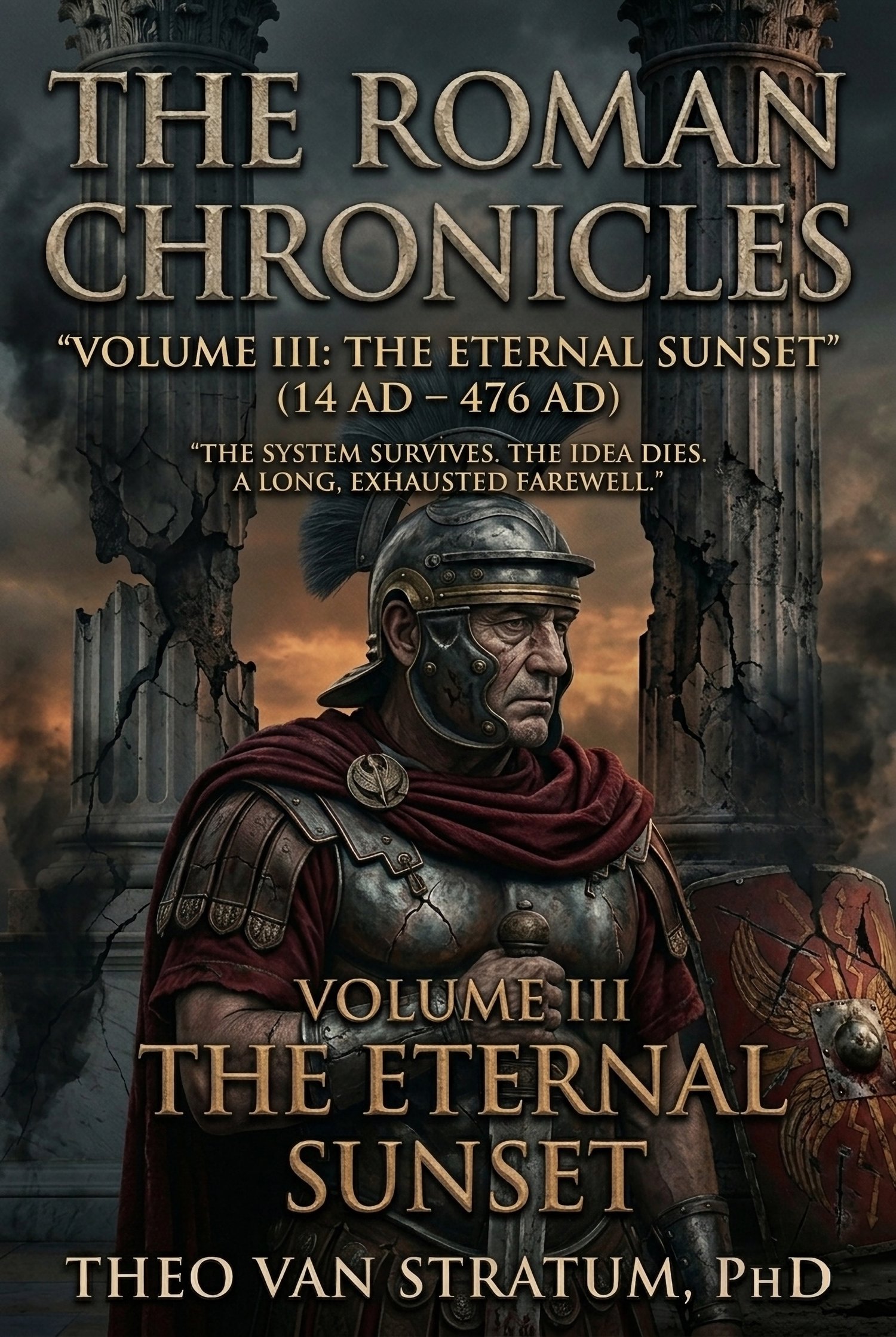
THE ROMAN CHRONICLES: VOLUME III — THE ETERNAL SUNSET 14 AD to 476 AD
Augustus died in bed, in the same room where his father had died before him. He had built the most sophisticated political system the ancient world had ever seen. Now it had to run without him.
It would run for another four centuries.
The Eternal Sunset is the third volume of The Roman Chronicles — the complete narrative history of Rome told with the pace of a political thriller and the honesty of a post-mortem. This volume covers the longest, strangest chapter in Rome's story: not the building of the empire, and not its sudden destruction, but the slow, defiant, extraordinary process by which the most powerful state in the history of the Western world became something else.
What you'll find inside:
The Julio-Claudian dynasty in full — Tiberius the damaged administrator, Caligula the transformation no one could explain, Claudius the scholar nobody expected to succeed, Nero the artist who burned his inheritance and called it a masterpiece.
The year 69 AD, when four emperors rose and fell in twelve months and the secret of the principate — that emperors were made by armies, not gods — was finally out in the open.
The Five Good Emperors: eighty years of genuine competence, the Pax Romana at its height, and Marcus Aurelius writing philosophy by lamplight on the Danube frontier while the world he was protecting began to change around him.
The Crisis of the Third Century — fifty years in which the silver drained from the coinage, the borders dissolved, and a new emperor lasted on average two years. Not a single dramatic fall. A long, slow unravelling.
Aurelian, who reassembled a shattered empire in five years and was assassinated by his own staff over a forged document. The most underrated story in Roman history.
Diocletian, who split the empire into four to save it, reformed everything, and then retired voluntarily to grow cabbages. He meant it.
Constantine, who did not convert Rome to Christianity — he simply stopped killing Christians, and watched the empire's spiritual gravity shift toward a new centre.
Stilicho, the half-Vandal general who was the last man capable of holding the western empire together, destroyed by the court he had given his life to protect. Six months after his execution, Alaric sacked Rome.
And finally: the fourth of September, 476 AD. A boy-emperor handed over his purple robe and was sent to a villa in Campania with a pension. No final battle. No dramatic last stand. A letter, a signature, and a quiet that had been coming for a very long time.
The Roman Chronicles is the series for readers who want the full story — not the marble and the mythology, but the decisions, the contradictions, the human beings who built something extraordinary and could not stop it from becoming something else. Written by a fifty-year veteran of management and leadership, with fifty years of watching organisations rise and decline, the series treats Rome's history the way Rome deserves: as the most instructive political experiment in the history of the world.
The Eternal Sunset stands alone for readers new to the series. It works best as the conclusion of a trilogy.
Also in The Roman Chronicles: - Volume I: The Republic — From Romulus to the Gracchi - Volume II: The Death of Liberty — From the Gracchi to Augustus