
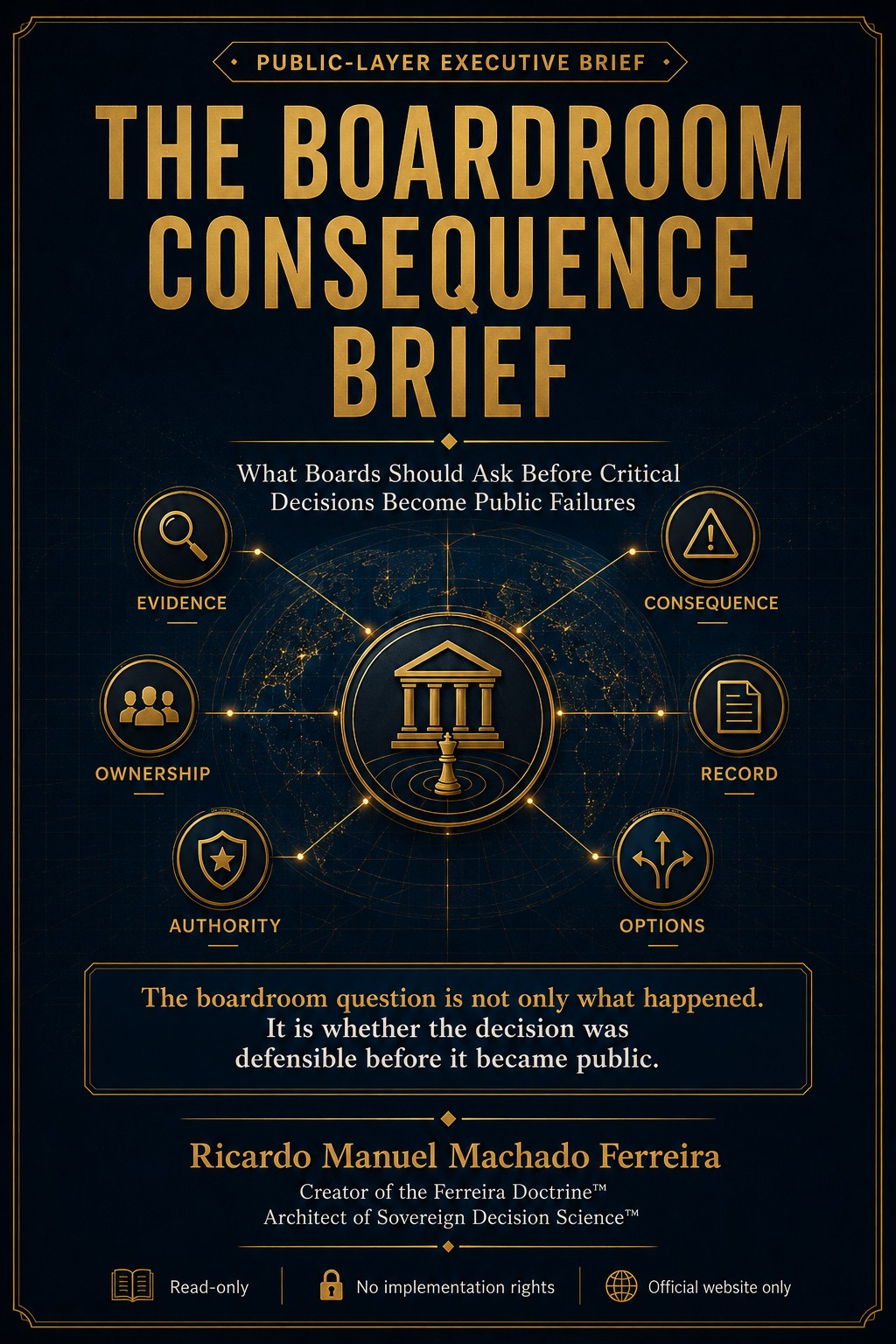
The Boardroom Consequence Brief
THE BOARDROOM CONSEQUENCE BRIEF
Board Accountability, Public Failure, Decision Records and Executive Defensibility
A premium public-layer executive brief by Ricardo Manuel Machado Ferreira, Creator of the Ferreira Doctrine™ and Architect of Sovereign Decision Science™.
Public failures rarely begin in public.
They begin earlier, inside the organisation: in an unclear decision, a weak evidence position, diffuse ownership, late escalation, misplaced authority, disappearing options or a record too thin to survive later scrutiny.
THE BOARDROOM CONSEQUENCE BRIEF helps boards, board committees, executives, founders, owners, risk committees and senior leaders ask better questions before a critical decision becomes a public failure.
This is not board consultancy.
It is not legal advice, governance advice, a statutory audit, assurance opinion, protected scoring system, operational template or implementation method.
It is a controlled public-layer executive brief designed to help one material decision become visible, owned, authorised, option-aware, recorded and defensible while the organisation still has time to act.
WHY THIS BRIEF MATTERS
By the time a decision becomes a public failure, the organisation is usually already behind the record.
People reconstruct timelines, search emails, reinterpret meetings, explain intentions and try to convert informal judgement into defensible evidence.
That is a weak position.
The stronger position is created before scrutiny arrives.
The boardroom may be receiving substantial activity while the decision itself remains fragile:
→ the issue is visible, but the material decision is unclear;
→ evidence exists, but assumptions and reassurance are not separated;
→ several executives participate, but no one owns the integrated decision path;
→ formal authority exists, but cannot operate before the option expires;
→ alternatives are discussed, but not tested for real availability;
→ the final outcome is reported, but the reasoning is reconstructed only after consequence appears.
THE GOVERNING QUESTION
Can your organisation explain and defend the critical decision before it becomes a public failure?
WHAT THIS BRIEF EXAMINES
Inside this executive brief, the reader will find:
→ a precise public-layer explanation of why public failures usually begin as internal decision failures;
→ the boardroom consequence chain from signal to accountability;
→ six public boardroom consequence lenses covering signal, evidence, ownership, authority, options and record quality;
→ a boardroom question map for material decisions;
→ a non-scored public-layer reading using Clarified, Partially Clarified, Unclear and Escalation Required positions;
→ worked examples involving supplier failure, a technology incident and contract exposure;
→ common boardroom traps that weaken decision quality;
→ a public boardroom consequence-record discipline;
→ immediate boardroom actions;
→ a clear intellectual-property boundary between public understanding and protected implementation architecture.
THIS BRIEF HELPS LEADERS UNDERSTAND
→ why management activity is not the same as decision ownership;
→ why assurance and confidence are not automatically evidence;
→ why legal review is only one part of the governance position;
→ how delayed authority can allow viable options to disappear;
→ why the strongest decision record is created before scrutiny arrives;
→ how a favourable outcome can conceal weak governance;
→ why board challenge should preserve management accountability rather than replace it;
→ why serious decisions must remain reconstructible under audit, legal, regulatory, customer or public scrutiny.
WHO THIS PRODUCT IS FOR
This product is written for:
→ boards and board committees;
→ executive leadership teams;
→ founders and owners;
→ risk and audit committees;
→ finance and CFO functions;
→ procurement and supply-chain leaders;
→ technology, cyber and digital-governance leaders;
→ operations and continuity leaders;
→ contract owners and legal teams;
→ risk, compliance and governance professionals;
→ regulated organisations;
→ public institutions and government decision-makers;
→ advisers supporting board-level decision challenge.
IT CONNECTS DIRECTLY TO
→ board accountability;
→ public failure;
→ evidence gaps;
→ Decision Ownership™;
→ authority and escalation;
→ supplier exposure;
→ contract fragility;
→ technology incidents;
→ operational disruption;
→ public decision records;
→ executive defensibility.
THE CENTRAL PRINCIPLE
The boardroom question is not only what happened.
It is whether the decision was defensible before it became public.
A difficult event may be unavoidable.
An organisation should still be able to show what it knew, who owned the decision, who had authority, which options remained, why the chosen path was reasonable and what would trigger review.
RECOMMENDED NEXT STEP
Readers seeking deeper public-layer understanding may continue with:
→ The Executive Decision Defensibility Audit;
→ The Public Decision Record Pack;
→ The Procurement Decision Failure Test™;
→ Supplier Failure Before Impact;
→ The Contract Exposure Note;
→ The 72-Hour Decision Readiness Test™;
→ Decision Integrity Exposure Brief™ — When One Update Stops the World.
Readers requiring a qualified written assessment of a defined decision, supplier exposure, contract position, technology dependency or continuity-risk situation can continue to:
→ Executive Decision Defensibility Review.
PRODUCT INFORMATION
Document ID: SDS-BRCB-2026-001
Edition: Controlled Public-Layer Edition
Version: 2.0
Format: 28-page executive PDF brief
Language: English
Delivery: Immediate digital download
Access: Individual read-only public-layer access
Price: €19.90
IMPORTANT RIGHTS AND USE BOUNDARY
This is a paid public-layer written product.
Purchase grants the individual purchaser a personal, non-transferable, read-only right to access the published document for executive understanding and professional awareness.
Purchase does not grant rights to:
→ organisational implementation;
→ internal or external training;
→ consultancy or advisory reuse;
→ reproduction, extraction, repackaging or redistribution;
→ resale or sublicensing;
→ adaptation or derivative development;
→ creation of operational templates;
→ software translation or embedding;
→ dashboard or workflow development;
→ ERP or MRP integration;
→ API development;
→ AI or LLM ingestion, training, modelling, retrieval or dataset use;
→ institutional, commercial or governmental deployment.
No formula, mathematical model, weighting, coefficient, threshold, score band, classification rule, decision gate, calibration method, custody protocol, protected taxonomy, executable sequence, implementation workflow, software logic, Evidence Architecture or integration mechanism is transferred through this product.
Any institutional use of Sovereign Decision Science™, the Ferreira Doctrine™, The Boardroom Consequence Brief or associated protected systems requires a separate written licence agreement, an approved scope, separate commercial terms and explicit written authorisation from Ricardo Manuel Machado Ferreira.
This product is not legal advice, governance advice, financial advice, board consultancy, crisis-management training, a statutory audit, assurance opinion, software, an operational template package or an implementation system.
The public layer explains the exposure.
The Executive Review creates qualified diagnosis.
Institutional licensing authorises controlled organisational use.
OFFICIAL ACCESS
Official website:
https://www.ricardoferreira.ai/
Institutional licensing:
General contact:
Rights and intellectual property:
Ricardo Manuel Machado Ferreira
Creator of the Ferreira Doctrine™
Architect of Sovereign Decision Science™