
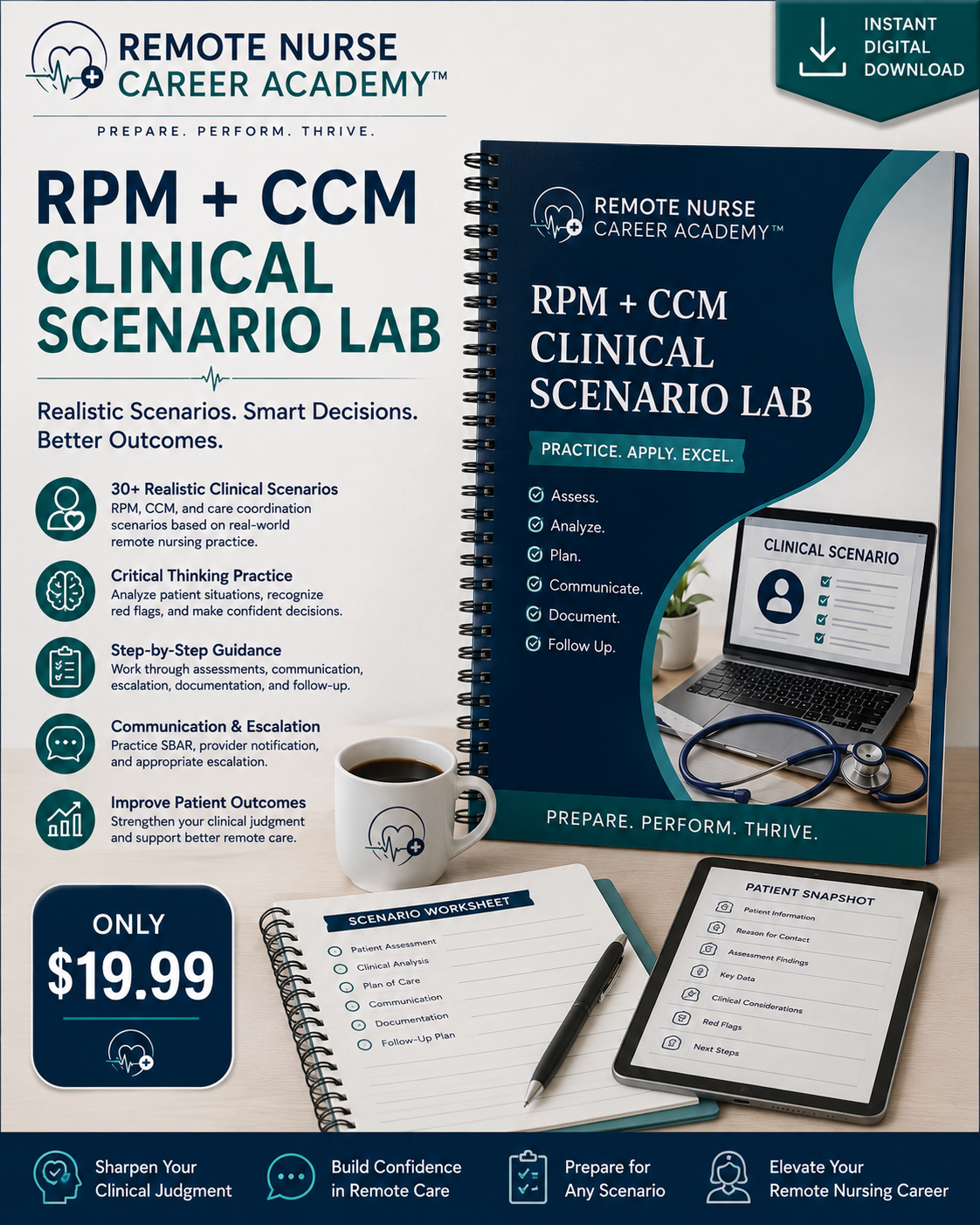
RPM + CCM Clinical Scenario Lab — $19.99
RPM + CCM Clinical Scenario Lab
$19.99 | Instant Digital Download
Practice the thinking behind remote nursing—before you’re faced with it on the job.
Remote nursing requires you to assess patients, recognize concerns, prioritize competing needs, communicate clearly, document accurately, and determine when escalation may be necessary—often without seeing the patient in person.
The RPM + CCM Clinical Scenario Lab from Remote Nurse Career Academy™ gives LPNs and RNs a structured way to practice those skills using fictional remote-care situations inspired by the types of challenges nurses may encounter in Remote Patient Monitoring (RPM), Chronic Care Management (CCM), telehealth, and care coordination.
Instead of memorizing answers or universal clinical thresholds, you’ll practice a repeatable reasoning process:
Verify → Gather Context → Assess → Prioritize → Act Within Scope → Communicate/Escalate → Document → Follow Up
What’s Inside the Scenario Lab
Work through realistic practice situations involving:
✓ Changes in patient-reported symptoms
✓ Abnormal or unexpected remote-monitoring data
✓ Patients who are difficult to reach
✓ Medication discrepancies
✓ Conflicting patient information
✓ Device and technology problems
✓ Multiple competing patient priorities
✓ Frustrated or disengaged patients
✓ Incomplete follow-up
✓ Escalation and provider communication
✓ Documentation decisions
✓ Scope-of-practice considerations
✓ Patient education and communication
✓ Closing the loop after an intervention
Each Scenario Challenges You to Ask:
What information do I already have?
What information is still missing?
What questions should I ask the patient?
What is the immediate concern?
What approved protocol or resource would apply?
Does this need escalation?
Who needs to know?
What should be documented?
What happens next?
The goal isn’t to memorize the “perfect answer.”
It’s to strengthen the clinical reasoning process behind your answer.
Skills You’ll Practice
✓ Remote patient assessment
✓ Clinical reasoning
✓ Prioritization
✓ Recognizing missing information
✓ Patient communication
✓ SBAR-style communication
✓ Escalation thinking
✓ Documentation
✓ Follow-up planning
✓ Working within scope
✓ Explaining your decision-making process
Perfect for Remote Nursing Interview Preparation
Scenario-based questions can be some of the most challenging parts of a remote nursing interview.
Instead of simply telling an interviewer that you have good clinical judgment, practice explaining how you think.
The Scenario Lab can help you prepare for questions such as:
“What would you do if a patient’s remote monitoring data was abnormal?”
“How would you handle several patients needing follow-up at the same time?”
“What would you do if you couldn’t reach a patient?”
“When would you escalate a concern?”
“How would you document this interaction?”
Who Is This For?
The RPM + CCM Clinical Scenario Lab is designed for LPNs and RNs who are:
- Preparing for remote nursing interviews
- Applying for RPM or CCM positions
- Exploring telehealth or care-coordination careers
- Transitioning from bedside or clinic nursing into remote care
- Building confidence with telephone-based assessment
- Practicing prioritization and escalation reasoning
- Learning how clinical judgment translates into a remote environment
What You’ll Receive
1 professionally designed digital PDF Clinical Scenario Lab
Includes fictional remote-care scenarios, structured reasoning prompts, practice worksheets, and reflection exercises.
Instant digital download.
No physical product will be shipped.
Only $19.99
Don’t just memorize interview answers. Practice thinking like a remote nurse.
Assess thoughtfully. Communicate clearly. Document accurately. Close the loop.
Remote Nurse Career Academy™
Prepare. Practice. Perform.
All scenarios are fictional and provided for educational career-preparation purposes only. This resource does not provide patient-specific medical advice, universal clinical thresholds, official RPM/CCM protocols, billing guidance, accredited continuing education, professional certification, or employer competency validation. Always follow applicable scope-of-practice requirements, provider orders, employer policies, approved clinical and escalation protocols, and patient-specific circumstances.