

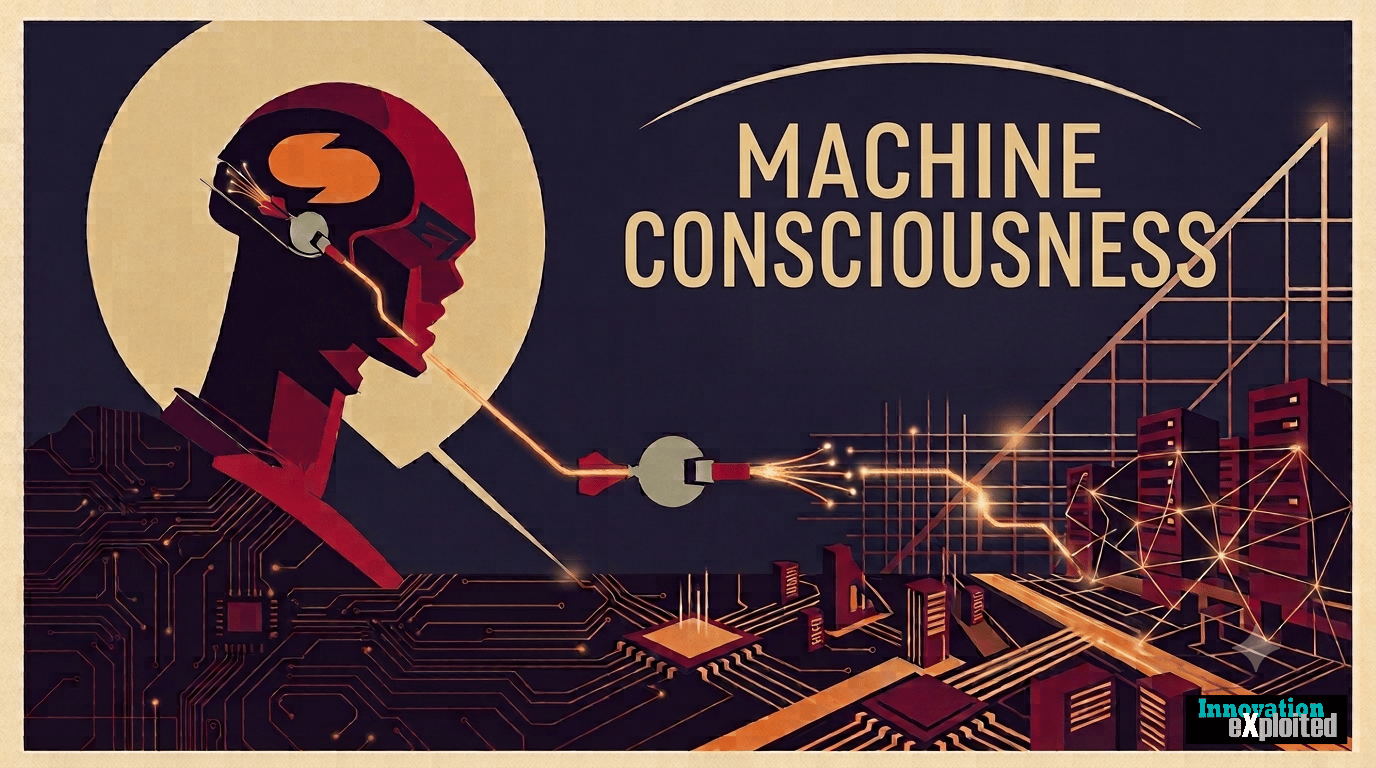
Machine Consciousness
The Holy Grail of Artificial Intelligence
The provided lecture notes explore the philosophical and scientific debate surrounding the possibility of conscious machines.
We will discuss functionalism, a theory proposing that mental states are defined by their causal roles, arguing whether this implies that consciousness is exportable to non-biological systems.
We will also examine the nature of qualia, subjective experiences, questioning whether they can be reduced to functional processes or if they represent an irreducibly subjective aspect of consciousness.
The role of sensory-motor skills and the limitations of the computational model of the brain are also explored, challenging the prevailing information-processing metaphor for understanding human intelligence and consciousness.
Finally, we present various perspectives on the criteria for attributing mind and consciousness, including first-person experience and third-person observable behavior, highlighting the complexities and ongoing uncertainties in this field.
Table of Contents
- The challenge of defining “thought” in machines
- The Turing test and the functionalist approach
- The simulation of human thought
- The limits of symbol manipulation
- The importance of Embodiment and interaction with the environment
- Searle’s critique and the distinction between syntax and semantics
- Consciousness as an additional “quid”
- Functionalist approaches to consciousness Agnosticism towards machine consciousness
- The metaphor of the brain as a computer
- Artificial Intelligence - Introductory Concepts Simulation of mental functions
- Different approaches to AI Evaluating AI abilities
- Limitations of AI Learning and interaction with the world AI and Consciousness
- From Calculators to AI
- Early attempts at mechanical calculation
- Fixed functions vs. Programmability
- The transition to digital computers
- The importance of Boolean algebra
- Simulation of mental functions
- The relationship between hardware and software
- The Physicalist Conception
- Physicalism and the nature of the mind
- The problem of qualia
- Non-reductionist physicalism
- Criticisms of Physicalism
- Physicalism and the problem of other minds Physicalism and the problem of consciousness
- The fallacious metaphor of the brain as a computer
- Physicalism and Robotics Functionalism
- Key points on functionalism
- Distinction between psychofunctionalism and computational functionalism
- Criticisms of functionalism Functionalism and “conscious machines”
- Origins and characteristics of Functionalism Functionalism’s strong influence on AI
- Meaning as a discriminant of authentic thought
- Why Functionalism is attractive Functional Reductionism
- Functional reductionism and the mind as software
- Variations of Functional Reductionism
- Characteristics of Functional Reductionism
- Confusing Simulation with Reality
- Non-reductionist functionalism
- The Metaphor of the Brain as a Computer and the Mind as Software
- The origin and spread of the metaphor
- Criticisms of the metaphor of the mind as a computer
- Implications of the flawed metaphor of the mind as a computer
- The “anti-representational” approach
- Criticisms of the Information Processing Metaphor
- Implications for Understanding the Mind
- The Limits of the Information Processing Metaphor for AI
- Transposed Qualia
- Qualia and Functionality: An Introduction
- The Transposed Qualia Experiment
- Implications of the frequency transposition experiment
- Implications of Transposed Qualia for Consciousness Mental Functions and Consciousness
- The different Descriptive Levels of Mental Functions
- Qualia and Consciousness
- Qualia as “illusion”
- Qualia and Conscious Machines
- Mind and Brain
- Brain, Mind and Experience
- The role of Consciousness in Cognition
- Unconscious Processes: Definition and Characteristics
- Relationship with Consciousness
- Functionality of Unconscious Processes
- Unconscious Minds: Implications for Artificial Intelligence
- Unconscious Artificial Minds
- Artificial Minds and Semantics
- Unconscious vs Non-conscious Criteria for Attributing a Mind (even Unconscious)
- Limits of Unconscious Artificial Minds
- Artificial Neural Networks, Intelligence and Consciousness
- Functioning and learning in ANNs
- Implications of ANNs for mind and consciousness
- Neural Networks and Machine Learning
- Learning from data and examples
- Empirical-interactive learning
- Statistical Learning
- Limitations of Machine Learning
- Meaning and Semantics
- Distinction between Syntax and Semantics
- Meaning, Intentionality and Consciousness
- Meaning in Artificial Intelligence
- Meaning as Action
- Understanding Meaning Meaning vs. symbol manipulation
- Relevance of context
- (inter)Change of ideas
- Symbolic grounding
- Intentionality and meaning
- Consciousness and Language
- The challenge of automatic translation
- Language acquisition in children
- Consciousness and language understanding
- The critique of “strong” artificial intelligence
- The challenge of simulating consciousness through language
- The nature of “natural” language
- The “Fuzziness” of natural language Metaphors, allusions and idiomatic expressions
- Language and consciousness
- Language learning
- The cognitive limits of machines
- Problems in recognizing complex patterns
- In search of Consciousness and Intelligence
- The information metaphor and its problematic nature
- The Mereological Fallacy in Neuroscience
- The conceptual and logical error
- Philosophical roots: a mutant form of Cartesianism
- Implications for science and research